Witches
A Werewolf Thing: A Rejected Mate Werewolf RomanceWitches are a supernatural people defined in the available narrative primarily by inherited magical power, leadership succession, and hybrid ancestry. Their importance lies less in a single appearance than in the way their existence changes the meaning of Saphira Richards and Trevor Richards: both are half Werewolf and half Witch, while their mother once led the Witches. This lineage makes witchcraft part of an intimate family history, a political inheritance, and a source of danger capable of influencing the wider conflict among supernatural peoples.
Identity and Lineage
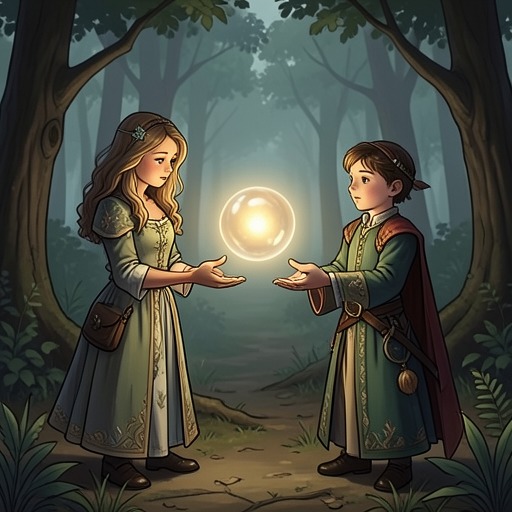
Witches enter the story through Saphira Richards’s first open discussion of her powers with her twin brother, Trevor Richards. The moment follows their playful confrontation and carries unusual emotional weight because Saphira realizes that, since their mother’s death, she has finally spoken about what they can do. Trevor’s pleased reaction suggests that he had been waiting for her to acknowledge this shared inheritance rather than treating it as an isolated personal secret.
The siblings’ mother had been the leader of the Witches. After her death, her sister—an aunt the family does not speak to—assumed that position. The succession therefore carries both political and familial rupture: witch authority passes within the family, but the transfer leaves estrangement behind. Saphira Richards and Trevor Richards are explicitly described as half Werewolf and half Witch, placing them between supernatural categories rather than wholly inside one. Their hybrid identity makes the Witches relevant to the novel’s recurring concern with whether blood, species, and social office can be kept separate.
Powers and Magical Agency
The evidence associates Witches with active transformation and magical manipulation. During their joking exchange, Trevor Richards threatens to turn Saphira Richards into a lizard, while Saphira answers with the threat of turning his legs to jelly. The exchange is playful, but it establishes that their powers are concrete capabilities rather than abstract family lore. Their humor also turns inherited power into a private language between twins, allowing the siblings to acknowledge grief and inheritance without abandoning their familiar teasing relationship.
Witchcraft can also operate through material substances. Saphira Richards recognizes that Trevor Richards may have been affected by a mind-control charm after he behaves cruelly toward her and later cannot explain why he acted that way. She knows that such a charm can be placed in a solid or liquid, which implies a practical magical method requiring an object or consumable medium. Trevor recalls eating steak that smelled of herbs before his behavior changed, and he believes someone may have wanted to separate the twins. The scene gives Witch magic a distinctly covert form: power can be concealed inside ordinary food, and its effects can be mistaken for personal betrayal until the hidden intervention is considered.
The possibility of a charm also changes the emotional interpretation of Trevor Richards’s conduct. His actions initially appear to be a deliberate attack on Saphira Richards, but the discussion of mind control introduces the possibility that his will was manipulated. Witchcraft thus complicates responsibility without erasing harm. It can preserve the bond between the twins by revealing an external cause, while simultaneously exposing how vulnerable intimate relationships are when magic can enter through an unnoticed substance.
Boundaries and Relations with Other Peoples
Witches belong to a world structured by sharp distinctions among supernatural peoples. The evidence separately identifies Werewolves, Vampires, Faeries, and Banshees, but Saphira Richards and Trevor Richards make those categories porous. Their half-Werewolf, half-Witch status demonstrates that lineage can cross species boundaries even when communities treat those boundaries as politically decisive. Their existence is therefore a challenge to any simple division between a person’s bodily nature and communal affiliation.
The novel repeatedly links supernatural identity to territory and exclusion. A member of a strange wolf pack tells Saphira Richards that she is on their territory and intends to take her in; later, it is noted that a Banshee can cross boundaries more easily than a Faery, because a Faery entering Banshee territory would be vulnerable to the Banshee’s shrieks. These scenes do not describe a Witch boundary directly, but they establish the larger system into which Witch identity fits: supernatural peoples are governed by territorial rules, species-specific vulnerabilities, and assumptions about who may safely enter another group’s space.
Witches also stand in contrast to Banshees and Vampires as different forms of supernatural power. Banshee screams can kill, and Vampire identity is revealed through bodily recognition and mate bonds. Witch power, by contrast, is presented through inherited transformation and charms that can be embedded in material objects. The distinctions are not merely decorative. Each people possesses a characteristic mode of influence—voice, blood and species identity, territory, or magical alteration—and the novel’s hybrid characters expose the instability of those classifications.
Political Inheritance and Narrative Significance
The Witches’ most consequential political fact is that Saphira Richards and Trevor Richards’s mother once led them. Her death leaves the leadership in the hands of her sister, while the siblings remain connected to a succession they do not control. The family’s silence about the aunt suggests that political inheritance is inseparable from unresolved grief and estrangement. Witch leadership is not presented as a distant institutional matter; it is embedded in the loss that the twins feel and in the powers they carry forward.
The broader prophecy intensifies this significance. A war is foretold between Vampires and Werewolves on the night when the sun is black and stars cross the sky, and two hybrids of the same origin are said to lead the winning side. The evidence does not explicitly identify those hybrids as Witches, but Saphira Richards and Trevor Richards’s shared half-Witch, half-Werewolf origin makes their lineage part of the novel’s larger hybrid framework. Their ancestry offers a possible bridge between categories that the prophecy turns into instruments of war.
Witch identity is consequently both intimate and strategic. It explains why Saphira Richards and Trevor Richards possess powers unlike those of ordinary Werewolves, gives their family a history of leadership, and places their sibling bond within a contested supernatural order. Even when the Witches remain offstage, their influence persists through inherited abilities, the memory of their former leader, the threat of magical coercion, and the possibility that hybrid bloodlines may determine the future of the supernatural world.