Ravenous Pack Attack
A Werewolf Thing: A Rejected Mate Werewolf RomanceRavenous Pack Attack is the decisive military confrontation in which the Ravenous pack invades the territory of Ashton’s pack. Announced as an unexpected emergency at the pack house, the assault transforms long-standing hostility into open violence. It also becomes a crisis of loyalty and protection: Ashton must mobilize the pack, Saphira refuses to remain safely removed from the fighting, and the discovery of Simon’s apparently lifeless body shows that the conflict has consequences far beyond a contest between rival groups.
Causes and Background
The attack is not presented as an isolated provocation. The Ravenous pack has never liked Ashton’s pack, and the narrative identifies that hostility as the immediate background to its decision to strike. The timing gives the event an especially abrupt quality: the community is gathered at the pack house when alarms and disturbance announce that the enemy is already close. The conflict therefore begins with a breach of expected territorial security rather than with a formal challenge or extended negotiation.
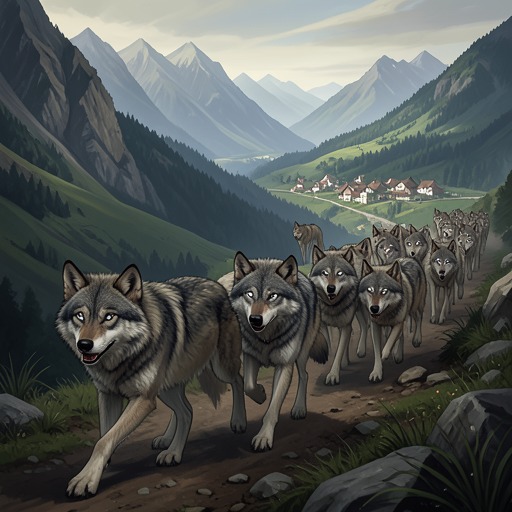
The two groups are also distinguished through their bodies. When Saphira reaches the battlefield, the attacking wolves appear dirty and sick, while the wolves belonging to Ashton’s pack look clean and healthy. Their eyes provide the sharpest visible difference: members of Ashton’s pack retain the eye color associated with their human forms, whereas the Ravenous wolves have sickly pale-white eyes regardless of their human coloring. These details make the rivalry seem like a conflict between recognizable communities, but they also risk turning social hostility into a bodily opposition between supposedly healthy and diseased kinds.
Mobilization and Course of the Battle
The crisis is announced when Ashton enters the pack house with Aiden and Trevor. His hair is disheveled and sweat marks his hairline, physical signs that he has come directly from urgent action rather than from a position of calm authority. He declares that the Ravenous pack has attacked. He then orders the pack warriors to prepare themselves, explaining that the enemy is close and must be intercepted in the forest before reaching their territory. Pack members rush outside, phase into their wolf forms, and charge toward the forest.
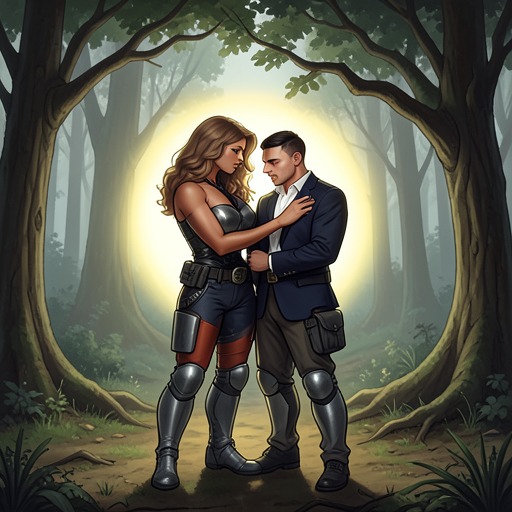
Saphira does not stay behind. She runs toward the area of the attack, searching for Ashton because she wants to speak sense to him and prevent him from doing anything reckless. Her motive is not merely strategic. She is trying to protect the person who has become central to her life while also confronting the danger directly. When she finds Ashton’s large wolf, she pushes herself to catch up rather than waiting for the battle to resolve around her.
The encounter becomes fully visible only when Saphira stops at the edge of the fighting. She can distinguish the wolves of Ashton’s pack from the Ravenous attackers by their contrasting appearance, and then watches Ashton charge forward and join the combat. She positions herself to lunge as well, but a wolf beside her suddenly growls, leaps onto her, and bites down on her neck before she can turn. The attack thus places Saphira in the role of both witness and target: her attempt to enter the defense of the territory immediately exposes her to the enemy’s violence.
Family, Protection, and Loss
The battle is also shaped by the pack mind link and by the protective logic of intimate bonds. Ashton’s concern that Saphira might be hurt through their bond leads him to turn away from the battle and run back toward the house. His retreat is not simple cowardice or abandonment; it is a protective response in which Saphira’s physical safety becomes inseparable from his own ability to continue fighting. The bond makes distance impossible, but it also complicates military duty by forcing him to respond to the danger threatening one particular person.
Saphira nevertheless continues toward the fighting, determined to make sure that Ashton does not act foolishly. On the route she passes several limp werewolves and stops when she reaches one of her own pack. The body is the source of the howl that drew attention to the area, but her search for signs of life finds none. The fallen brown wolf is identified as Simon. His apparent death gives the attack its most devastating consequence and turns the scene from a territorial clash into a personal catastrophe for the pack and for Simon’s relationships.
The event’s wider context makes Simon’s fate especially charged. The surrounding story has already established violent boundaries between werewolves, vampires, Faeries, and Banshees. Saphira reacts protectively when she realizes that the girl accompanying Simon is a vampire, while Simon protects the vampire in return because she is his mate. That cross-species bond stands in direct contrast to the Ravenous attack’s division of communities into hostile categories. Against this background, Simon’s fall suggests how fragile such connections remain when collective identity is organized through species and territory.
Consequences and Aftermath
Ravenous Pack Attack leaves the pack with casualties and forces its leaders to treat the forest as an active war zone. The order to intercept the Ravenous wolves before they reach the territory reveals that the immediate objective is containment, but the battle demonstrates that containment cannot prevent intimate loss. Saphira’s injury and Simon’s apparent death show that the danger reaches both the fighters and the family networks surrounding them.
The attack also foreshadows a larger supernatural conflict. A later prophecy states that a war will occur on the night when the sun is black and stars cross the sky, and that the struggle will be between vampires and werewolves over which race will become dominant. It further predicts that two hybrids of the same origin will lead the winning side. The Ravenous assault is not identical to that prophesied war, but it prepares the narrative for it by presenting inter-group violence as an escalating political and species-wide crisis rather than a private dispute.
Finally, the event’s aftermath is complicated by knowledge that arrives unevenly. Saphira later confronts poison, injury, and the apparent death or incapacitation of people close to her, while the story continues to place protection beside restriction. When Trevor tells Saphira that she cannot lead an army because she is pregnant, her determination to use a protective charm instead shows that the battle has not erased her agency. Her eventual reunion with Ashton, when she runs into his arms and he carefully holds her around her stomach, reframes survival as a family future rather than merely a military victory. The attack therefore remains important not only for the damage it causes, but for the commitments it tests: territorial loyalty, familial obligation, cross-species attachment, and the difficult boundary between protecting someone and deciding what they are allowed to do.