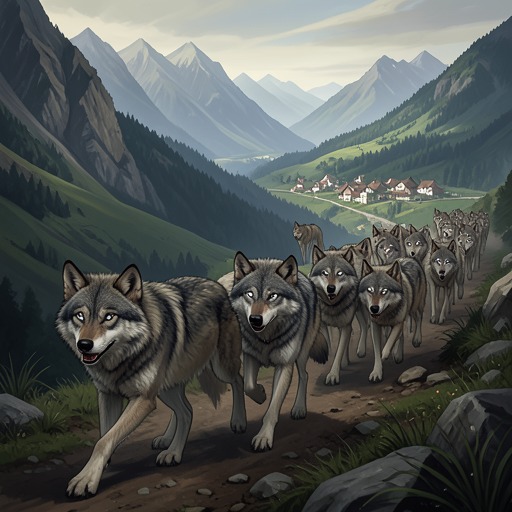
Ravenous Pack Territory
A Werewolf Thing: A Rejected Mate Werewolf RomanceRavenous Pack Territory is the domain claimed by the Ravenous pack and one of the story’s important hostile spaces. Its significance comes less from a detailed physical description than from the social and territorial order it represents: the Ravenous pack is already opposed to Ashton’s pack, and movement across wolf and supernatural boundaries can determine whether a character is protected, captured, or forced into a fight. The territory therefore functions as both a place and a rule-governed zone of danger.
Definition and Territorial Function
Ravenous Pack Territory is presented as the land controlled by the Ravenous pack, a rival werewolf group that has never liked Ashton’s pack. That hostility is not merely personal. It establishes the territory as part of a larger system in which packs define themselves through possession of land, defense of borders, and control over who may enter. The location is consequently understood through jurisdiction: being inside another pack’s territory is enough to make a passerby vulnerable to detention, regardless of whether that person intended to cause trouble.
The same territorial logic appears when Saphira encounters a tattooed werewolf while passing through his area. She explains that she is only passing through and hopes he will let her continue, but he refuses, insisting that she is still on his territory and that he will take her in. His attempted grab transforms the boundary into an immediate physical threat. Saphira’s heightened reflexes allow her to dodge him and run, but the werewolf then uses the pack mind link to summon multiple wolves. Ravenous Pack Territory is thus not a neutral wilderness; it is a monitored space in which one member’s recognition of an intruder can mobilize an entire collective.
Boundaries and the Cost of Crossing Them
The novel repeatedly contrasts the relative mobility of different supernatural peoples across territorial borders. During the pursuit involving Sondra and the Banshees, Saphira recognizes that a Banshee can cross boundaries more easily than a faery. A faery entering Banshee territory would be exposed to shrieks capable of defeating them, while the Banshee can carry Sondra toward its own village with fewer defensive disadvantages. This comparison gives territorial space a biological and political dimension: boundaries do not impose the same cost on every species.
That pattern clarifies the danger associated with Ravenous Pack Territory. A border is not simply a line on a map. It determines which body is authorized to move, which form is safe to assume, and what kind of response an intruder may provoke. Saphira can use her speed to escape the hostile wolf, but the chase becomes more dangerous once the pack is alerted. The territory’s power lies in this combination of physical enclosure and communal enforcement.
Conflict with Ashton’s Pack
The Ravenous pack’s relationship with Ashton’s pack provides the territory’s clearest plot function. Ashton announces that the Ravenous pack has attacked, and the news produces immediate alarm among the pack members. He explains that the Ravenous pack has never liked his pack and has now chosen to launch an assault. The conflict is therefore framed as the eruption of an established rivalry rather than an isolated accident.
Ashton responds by ordering the pack warriors to prepare themselves. Because the attackers are close, he directs the warriors to intercept them in the forest before they can reach Ashton’s pack’s territory. The order reveals how neighboring spaces structure the battle: the forest becomes a defensive threshold, while the pack’s own territory is something to be protected from penetration. Warriors rush outside, phase into their wolf forms, and charge toward the forest. Ravenous Pack Territory is consequently present even when the action occurs beyond its visible edge, because the threat is defined by the possibility that the Ravenous pack will cross into another pack’s land.
Threat, Uncertainty, and Supernatural Politics
The location also participates in the novel’s atmosphere of uncertain identity and hidden danger. After Saphira finds a brown werewolf among the aftermath of violence, the narration identifies him as Simon. Elsewhere, Saphira’s confusion about Trevor’s reported whereabouts leads her toward a storage room, where she wakes in darkness beneath a flickering lightbulb, with water dripping from the ceiling. These scenes do not establish that the storage room lies within Ravenous Pack Territory, but they reinforce the broader spatial pattern in which characters are displaced, watched, pursued, or deprived of reliable knowledge about where they are.
The same instability extends to the wider supernatural order. The prophecy describes a future war between vampires and werewolves, occurring on the night when the sun is black and stars cross the sky, with two hybrids of the same origin destined to lead the winning side. Ravenous Pack Territory belongs to the local, territorial form of this conflict: before the prophecy expands the stakes to species dominance, rival communities already organize violence through land, allegiance, and inherited hostility.
Narrative Significance
Ravenous Pack Territory gives the book’s werewolf society a concrete geography of belonging and exclusion. Its borders create obligations for those who defend them and danger for those who cross them. Saphira’s attempted arrest shows how quickly territorial authority becomes coercion; Ashton’s mobilization shows how quickly an old rivalry becomes collective warfare; and the distinction between species-specific boundary risks shows that supernatural geography is unevenly experienced.
The territory is therefore significant not because the narrative inventories its scenery, but because it makes social categories spatial. Pack identity becomes visible through claims over land, and conflict becomes inevitable when one group treats another’s movement as trespass. In that sense, Ravenous Pack Territory is both a setting and an instrument of the novel’s larger argument about divided communities: the same boundaries that promise safety for insiders make outsiders vulnerable, and the defense of home can become the mechanism by which war reaches everyone.