The Death of Saphira and Trevor’s Father
A Werewolf Thing: A Rejected Mate Werewolf RomanceThe Death of Saphira and Trevor’s Father is presented as both a sudden family catastrophe and a delayed recognition: the death is first announced in a moment of bodily shock, then fully understood only after Saphira awakens and her memories return. Its decisive consequence is that Saphira and Trevor become orphans, while the loss also appears to confirm the supernatural warning surrounding the hybrids, the solar eclipse, and the meteor shower. The event therefore changes the story’s emotional center from domestic security to inheritance, prophecy, and war.
Causes and Immediate Circumstances
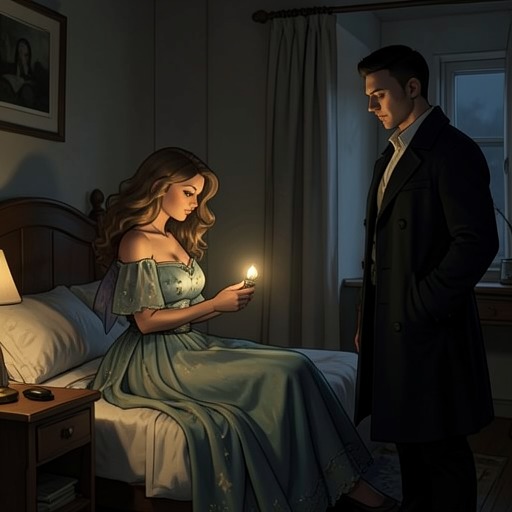
The available sequence places the announcement inside an already dangerous period. Earlier, a doctor explains that the arrow that struck Saphira was coated in poison, establishing that the family is dealing with deliberate violence rather than an ordinary illness or accident. Later, Trevor is found in a severely weakened condition: his body is limp, his skin is sickly pale, sweat mats his hair, and his eyelids twitch as though he is struggling to wake. Carmen has not slept since his arrival and is barely eating, while Saphira must beg her for more than five minutes before being allowed an hour alone with him. These details make care itself part of the crisis. The family is not grieving from a position of stability; it is attempting to preserve the living while another loss approaches.
The father’s death is not shown through an extended account of its cause. Instead, the narrative withholds the decisive fact until Trevor enters the kitchen, making the loss arrive first as a physical reaction. Ashton has just told Saphira that he loves her, and she is beginning to answer when Trevor runs in, panting and crying. Her heart drops at the sight of him, her knees buckle, and pain overtakes her so completely that the oxygen seems to leave her lungs. The interruption turns an intimate declaration into a threshold between ordinary affection and irreversible bereavement.
Announcement and Recognition
Trevor’s statement, “Dad’s dead,” functions as the event’s blunt verbal center. It does not merely describe a completed death; it performs the transfer of knowledge to Saphira and makes Trevor the bearer of the family’s most terrible news. Saphira collapses into Ashton’s outstretched arms, closes her eyes, and loses consciousness as the world disappears. The scene’s value shift is immediate: love and bodily reassurance give way to death, shock, and helplessness.
The narrative then presents recognition in two stages. When Saphira regains consciousness, she initially cannot understand what caused her hospitalization or where Trevor is. The memory returns as a flood rather than as a calm explanation. She remembers Trevor telling her that her father was dead but insists that such a thing is impossible. Her first response is denial: she shakes her head and tries to preserve the belief that her father is fine.
Ashton’s silence supplies the confirmation that words initially cannot. When Saphira asks why he is not saying that the memory is crazy, his sad eyes meet hers, and she understands that the death is real. The recognition is therefore communicated through both speech and withheld speech. Trevor’s earlier declaration announces the fact; Ashton’s inability to contradict it makes the fact emotionally undeniable. Saphira covers her ears as if she could block out reality, but the attempt fails. She finally states the loss plainly: her father is dead, and both of her parents are gone.
Orphanhood and Prophecy
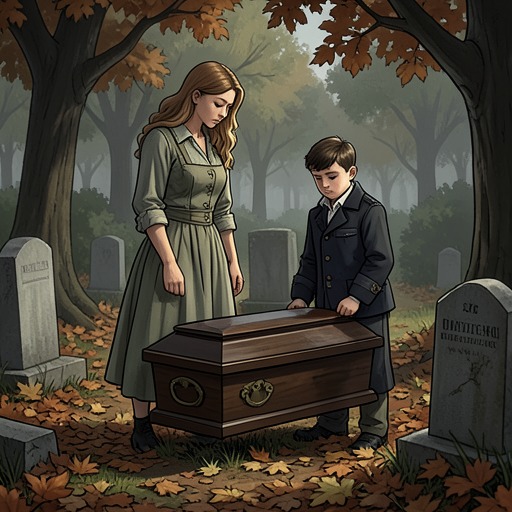
The father’s death changes Saphira and Trevor’s status within the family as well as their emotional condition. Saphira explicitly recognizes that she and Trevor are now orphans. The word gathers the loss of both parents into a new identity, transforming bereavement into a permanent condition. Their relationship becomes not simply that of siblings facing danger but of twins carrying the remains of a family that has lost its older generation.
The aftermath also reconnects the death to Amanda’s warning. While Trevor drives, Saphira asks whether Amanda was right about something terrible happening to the hybrids and leading to war. She recalls that the meteor shower and eclipse were supposed to occur on the day her father died, and Trevor confirms that they did occur while Saphira was unconscious. The coincidence is not treated as a private superstition; it becomes evidence in the larger prophecy structure. Saphira concludes that everything Amanda predicted has happened and asks whether she and Trevor are the hybrids in the prophecy.
Trevor answers with resolve rather than certainty. If they are the figures named in the prophecy, he says they will fight. The father’s death thus becomes a call to action: grief does not remain confined to mourning but is translated into a possible obligation to confront the coming war. At the same time, the scene preserves fear and uncertainty, because the prophecy is still approached through a conditional question rather than an indisputable revelation.
Protection, Pregnancy, and Conflict
The death intensifies a conflict over who may act and who must be protected. Trevor tells Saphira that she must not fight because she is pregnant and cannot lead an army. His objection is grounded in concern for her and the unborn child, but it also places her bodily condition against her political and supernatural role. Saphira rejects the limitation by invoking her half-faery identity: she argues that she can cast a protective charm on herself.
This exchange reveals why the loss is consequential beyond the fact of bereavement. The death leaves Saphira and Trevor facing the possibility that they are central figures in a war, yet Saphira’s pregnancy makes any decision to enter that war ethically and physically dangerous. Trevor treats protection as a reason to restrain her; Saphira treats her inherited powers as a means of remaining active. Their disagreement is not a rejection of family loyalty. It is a struggle over whether care should preserve a vulnerable body by removing it from danger or equip that body to choose its own danger.
Narrative Significance and Aftermath
Structurally, the event is built around belatedness. The reader first encounters the death as an announcement that knocks Saphira unconscious, then returns to it when memory floods back after hospitalization. This repetition does not duplicate the event; it changes its meaning. The first version emphasizes impact and bodily collapse, while the second makes the loss legible as orphanhood and links it to Amanda’s prophecy. The delayed recognition gives the death the shape of trauma: what happened is known before it can be fully accepted.
The event also joins private grief to the book’s wider supernatural conflict. A father’s death becomes the date against which the eclipse and meteor shower are measured; a family’s orphanhood becomes possible evidence that the hybrids have entered the prophecy’s decisive phase. Saphira’s pregnancy and Trevor’s determination to fight then carry the loss forward into questions of succession, protection, and war. The death is therefore not an isolated ending for the older generation. It is the turning point that forces the surviving siblings to inherit both the family’s absence and the conflict that may have caused their world to change.
The later reunion with Ashton does not erase the loss, but it shows Saphira moving through its aftermath rather than remaining frozen at the moment of collapse. When Ashton approaches, she finds her feet moving toward him and throws herself into his arms; he embraces her carefully around her stomach and tells her that he missed her. The gesture places tenderness beside the continuing signs of vulnerability. Saphira can still seek attachment and receive care, but the father’s death has permanently altered what that care must protect: not only Saphira herself, but also her pregnancy, her surviving bond with Trevor, and the future threatened by the prophecy.