Adam Fairley
A Woman of SubstanceAdam Fairley, known as the Squire, is the head of the Fairley family and its extensive Yorkshire enterprises. His public authority rests on inherited wealth and responsibility; his private life is marked by insomnia, loneliness, and regret over the military career he relinquished to serve his family. The concealed history of his love for Elizabeth Harte gives his story a further significance: it reveals that the estrangement between the Hartes and Fairleys began not only in class conflict, but also in an intimate loss whose consequences endured across generations.
Identity and Inherited Duty
Adam’s path was redirected by bereavement. After his elder brother Edward drowned in a boating accident, their father required Adam to return to Yorkshire and take his brother’s place in the family businesses. Adam had just received a commission in the Fourth Queen's Own Hussars, but his father regarded service to the family as his duty. Adam obeyed, surrendering a military future he later came to regard as his lodestar. In old age, he believed his life might have been very different had he followed that calling rather than turning aside out of loyalty to his father.
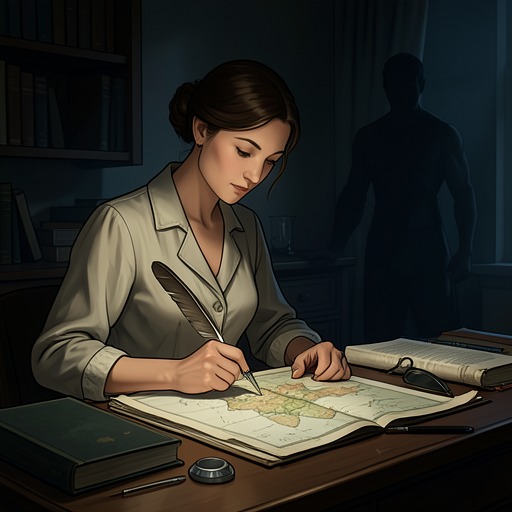
The choice left him with more than professional regret. Adam’s recurring insomnia brought long, troubled nights and repeated reckonings with his past. Even drinking five or six large glasses of vintage port after dinner did not provide lasting sleep. He might sink into a heavy stupor, only to wake again in the early hours with memories and assessments of his life pressing on him. He no longer expected happiness; what he wanted was contentment and peace of mind. His wealth and position could not ease the loneliness he recognized as partly self-created, rooted in what he felt was a betrayal of his ambitions, ideals, and moral convictions.
The Squire as Father and Employer
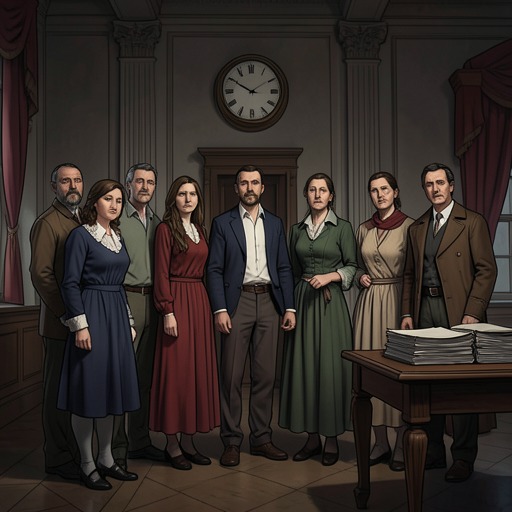
Adam’s authority at Fairley Hall is firm, but the evidence also shows him trying to use it responsibly. When he decides that Edwin should return to school, he approaches Adele carefully, aware that discussion of their son is painful for her. Once she resists, Adam makes clear that his decision is final and that Edwin himself wants to resume his education. Yet his resolve is not simply coldness: he ends their difficult exchange by expressing sympathy and saying that his concern is for Edwin. The scene presents a father capable of tenderness, though his manner can become rigid when he believes duty requires a decision.
His relationship with his sons also exposes his standards as an employer. Adam tells Gerald that he has consistently tried to improve conditions at the mill and intends to continue doing so. After the warehouse fire in which Jack Harte died saving Edwin, Adam’s priorities become unmistakable. He orders help to fight the blaze, but insists that the mill can be rebuilt while cottages and the village must be protected from the spreading fire. Afterward, he thanks the mill hands for their efficiency and courage and promises them bonuses in the following week’s pay. He credits their actions with saving both the mill and the village.
Adam is particularly moved by Jack’s sacrifice. He recognizes that Jack put himself at risk to save Edwin and describes the act as fearless and unselfish. The loss also sharpens his anger at Gerald for disobeying his instructions to treat the workers decently. In the immediate aftermath, Adam turns from grief and gratitude to the practical problem of replacing the wool destroyed in the warehouse. His response joins personal feeling to the obligations of ownership: he honors the workers, protects the village, and confronts the damage to the business.
The industrial setting helps explain the importance of that business. Fairley village lies in the Pennine foothills, where the West Riding’s millstone grit country offers streams of soft water as well as land suited to sheep. The combination of wool and water that is kind to fibres makes the region well suited to cloth production. Adam’s estate is therefore not merely a family seat; it is part of a local economy whose prosperity depends on mills, raw materials, workers, and the surrounding community.
Love, Jealousy, and a New Marriage
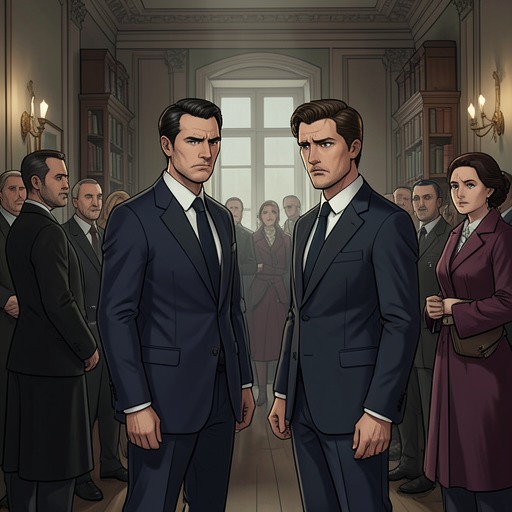
Adam’s emotional life changes when he recognizes his feelings for Olivia Wainright. At a dinner hosted for Bruce McGill, Adam appears relieved that the evening has gone well. But his composure gives way when he understands the source of his agitation: he is jealous of Bruce and Andrew Melton because he wants Olivia for himself. The recognition is a turning point, transforming an unsettled feeling into acknowledged desire.
When Adam realizes that Olivia’s apparent sadness is actually longing for him, he responds with joy, and they begin a relationship. The account makes the mutuality plain: Olivia tells him that she loves him, has loved him for years, and expects to continue loving him. But she refuses to remain in the same house as her sister, Adele, and carry on a clandestine affair with Adele’s husband. Her condition gives the romance a real cost; feeling alone cannot resolve the conflict created by their household and family ties.
Their eventual marriage becomes possible after the Deceased Wife’s Sister Marriage Act was passed in 1907, legalizing marriage between a man and his sister-in-law. Adam persuaded Olivia to marry him in 1908. Years later, their life together is remembered as deeply compatible and happy. When Adam returns from Worksop after their first night together, his love is visible in his buoyant manner and renewed expression. Later, Olivia’s death devastates him. In a subsequent account, Paul McGill recalls that Adam was never the same after her death and that a stroke left him confined to a wheelchair, a sharp contrast with the active man he had been.
Elizabeth Harte and the Hidden Past
A secret from Adam’s youth is first preserved in the cave beneath Ramsden Crags. Emma Harte finds a column of names derived from Elizabeth, including Elizabetta, Isabella, Lilibeth, Beth, Betty, Bess, Eliza, Liza, and Lisa. Beside them is Adam’s name, with a heart pierced by an arrow and the initials A E. Edwin speculates that the woman was Elizabeth, the sister of Lord Sydney, because the Sydneys and Adam’s family had grown up together. The inscription offers a clue, but not the full history.
That history is disclosed much later through Jim Fairley. After Olivia’s death, Jim’s grandfather took Adam a painted stone portrait, believing it might comfort him. Adam refused it again; his father then explained that the portrait depicted Elizabeth Harte, Emma’s mother, and that she and Adam had been childhood sweethearts. Jim subsequently tells Emma that the relationship went further: Adam and Elizabeth were lovers, and Elizabeth became pregnant by him.
According to the family account, Elizabeth left Fairley and went to Ripon. Adam found her there weeks later and had decided to abandon his military career, defy his father, and emigrate to America with her. By then she had miscarried. Adam did not know whether the loss had occurred naturally or had been caused by a midwife. Elizabeth was gravely ill, eventually recovered, and rejected Adam’s plan to elope. She returned to Fairley and soon married Jack Harte; afterward, she never spoke to Adam again. The episode gives personal meaning to Adam’s later regret about his abandoned commission: once, he had considered giving it up for Elizabeth, but family obligation and the circumstances of her illness and pregnancy had separated them instead.
Legacy and Narrative Significance
Adam’s story is built around choices made in the name of duty and the feelings those choices could not extinguish. He returned to Yorkshire when his father summoned him, became responsible for the family enterprises, and tried to exercise that power with concern for workers and village residents. Yet his lost military ambition remained a source of private grief, while his early love for Elizabeth was concealed from the next generation. The two histories intersect: the same young man who once considered leaving with Elizabeth later lived with the consequences of the path he had not taken.
The revelation does not erase the antagonism between the families or make Adam solely responsible for its later course. It does, however, alter how the family history can be understood. The cave inscription, the stone portrait, and the locket engraved A to E 1885 connect a hidden romance to objects passed between generations. Adam’s private past thus survives in material traces and belated testimony, long after the people who made those choices are gone. Through him, the novel presents inheritance as more than ownership of mills or family position: it also includes unfinished love, regret, and truths whose delayed disclosure changes the meaning of the present.