Adam’s painted pebble
A Woman of SubstanceAdam’s painted pebble is a round stone bearing a remarkably well-preserved oil portrait of Olivia Wainright. Painted by Adam Fairley when he was about seventeen, recovered years later by Edwin Fairley, and returned by Adam to the son who found it, the small object joins three generations’ knowledge and silences. Its appearance brings Adam’s distant memories sharply into the present, while his refusal to explain its history leaves the family story it carries unresolved.
Identity and Material Form
The pebble is modest in scale but unusually durable as a keepsake. When Edwin presents it to Adam, it is wrapped in a silk handkerchief. The cloth conceals the stone until Adam unwraps it and sees the painted face again. The oils remain remarkably well preserved, enough for Adam to smooth a finger over the image and ask whether Edwin has varnished it again. Edwin confirms that he has, explaining that the varnish was meant to protect the paint. The portrait’s survival is therefore not simply passive: Edwin has taken practical care of it, extending the life of Adam’s earlier work.
The image is recognizably Olivia Wainright to both men. Edwin identifies the striking resemblance and presses Adam to confirm that the portrait is of his aunt. Adam’s attention, however, moves beyond identification. He gazes at the sweet face, and the preserved likeness becomes the focus of a memory that has remained vivid across decades. The pebble carries an image, but its significance exceeds what the image can establish: it prompts a recollection and signals a story Adam still chooses not to tell.
Recovery and Return
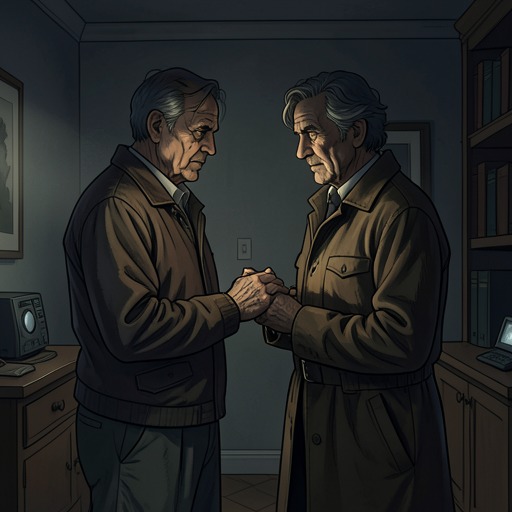
Edwin introduces the stone as something he has kept for years and now wants Adam to have. Adam initially receives it absently, but his response changes as he recognizes the portrait. After the memory passes, he wraps the pebble again, almost tenderly, and hands it back to Edwin. He tells his son to keep it because Edwin found it. The exchange therefore ends not with Adam reclaiming his painting, but with him affirming Edwin’s claim to the object through its recovery.
Adam also connects that recovery to a specific place. He presumes Edwin came upon the pebble in the old cave on the moors by Ramsden Crags, and Edwin confirms that he did. The stone’s journey from Adam’s youthful act of painting to Edwin’s discovery and then into this conversation gives it a history of changing custody. Yet the text does not explain how it came to be in the cave or how long it remained there. Its location is confirmed; the circumstances that placed it there remain part of the undisclosed past.
The Memory Within the Portrait
As Adam studies the image, the decades seem to fall away. He remembers Olivia standing beneath the crags at the Top of the World, her dark hair moving in the breeze and her blue eyes bright. In that recalled scene she tells him she is going to have a baby. The visual likeness thus opens onto a particular moment in Adam’s life, not a general nostalgia: the portrait returns him to Olivia and to the news she shared with him.
Edwin notices Adam’s expression but does not understand its cause. His insistence that the portrait depicts Olivia interrupts the memory, bringing Adam back from recollection to the present exchange. The scene sets Edwin’s straightforward recognition against Adam’s private association. The same face is, for the son, an aunt’s likeness on a found stone; for Adam, it is a passage into a past whose emotional and familial implications are not yet disclosed.
Withheld History and Narrative Significance
Adam does not tell Edwin the story behind the stone. Instead, he says that he will explain it one day, but not now, and gives no account of what the pebble means beyond his own memory. That restraint is especially pointed because Edwin is preparing to leave for war and has just said that he must unburden himself to his father before departing. Adam offers understanding to Edwin’s confession while holding back his own explanation of the object. The pebble makes that imbalance visible: one family history is about to be spoken, while another remains deferred.
The object’s significance rests on this combination of preservation and incompleteness. The varnish protects the painted surface; the silk handkerchief briefly wraps it from view; Adam’s memory restores a scene that the portrait alone cannot disclose. Yet neither careful keeping nor vivid recollection turns the pebble into a full explanation. Adam returns it to Edwin, and the promise of a later telling leaves its meaning open. It remains a tangible connection among Adam, Olivia, and Edwin, while also marking the boundary between what the family can recognize and what it has not yet been told.