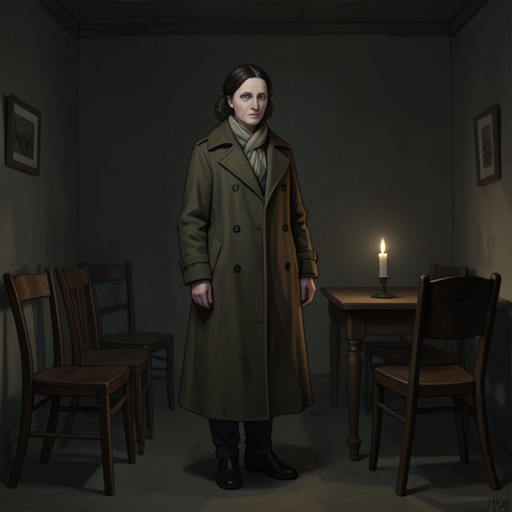
Adele Fairley
A Woman of SubstanceAdele Fairley is the mistress of Fairley Hall, a strikingly beautiful woman whose withdrawal from her family and dependence on alcohol are gradually exposed as parts of a life shaped by isolation, fear, and a loveless marriage. Her apparent fragility conceals brief but consequential flashes of resolve: she protects Edwin from Gerald, while her increasingly confused and suspicious perceptions leave her vulnerable within the very house she is meant to rule. After her death, the Blue Suite preserves the contradiction at the center of her character—a room filled with beautiful possessions, yet experienced as an empty and desolate world.
Identity and Background
At thirty-seven, Adele retains a girlish, sculptural beauty that the narrative presents as cold and remote. Adam recalls being captivated by her appearance, only to decide that it masked selfishness and emotional coldness. His account is itself colored by resentment and long estrangement: he had not crossed the threshold of her sitting room for ten years, and he acknowledges that he accepted the end of their marital life with relief. Their marriage has become a lifeless arrangement rather than an intimate partnership.
Adele has also retreated from the management of Fairley Hall. After Olivia Wainright arrived in February, Olivia took over many of the household’s managerial duties. Adele later tells herself that she will resume them, insisting that she is well enough to act as mistress of the house. But that determination is unstable. She believes Adam considers her a fool and sees his reserve, his watchfulness, and Olivia’s presence as evidence that the two are plotting against her. Her wish to reclaim authority coexists with a conviction that her closest relations are enemies.
The setting gives her isolation a physical form. Adele’s vast upstairs sitting room is crowded with antiques, porcelain, crystal, silver, mirrors, and blue damask, beneath a white vaulted ceiling and a great chandelier. A fire burns, lamps glow, and the furnishings gleam, but none of this abundance dispels the room’s bleakness. Its elegance seems less like comfort than enclosure: Adele possesses a world of beautiful objects while remaining cut off from warmth and companionship.
Withdrawal, Alcohol, and Fear
Adele’s disordered state is initially filtered through Adam’s attempts to explain it away. He has dismissed her strange fears and delusions as female vapours, depression, hypochondria, or a longstanding vagueness of character. Looking back, he recognizes that this dismissal may have protected him from confronting the possibility that she was losing her mental stability. He had once described her behavior to his friend Andrew Melton, a doctor, who recommended that she be examined in Leeds or London. Adam returned to Fairley to find Adele apparently normal, but that reprieve only made him more apprehensive about how precarious her condition might be.
Adele’s drinking is shown not as casual indulgence but as an urgent means of quieting terror. She unlocks a French display cabinet with a small key and takes out a priceless, dark-red Venetian-glass decanter. She drinks quickly, without admiring an object she once treasured, and feels the alcohol soften the anxiety that greets her each morning. When the decanter is empty, she shakes it in disbelief, trembles, and panics because no alcohol remains in her rooms. Even the knowledge that a drink is available has served as a form of security. Clutching the empty vessel, she rocks and moans in distress.
In this confusion, Adele mistakes the decanter for a baby and addresses it as Gerald, then corrects herself and identifies it as Edwin. The moment entwines her dependence with her maternal attachments, but it also shows how far her grasp on the immediate world has weakened. On another morning, she mistakes Emma for the sick Polly and asks when Polly will return to work. When Emma tells her that Polly died the previous week, Adele briefly recalls the death, attributes her forgetfulness to headaches, and then drifts back into a trance-like state. These lapses alarm the people around her, even as Adele tries to explain them away.
Her fears also take a more suspicious form. She watches Adam and Olivia watching her and imagines that they whisper together as conspirators. She believes she must remain alert to their plans and searches frantically through her wardrobe for a particular dress that she thinks will restore her authority as mistress of Fairley Hall. The scene sets her desire for control against her increasingly unreliable sense of what is happening around her: clothing becomes invested with the power to recover a position she feels has been taken from her.
Marriage and Family Conflict
Adele and Adam’s estrangement has lasted for a decade. She withdrew into what the narrative calls semi-invalidism and shut her bedroom door against him; Adam accepted the separation rather than trying to restore their intimacy. He describes avoiding conversations with her for weeks and finding their encounters painful, while also admitting that he avoids facing the seriousness of her condition. His concern and irritation coexist, but the distance between them has made care difficult to distinguish from judgment.
Olivia’s arrival complicates Adele’s position in the household. Olivia assumes managerial responsibilities, while Adele feels displaced and interprets the sisters’ relationship with Adam as a threat. Adam, meanwhile, relies on Olivia’s presence and tells her that he and Adele have not lived as husband and wife for more than ten years. He hopes Olivia will remain at Fairley through the summer and regards her as essential to his own emotional stability. Adele’s suspicion is therefore set against a real shift in household authority and Adam’s closeness to Olivia, though her belief that they are plotting against her exceeds what the evidence establishes.
Adele’s relationship with her sons is not uniform. She adores Edwin, her favorite, and her alarm at the thought of his return to boarding school makes Adam’s proposal immediately fraught. Her attachment becomes most active when she sees Gerald tormenting him. From her window, she witnesses Gerald berating Edwin and kicking Edwin’s horse, Russet Dawn, in the ribs. The horse rears, and Edwin narrowly avoids being thrown onto the cobblestones. Adele’s fear of Gerald, whom she already recognizes as a bully, gives way to anger and concern for Edwin.
She confronts Gerald with a steadiness that surprises him. Adele demands an explanation for his treatment of Edwin and rejects his attempt to soften the incident into a minor quarrel. When she understands that Gerald’s account does not excuse the danger he caused, she grabs his wrist and strikes him across the cheek. She warns him not to endanger Edwin again. The violence is startling, but it is also a rare moment in which Adele’s maternal attachment becomes direct resistance to Gerald’s bullying.
Emma’s Witness and Adele’s Death
Emma encounters Adele at several points where care and unease meet. Before a dinner, Adele becomes so distracted that Emma decides she must bring her back to the present without summoning Olivia or Edwin. Kneeling before her, Emma grips Adele’s cold hands and insists that the guests will soon arrive and that Adele must go downstairs as the Squire’s wife and mistress of the house. Emma considers but rejects slapping her, unwilling to mar her fragile skin. Adele’s eyes eventually show signs of returning attention. The scene gives Emma a demanding role in sustaining the appearance of household order, even as she recognizes that Adele is in distress.
Later, when Annie reports that Adele has been speaking to an empty chair, Emma doubts the literal account but suspects there may have been no one else in the room. Her uncertainty does not erase her concern; she decides to go upstairs to see Adele. The episode extends the pattern established by Adele’s confused conversations and mistaken perceptions, while showing how the servants become witnesses to a private deterioration that the family does not openly resolve.
Adele’s death is announced by Murgatroyd, who tells Emma that it is the mistress, not Edwin, who has died. Her funeral takes place later that week. The Fairley mill closes for the day, and workers, Hall servants, villagers, local gentry, and family friends fill the cemetery beside Fairley Church. The scale of the attendance places Adele’s death within the life of the community, even though her own days at the Hall have been marked by withdrawal. Two days after the funeral Olivia leaves for London with Edwin; a week later Adam departs to join his youngest son at Olivia’s Mayfair house. Gerald remains behind with the mill under Ernest Wilson’s charge, already anticipating the opportunity created by his father’s absence and unmoved by his mother’s death.
Memory and Narrative Significance
Adele’s influence persists in Emma’s memory after the Hall has changed hands. During a later tour with Blackie, Emma enters the neglected Blue Suite, unused for years. She remembers that as a child she had been awed by the antiques, but now sees the room as the setting of Adele’s isolated life and recognizes her alcoholism. Emma still wonders whether Adele was also mentally ill; the novel does not turn that uncertainty into a settled diagnosis. In the adjoining bedroom, the silence and the remembered traces of Adele’s laughter and jasmine perfume momentarily unsettle Emma. She returns to the sitting room and thinks of the room as a pathetic memorial to a woman who had been beautiful.
Adele also remains attached to Emma’s decisive recollection of Fairley Hall. Emma remembers Adele warning her to get away from the house before it was too late. In retrospect, Emma interprets the warning as evidence that Adele had understood something of the danger and disorder within the Hall, despite the assumption that she was foolish. The memory becomes part of the moment in which Emma resolves not to let anyone or anything divert her again: she will pursue wealth as power and, afterward, revenge. Adele does not direct that ambition, but her warning helps give Emma’s departure a shape, linking the domestic world Adele could not escape with the future Emma means to build beyond it.