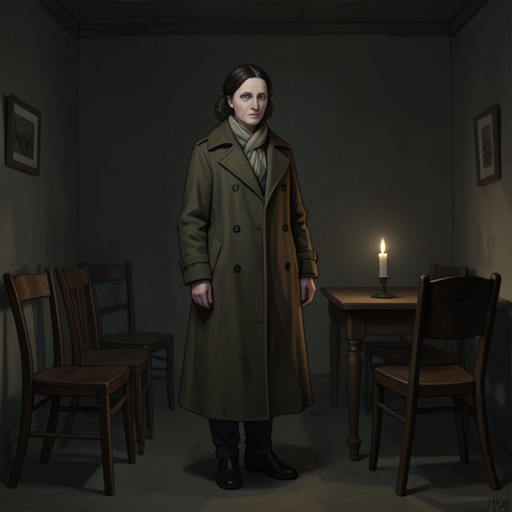
Adele Fairley’s mental instability
A Woman of SubstanceAdele Fairley’s mental instability becomes visible both in her disoriented behavior and in the emotional desolation of the rooms where she lives. At Fairley Hall, she can appear briefly recovered, but that apparent normality does not reassure Adam Fairley for long: he comes to fear that her fragile hold on sanity may shatter again. The narrative links this uncertainty to her withdrawal from other people and to the lavish, increasingly lifeless surroundings in which she tries to find solace.
Signs of Deterioration
Adam has spent years explaining away Adele’s strange behavior. He has treated her fears and delusions as female vapours, depression, hypochondria, or a vagueness already present in her character. This dismissal protects him from facing the possibility that she is losing her mind. When he finally recognizes the seriousness of her condition, he also feels a small stab of guilt: his explanations may have served his own need not to know.
The signs he can no longer ignore are concrete and unsettling. Adele has wandered the upstairs corridors in bewilderment, dazed, her hair disordered and her expression glazed. Adam remembers how she seemed like a figure moving without comprehension through familiar surroundings. The account does not give her a medical diagnosis; instead, it presents behavior that has become difficult for her husband to explain away as mere eccentricity.
Her condition is not represented as a steady, uninterrupted decline. On a business trip to London, Adam described her behavior to his doctor friend Andrew Melton, who suggested that she be examined in Leeds or, preferably, by Melton himself. Adam was prepared to take her to London. But when he returned to Fairley Hall, Adele seemed to have become normal again. The temporary improvement relieved him, yet it did not resolve his concern: he now suspects that her apparent stability may be only a fragile interval.
Adam’s Recognition and Retreat
Adam’s belated recognition develops alongside his own introspection and forgetfulness. Searching frantically through his desk for a letter, he realizes that preoccupation with his problems has made him forgetful. He tells himself he must escape his mental dejection before it becomes permanent, then compares his own danger to the condition of the woman upstairs. The comparison brings Adele’s state into focus, but it does not make him ready to remain with that knowledge.
He has long dismissed her behavior as a combination of familiar complaints, and his reasoning reveals how easily an explanation can become a refuge. If her fears are only imaginings, he need not confront the possibility of serious illness; if he does not think about that possibility, he need not act on it. His earlier willingness to seek a doctor gives way, after her temporary recovery, to renewed avoidance. Even when dread tells him that her sanity might break again at any moment, he pushes the thought away and turns back to business papers. His concern is real, but so is the habit of retreating from it.
A Room of Possessions and Desolation
Adele’s upstairs sitting room at Fairley Hall gives physical form to the distance between material abundance and emotional life. The room is vast and crowded with beautiful objects: white plasterwork and a crystal chandelier rise above pale-blue damask, antique furniture, mirrors, porcelain, silver, and glass domes enclosing dried flowers and wax fruit. A fire burns in the marble fireplace, and lamps soften the light, but the richness does not make the room welcoming. Its coldness and sense of abandonment persist beneath the ornament.
The contrast matters because Adele’s surroundings are not empty for lack of furnishings. They are crowded with things, yet seem lifeless. The narrative describes the possessions as part of her effort to find solace in material wealth and to restore a damaged psyche by surrounding herself with objects rather than people. The room thus reflects her isolation without reducing it to a simple absence: there is much to look at, but little that appears to connect her to another person or to the world outside.
Adele’s relationship with this environment has also changed. She once took pride in the exquisite objects she collected on travels with Adam and found pleasure in them. Now they no longer interest her. The collection that once offered satisfaction has become part of a setting in which she seems lost, moving abstractedly among possessions she has accumulated but no longer notices. Material comfort remains; the consolation it was meant to provide has faded.
Withdrawal and Fragile Presence
Adele enters the sitting room cautiously from the adjoining bedroom, pausing at the threshold and scanning the space. She clutches her silver-streaked white silk peignoir close around herself and looks again to make sure she is alone, afraid that a servant might be hidden in a corner. The gestures suggest that even a familiar private room does not feel entirely secure to her. Her attention is turned toward possible intrusion rather than toward the beautiful objects around her.
At thirty-seven, Adele is described as tall and graceful, her pale-blonde hair nearly silver. Yet her movement can seem slow and remote; standing at a window, she gazes across the valley without really seeing its first signs of spring. The landscape has changed, but she perceives it dimly, as if through a veil. Her inward life has become her only reality, leaving her detached from external surroundings even when they are directly before her.
This separation makes her presence in the house paradoxical. She is surrounded by possessions and lives within a grand setting, but the room’s abundance cannot restore connection or ease. Even Adele appears adrift within the accumulation she created, while Adam’s belated awareness offers no certainty of recovery. Her mental instability is therefore shown not as a settled condition with a clear outcome, but as a frightening fluctuation: a period of apparent normality can follow disorientation, yet beneath it remains the possibility of another rupture.