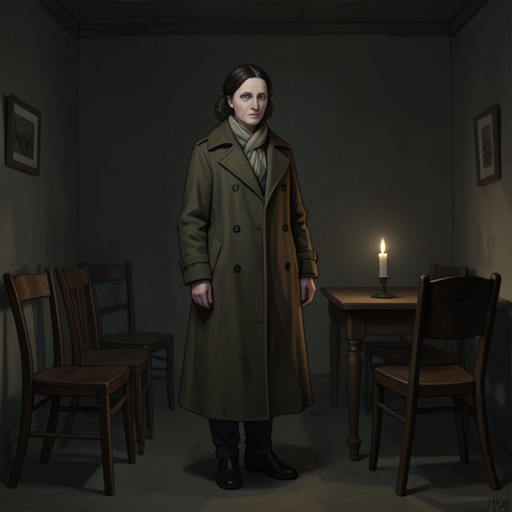
Adele confronts Gerald over the trapped dog
A Woman of SubstanceAdele Fairley’s confrontation with Gerald Fairley turns a dispute over a trapped dog into a direct challenge to Gerald’s bullying of his brother Edwin. Seeing that Edwin has been distressed and placed in danger, Adele overcomes her habitual fear of Gerald, demands an account of his behavior, and makes him help ensure that the injured animal is dealt with. Her intervention is a rare moment in which concern for Edwin and compassion for an animal overcome her reluctance to confront her son.
The incident in the courtyard
Adele learns what is happening when Emma Harte looks out from the window and reports that Gerald is shouting at Edwin, who appears to be crying. Adele rushes to the window. The brothers are still mounted after a ride, and Gerald is berating Edwin while the younger boy tries to defend himself. When Adele opens the window to intervene, she sees Gerald deliberately kick Edwin’s chestnut stallion, Russet Dawn, in the ribs. The startled horse surges forward, putting Edwin at risk of being thrown, but Edwin’s horsemanship enables him to regain control and remain mounted.
The danger changes Adele’s response. She has long admitted to herself that Gerald frightens her, and his behavior confirms her view of him as a bully. But her concern for Edwin overcomes that fear. When the courtyard falls quiet, she calls down to Gerald and condemns both his conduct and the way he repeatedly picks on his brother. Gerald is surprised by the firmness of her intervention. Rather than accept responsibility, he dismisses the episode as unimportant, disparages Edwin, and tells Adele not to interfere.
A contested account
Adele insists that Gerald explain himself. Gerald approaches her in the room where Edwin stands beside his father’s desk, presenting an apology and an account designed to make the conflict sound minor. He says the brothers encountered a dog caught in one of the traps their father had set for rabbits and other vermin. According to his version, Edwin became upset and wanted to release the animal, while Gerald stopped him because the traps were dangerous. Gerald portrays Edwin’s distress on their return as inexplicable and maintains that he has told the truth.
Adele does not accept Gerald’s explanation without hearing Edwin. Edwin confirms part of it, but supplies the crucial fact Gerald has omitted: the dog was alive and suffering. Rather than risk handling the trap himself, Edwin had proposed asking the yardman to free the dog, or, if that could not be done, to shoot it to end its suffering. Gerald had laughed at him, dismissed his concern as childish, and argued that helping the animal would waste time and a bullet. Edwin says Gerald became abusive when he threatened to tell their father. His account makes clear that the dispute was not simply about Edwin’s distress or safety: it also concerned Gerald’s deliberate indifference to the animal’s suffering.
Adele confronts Gerald
Once Edwin has explained what happened, Adele condemns Gerald’s refusal to help the dog. She nevertheless continues to question the danger to Edwin rather than allowing Gerald’s account to close the matter. Gerald attempts to soften the confrontation with a further show of conciliatory behavior, but Adele holds her ground, tells him that his rudeness and repeated treatment of Edwin are unacceptable, and makes plain that an apology alone will not settle the issue.
Adele then confronts him with what she saw from the window: he kicked Russet Dawn, and the horse’s sudden movement could have thrown Edwin. She warns Gerald that if he endangers Edwin again, or if she hears that he has done so, she will not ignore it. Although she decides not to tell their father about this incident, she reserves the right to do so if the behavior recurs. Gerald acknowledges the warning and leaves. The encounter marks a shift in their immediate balance of power: Adele’s fear has not disappeared, but concern for Edwin has made her willing to challenge Gerald openly and impose a consequence he cannot dismiss as a private quarrel between brothers.
The order concerning the dog
Adele’s intervention does not end with Gerald’s departure. When he returns with the yardman, she directs the yardman to go to the trap and deal with the dog. The man objects that the traps are dangerous and that their father may disapprove of a woman intervening in men’s business. Adele accepts responsibility for the decision and gives him a clear set of instructions: if the dog is dead, it should be buried; if it is alive and has a chance of surviving, it should be brought back and cared for; if it cannot recover, it should be shot and buried on the moors.
She also requires Gerald to accompany the yardman and report back, preventing him from leaving the practical task to someone else. Gerald objects, but Adele refuses to entertain the objection, and the two men go together. The evidence does not establish what ultimately happens to the dog, only that Adele orders an immediate response intended to prevent needless suffering. Emma reassures Adele that the men will do as they have been told, while Adele sits by the fire, still affected by the incident.
Significance
The scene links two forms of vulnerability: Edwin’s exposure to his brother’s bullying and the trapped animal’s helplessness. Adele’s actions are especially consequential because she has been afraid of Gerald and has usually retreated from conflict with him. Here, she moves from witnessing danger to publicly challenging its cause, then follows through by making sure the dog receives attention. Her concern for the animal is presented as a striking contrast with her relative insensitivity to human suffering, giving the episode a particular moral tension without making her conduct uncomplicated.
The confrontation also distinguishes an appearance of remorse from accountability. Gerald offers an apology and a softened explanation, but Adele requires Edwin’s account, recognizes what has been left out, and insists on both a warning against future harm and a practical response to the dog’s condition. The incident therefore develops Adele’s relationship with her sons through a decisive act: she does not resolve their larger conflict, but she intervenes when Gerald’s conduct threatens Edwin and refuses to let his version of events determine what happens next.