Bruce McGill
A Woman of SubstanceBruce McGill brings together two worlds central to the novel’s commercial and personal stories: the wool-producing landscape of Yorkshire and the sheep country of Australia. A widowed rancher, father, and prospective business partner, he is at ease in company and alert to opportunity, but his warmth does not make him careless. His conversations with Adam Fairley link hospitality to investment; his conversations with Paul McGill turn a father’s concern into a warning about the risks of romantic scandal.
Identity and Background
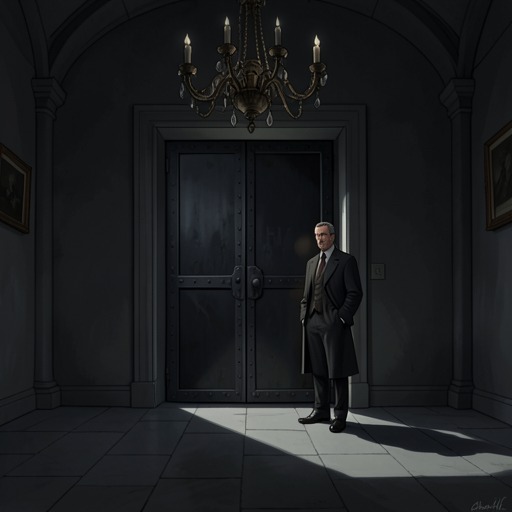
Bruce is an Australian sheep rancher in his late forties, tall and spare, with a weather-beaten face, curling brown hair, and the rolling gait of someone who has spent much of his life on horseback. His manner is masculine and engaging; his merry eyes and evident confidence help explain why he readily inspires trust, particularly among women. He combines the familiarity of a man accustomed to open-air work with the polished ease of a guest among Yorkshire’s wealthy mill owners.
His home is Dunoon, a sheep station near Coonamble, where he lives with his son, Paul, apart from the workers on the station. Bruce’s wife died three years before one of his conversations with Adam. He also has a housekeeper and describes his household as ready to make a visitor comfortable. These details establish him as a widower whose family life is centered on Paul, even while his work and connections carry him between Australia and Britain.
Wool, Land, and Business
Bruce’s presence in Yorkshire has a practical foundation: he has been visiting the region on business, and Adam has been hosting him on several trips in recent months. The connection reaches beyond personal acquaintance. The Fairleys’ textile enterprise depends on wool, while Bruce’s occupation places him within the sheep-raising economy that supplies the raw material for cloth. Yorkshire’s geology and climate support both sheep and the soft water needed in wool manufacture; Bruce’s Australian station offers another setting for sheep production and a possible extension of Adam’s supply chain.
In the library after dinner, Bruce turns their cordial business relationship toward a specific proposal. He invites Adam to visit Dunoon later in the year, offering to show him the station and spend time with him in Sydney. He then suggests that Adam buy land in Australia, establish a small sheep station, and use Bruce’s help finding suitable workers. Bruce even offers to supervise the venture during Adam’s absence, so that Adam could become his own supplier. The proposal is more than a friendly invitation: it connects overseas land, labor, and livestock to the needs of a British wool manufacturer. Adam considers the idea seriously, though the evidence does not establish whether he makes the trip or invests.
Bruce’s commercial confidence is matched by a straightforward manner that Adam appreciates. At the dinner, the two men toast a successful business relationship and the prospect of friendship. Bruce is willing to strike a hard bargain, but Adam regards him as honest and direct. Their rapport makes the Australian proposal persuasive: it comes not from an unknown promoter but from a partner whose character Adam believes he understands.
At Fairley Hall
Bruce attends a dinner at Fairley Hall planned by Olivia Wainright for him, an Australian sheep rancher visiting Yorkshire. Adele Fairley has appeared unwell and confused earlier that day, but at dinner she surprises Adam by becoming charming and attentive to the guests. Bruce is especially taken with her. He watches her arrive at the staircase, pause theatrically on the landing, and descend in a manner that captures the room’s attention. Seated beside her, he gives her his full attention, while her laughter carries across the table.
Adam observes Bruce’s fascination with wry amusement. The scene also sharpens Adam’s own contrast between Adele and Olivia: Adele’s beauty and social performance seem to him brittle and unreachable, while Olivia’s poised presence prompts a different, more intimate response. Bruce’s uncomplicated admiration makes him a participant in the evening’s social display, but he does not see the estrangement Adam feels within his marriage. Later, he compliments Adam on having a beautiful and entertaining wife. Adam answers amiably, concealing the bitterness behind his response. Bruce’s compliment is sincere, but its effect is to underline how little an apparently successful household reveals to an outsider.
Fatherhood and Paul’s Affairs
Bruce’s relationship with Paul is affectionate and candid. When they meet over dinner in England, Paul is recovering from a wound that has taken longer to heal than he would like. Bruce asks whether it is painful and listens as Paul describes the injury as aggravating rather than severe. Paul has survived the Gallipoli campaign without being wounded, only to be injured later in France. Bruce recognizes his son’s luck, while also regretting that the wound is unlikely to release him from military service and bring him back to Coonamble. Paul expects to return to France and rejoin Colonel Monash, but prefers to set aside that prospect for the evening.
Bruce would like Paul to return to Australia with him, and his concern is plainly personal as well as practical: life at the station includes only the two of them as family. Yet he does not try to turn Paul’s recovery into a reason to disregard his military obligations. Instead, he urges him to take care and refers to a previous romantic encounter that had caused gossip, teasing him about the scandal it left behind. Their exchange presents an intimate father and son who can speak openly, even as war and distance limit the life Bruce hopes to share with him.
Political Caution and Narrative Role
When Bruce notices Paul’s interest in a woman across the dining room, he recognizes the intensity of his son’s attraction but does not treat it as harmless flirtation. He warns Paul to be careful: Bruce is involved with several politicians in Britain, and a romance with a politically connected man’s wife could create trouble for him. Paul assures his father that he will not embarrass him, while remaining determined to discover the woman’s identity. Bruce’s warning establishes that his international business and social life overlap with political relationships, giving Paul’s pursuit possible consequences beyond private embarrassment.
That caution becomes pointed when Frank Harte later tells Emma Harte that Paul is married. The revelation confirms the relevance of the complications surrounding Paul’s romantic conduct, though it does not establish that Bruce knew the details of Paul’s marriage when he warned him. Bruce’s role is therefore both connective and limited: he joins Yorkshire’s wool industry to Australian pastoral investment, and he supplies a familial perspective on Paul’s charm, military service, and romantic recklessness. His scenes make visible the practical and reputational ties that can extend from a private affair into business, family, and political life.