Class inequality and labor exploitation
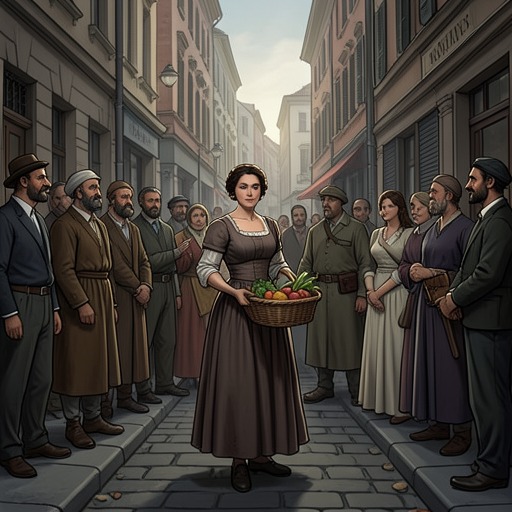
A Woman of SubstanceClass inequality and labor exploitation are not merely a contrast between rich and poor in the novel: they govern who can feel secure, whose labor sustains privilege, and which forms of ambition society will permit. The gulf between Fairley Hall and the village gives Emma Harte an early education in power. It also makes wages, working conditions, and social recognition central to the choices of workers and employers alike.
Wealth, wages, and security
Emma sees the Fairleys’ luxurious life as being financed by workers’ unrelenting labor, while the people who perform that labor remain exposed to poverty. From this contrast she draws a practical conclusion: money buys more than food and medicine. It brings power and protection in a world where the poor have little access to justice or liberty. Her ambition to make a fortune grows directly from her wish to secure her family, especially her ill mother, and from her refusal to accept that wealth belongs only to those who inherit it or happen upon good luck.
Jack Harte’s decision to leave the brickyard makes the pressure of low wages concrete. He objects not to hard work but to the pay: after ten-hour days handling wet clay, he would take home eighteen shillings and tenpence to support a wife and three children. His foreman sympathizes but says that even supervisors earn only a little more and that he cannot change the arrangement. Jack chooses to leave rather than accept the wage, then swallows his pride to seek work at the Fairley mill. A childhood friend, the foreman Eddie, secures him a position at twenty shillings a week. The improvement is small, but the mill is close to home, a practical consolation while Elizabeth is ill. The episode presents a labor market in which workers can protest unfairness, yet their alternatives remain sharply limited by scarce jobs and family needs.
The same hierarchy appears inside Fairley Hall. Murgatroyd dismisses Emma’s work as worth little and treats the three shillings a week she receives as excessive payment, while demanding that she serve the household. His authority is reinforced by the Squire’s position and by Emma’s dependence on the job. When Murgatroyd later tries to pay Blackie O’Neill fifteen shillings for a week’s work and board, Blackie insists on the guinea agreed with the Squire in Leeds. The attempted reduction shows how a worker’s pay can be contested, but also how easily an employer’s representative may test the limits of an agreement.
Workplaces and control of labor
The novel contrasts different systems of work rather than treating the factory as a single, uniform experience. At Abraham Kallinski’s Rockingham Street workshop, about twenty workers make clothing components for larger manufacturers. They do not produce complete suits: one order might involve sleeves, jacket fronts and lapels, backs, or trousers, which the major factories later assemble. This division of production is described as organized, cheaper, and faster, and as a force in Leeds’s growth as a center of ready-made clothing.
The workshop’s labor arrangements are comparatively humane. Workers are paid by the piece, but Abraham does not impose strict clocking rules or police conversation and breaks. He expects his obligations to larger clothiers to be met, yet does not use discipline for its own sake. Emma enjoys the lively cooperation there and proves unusually quick at the work. The shop’s relative freedom does not erase economic pressure, but it establishes a contrast between demanding labor and unnecessary managerial harshness.
At Thompson’s mill, Emma encounters a much more rigid environment. The working day with Laura Spencer runs from six in the morning to six at night, under the oversight of demanding foremen. The noise and hazards of weaving are part of the job: Emma sees a shuttle fly off and badly injure a worker, an accident the narrative presents as not unusual. She learns to weave within a month and avoids a loom failure that could cost hours of repair and force a worker to make up lost time. Her skill increases, but competence does not make the workplace congenial or shorten its long hours. As her pregnancy advances, standing at the loom leaves her exhausted and with swollen legs; Laura’s support helps her persist.
Class power and social boundaries
Economic rank is reinforced by household authority and unequal standards of dignity. Murgatroyd’s treatment of Emma demonstrates how a domestic servant can be both essential to a household and denied respect within it. Olivia Wainright’s arrival changes the conditions without abolishing the hierarchy. Her attention to household management and her respect for honest labor make her a buffer between Murgatroyd and the servants, particularly Emma. The atmosphere improves, and Murgatroyd no longer strikes Emma, though he continues to rebuke her verbally. Individual intervention makes service less abusive, but the servant’s dependence and subordinate place remain.
Class also restricts intimate choices. When Emma tells Edwin Fairley she is pregnant, he considers marriage but fears his father’s anger and the loss of his education and future as a barrister. He sees Emma’s village origins and servant status as a barrier that could not be overcome, despite imagining that clothing, elocution lessons, and an invented background might alter how she was received. He remains silent; Emma understands that silence as rejection and names the distance between the gentry and working class. The scene shows that social boundaries do not operate only through income: birth, occupation, family authority, and public respectability govern who may be accepted as a spouse.
Work as mobility and its limits
Emma tries to manage the signals by which class is read. After leaving Fairley, she presents herself in Leeds as a young woman of quality, using clothes from Olivia’s wardrobe and a carefully practised genteel manner. Her cultivated speech, which she had learned partly through practice with Edwin, is not simply an ornament: it helps establish the social identity she intends to claim. At the same time, her work and frugality remain indispensable. At the Kallinski workshop she earns enough to live without drawing on her savings, walks rather than spending on tram fares, and buys nourishing food so she can keep working and protect her pregnancy.
The novel does not suggest that hard work automatically dissolves class barriers. Emma’s speed at the sewing table and her rapid mastery of weaving create capacities, not immediate equality; the long hours and dependence on wages persist. Yet work also gives her a practical means to pursue a different future. Across the brickyard, the Fairley household, the clothing workshop, and the mill, labor is shown both as a source of wealth for those who control production and as a constrained, risky necessity for those who perform it. Emma’s determination to build economic independence begins in that unequal landscape, where security is scarce and the right to command one’s life is closely tied to money.