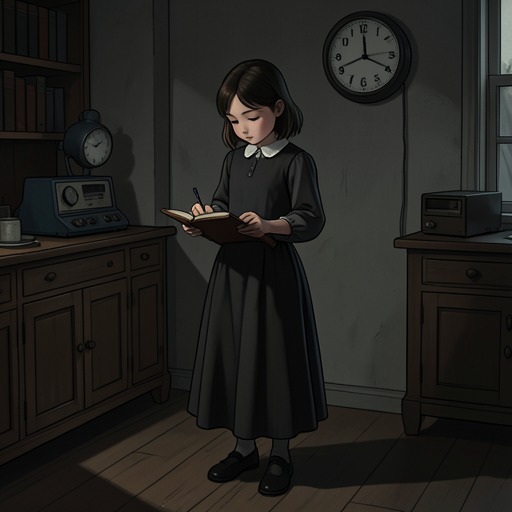
Edwina Laura Shane Harte
A Woman of SubstanceEdwina Laura Shane Harte is Emma Harte’s firstborn child, born outside marriage to Edwin Fairley and separated from Emma in infancy so that Emma could work and support her. Her life begins with a contradiction that shapes the family around her: Emma’s fierce determination to secure her daughter’s future depends on concealing the circumstances of her birth. Later, Edwina’s emotional distance from Emma and her alliance with Robin Harte turn that early history of sacrifice and secrecy into a lasting family rupture.
Identity and birth
Edwina is born while Emma is living with Laura Spencer in Leeds. Four days later, Emma watches her sleep in a makeshift cot fashioned from a drawer and lined with blankets and pillows. Firelight catches the baby’s silver-blonde hair and pink face. Emma recognizes her as part of herself and promises to protect her and provide her with everything money can buy. The promise is not abstract: Emma imagines beautiful clothes, the best schools, and a future in which Edwina will be a lady.
Emma’s pregnancy followed her relationship with Edwin Fairley. When she tells him she is going to have a baby, his shock gives way to fear of his father’s reaction and of losing the support on which his education and plans to become a barrister depend. He does not claim Emma or offer to marry her. Instead, he sees their class difference as an insurmountable barrier and remains silent. Emma reads his silence as rejection, refuses to seek an abortion, and faces motherhood without his support.
Blackie O’Neill christens the baby Edwina Laura Shane Harte. Emma, despite her rejection of religion, insists that the ceremony be performed according to the Church of England practice she considers appropriate, asking Blackie to begin again after he makes a cross on the child’s brow. His role in the ceremony is intimate as well as ceremonial: he names and kisses the baby, and Emma speaks of the life and education she intends to give her. He calls her Tinker Bell, a playful name alongside the formal one.
Separation and the protection of a secret
Emma cannot keep Edwina with her while working at the mill, and she will not consider either adoption or an orphanage. After several sleepless nights, she settles on leaving the child with her cousin Freda in Ripon. She has not first secured Freda’s agreement in writing; she is confident that Freda’s affection for children and closeness to Emma’s mother will make her take the baby in. Emma plans to pay for Edwina’s care and asks Freda to keep the circumstances secret from Jack Harte. Freda welcomes them, promises to cherish the child as her own, and agrees to keep the secret.
To explain the pregnancy, Emma intends to tell Freda a version of events in which a village boy let her down and ran off to the navy. That account conceals Edwin Fairley’s identity. The birth registration creates a further problem: Blackie points out that the registrar in Leeds must record a father’s name. Emma does not want to name the real father and considers the consequence of having the certificate state that the father is unknown. Blackie offers his own name instead, reasoning that it would be better than leaving the field blank, and insists on accompanying Emma to the registrar. The certificate will still mark Edwina as illegitimate, but Blackie is willing to assume a public responsibility that is not his biological one.
Freda proves to be the safe and loving carer Emma hoped for. She takes Edwina in for as long as Emma needs, praises her prettiness and docile temperament, and keeps Emma’s situation from Jack. Emma leaves Ripon saddened, but reassured that her daughter will be cherished. For the next year she works without taking time off, visiting Edwina once each month. The visits are her only regular respite from relentless labor, which she tells herself is necessary to provide for the child’s future. Her devotion is therefore expressed through both presence and absence: she longs to keep Edwina close, yet chooses separation as the means of protecting her.
Motherhood, marriage, and concealed parentage
Edwina’s birth remains a guarded part of Emma’s history as she builds a new life. When Joe Lowther proposes, Emma tells him plainly that Edwina is illegitimate, but withholds the father’s identity and repeats the account she had earlier given to Blackie. Joe accepts the disclosure without seeking further explanation and does not regard Emma’s past as an obstacle to marriage. The truth is disclosed selectively: Emma does not begin the marriage by denying Edwina’s status, but she does keep Edwin’s paternity hidden.
That concealment is bound up with the identity Emma presents to Joe. He believes her to be the widow of a sailor called Winston Harte, while Winston Harte is in fact Emma’s brother. Emma eventually explains the half-truths to Laura Spencer and David Kallinski, who accept her account with understanding. Telling her brothers about the existence of her three-year-old daughter is more difficult. Frank Harte offers no criticism, while Winston is initially angry and disappointed; he later persuades himself that Emma had been deceived and was not to blame. Edwina’s childhood is thus protected by an accumulating set of omissions and explanations, each intended to preserve the child and Emma’s place in the family, but each also keeping her true parentage out of view.
Estrangement and the family conflict
Emma recalls having worked like a drudge and fought like a tigress for Edwina when Emma herself was still young, and says that she loved her daughter with all her heart. Yet she also remembers Edwina as distant from childhood onward: remote in youth, then increasingly cold in later years. The disparity between Emma’s exertions and the closeness she hoped for is central to how Emma understands their relationship. Her account does not show Edwina’s perspective, so the reasons for Edwina’s distance remain unstated.
As an adult, Edwina backs Robin in a takeover bid and later becomes, in Emma’s estimation, his chief ally in a scheme to divide the Harte holdings. Emma regards Robin as the plot’s instigator and Kit Harte as a patient, stubborn participant whom Robin can steer. She sees Edwina’s support as part of the same disloyal alignment. When Gaye Sloane reveals the children’s plotting in New York in January, Emma is stunned, but quickly acts to make the conspirators powerless. By the time the family gathers at Pennistone Royal, ostensibly for a weekend after Emma’s bout of pneumonia, Edwina, Robin, Kit, and Elizabeth Harte do not know that Emma has learned of their duplicity or already circumvented them. Emma has summoned them for a confrontation intended to protect the businesses and the dynasty she has built.
Edwina’s role makes her more than a figure in Emma’s account of motherhood: she stands at the intersection of the family’s concealed origins and its later struggle over inheritance and control. Emma’s early promise to give her daughter security survives in the monthly visits, the provision for her care, and the concealment of her paternity. But the adult Edwina’s alliance with Robin places her on the opposing side of the empire Emma means to preserve. The available account presents that rupture chiefly through Emma’s judgment, leaving Edwina’s own motives and understanding of their history unresolved.