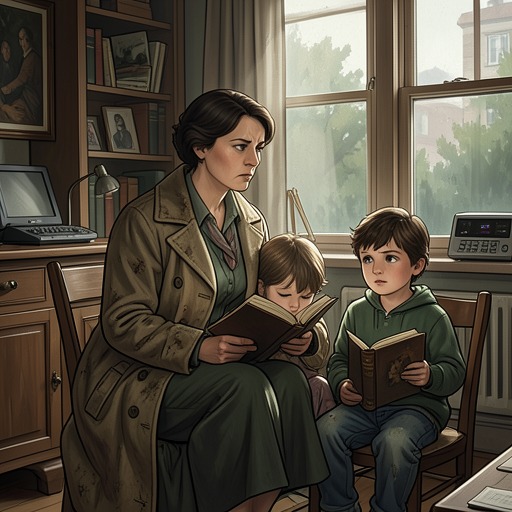
Edwina’s estrangement from Emma
A Woman of SubstanceEdwina’s estrangement from Emma grew out of a secret Emma had kept since her daughter’s birth: Edwina was illegitimate, and her biological father was Edwin Fairley. Emma’s concealment was meant to protect her child, but it also deprived Edwina of the truth about her origins. When the secret surfaced through a copy of her birth certificate, Edwina rejected Emma and left home. The separation endured into Edwina’s adult life, despite Emma’s continued financial support and hope that they might one day reconcile.
The secret behind the distance
Emma’s attachment to Edwina began in circumstances that left little room for an ordinary mother-daughter life. Still a young woman, Emma told Edwin Fairley she was pregnant. He recoiled from the prospect of marrying a servant, fearing his father’s anger and the loss of his prospects, and stayed silent rather than claim her. Emma understood his withdrawal as a repudiation. She left Fairley while pregnant, carrying the burden alone and resolved to protect the child from the consequences of her father’s refusal.
The birth registration created a practical problem as well as a private one: Emma was told that the father’s name had to be given. She would not identify Edwin. Blackie O’Neill proposed that his name be put on the certificate rather than leave the father recorded as unknown, while acknowledging that the document would still show Edwina was illegitimate. His offer gave Emma a way to provide a name without exposing the truth. Years later, when Emma accepted Joe Lowther’s marriage proposal, she told him that Edwina was illegitimate but withheld the father’s identity, repeating the explanation she had used with Blackie. Joe accepted her account without asking to investigate her past.
Secrecy did not resolve the emotional distance between mother and daughter. Emma remembered working and fighting for Edwina when she herself was still young, and loving her wholeheartedly. Yet Edwina had seemed remote from childhood onward, and Emma felt that the distance hardened into coldness as her daughter grew older. Emma’s devotion and Edwina’s reserve therefore preceded the discovery of the certificate; the revelation made an existing gulf impossible to ignore.
Discovery and departure
As a young woman, Edwina obtained a copy of her birth certificate from Somerset House after Emma refused to give her the original. She confronted her mother with the document and made clear that she understood why it had been kept from her. Emma was shaken, but Edwina would not hear an explanation. She treated the concealment as a betrayal and emphasized the humiliation of being illegitimate, rather than accepting Emma’s claim that the secret had been kept for her welfare.
Emma pleaded with Edwina to stay and talk, saying she wanted her daughter to understand her reasons and forgive her. Edwina refused. She announced that she would spend Christmas with Cousin Freda in Ripon and then attend the finishing school in Switzerland that she had previously asked to attend. She also demanded that Emma arrange her place and continue her allowance. Emma insisted that she had never intended to deprive her of anything, but the assurance did not change Edwina’s decision. At the door, Edwina declared her hatred and said she would never return. She left, and the family Rolls-Royce carried her away to the railway station.
Emma had dreaded the confrontation for years and believed that revealing the truth would cost her what little affection Edwina had for her. After the departure, she wondered whether she should disclose that Edwin was Edwina’s real father, but recognized that knowing his identity would not undo the humiliation Edwina felt about her birth. She chose not to add that disclosure in the immediate aftermath. Her hope that they might talk after Christmas briefly rallied her; finding Edwina’s room emptied of clothes and the car gone, she understood that reconciliation might not come. She was left grieving both the separation and her daughter’s pain.
A lasting, managed separation
The rupture did not lead Emma to withdraw material support. After two years at finishing school, Edwina settled in a Mayfair flat and entered a lively social life among upper-class friends. Emma did not restrict her spending and established a substantial trust fund that gave her an independent annual income. Winston Harte managed Edwina’s financial affairs on Emma’s behalf, becoming the narrow channel through which mother and daughter remained connected. Emma longed to bring Edwina back into the family, but judged that any first approach would have to come from her daughter.
Edwina later married the Earl of Dunvale, who was twenty years older. Winston reported that she seemed deliriously happy, though he could not tell whether her happiness came from her new title and place in an old Anglo-Irish family or from love for her husband. Emma sent a wedding present. A year later, Edwina gave birth to a son, Anthony George Michael, who as firstborn held the courtesy title of Lord Standish and stood to inherit the earldom. Emma congratulated her and sent another gift. Edwina replied with a courteous but cool note of thanks. Emma took the civility as a possible opening and hoped it might eventually lead to reconciliation, asking Winston to help if he could.
The meaning of the estrangement
The relationship’s central paradox is that protection and concealment became inseparable. Emma’s decision to hide the identity of Edwin Fairley, and to keep Edwina from knowing the circumstances recorded in her birth certificate, was an attempt to shield her daughter from stigma and preserve her place in the family. But Edwina experienced the withheld truth as a denial of her right to understand her own origins. The protective intention could not control the effect of the secret once Edwina discovered it for herself.
Emma’s response after the break combined grief with restraint. She continued to provide for Edwina, sent congratulations and gifts, and held open the possibility of renewed contact, but refrained from forcing reconciliation. Her hope persisted even as their connection narrowed to financial arrangements and formal notes. The estrangement thus remained unresolved: it was neither repaired by Emma’s generosity nor erased by Edwina’s later marriage and motherhood, but carried forward as the most painful distance in Emma’s family life.