Elizabeth’s gold locket
A Woman of SubstanceElizabeth’s gold locket is a concealed heirloom that turns an intimate object into evidence of a hidden love story. Emma Harte finds it among her mother’s possessions, and its initials and date prompt questions the family has left unanswered; later, a cave inscription makes those marks newly legible as part of the history between Elizabeth Harte and Adam Fairley. The locket’s significance lies not only in what it holds, but in how a secret preserved in a private keepsake returns to affect the lives of the next generation.
Discovery and physical details
Emma discovers the locket while searching the small wooden box in her mother’s trunk. The box contains modest jewellery, including the garnets Elizabeth wore on important occasions, but the locket has been tucked beneath the loose velvet lining at the bottom. Its concealment distinguishes it from the family’s ordinary keepsakes: Emma has seen the box before, yet has never noticed this piece or seen her mother wear it.
The locket is old, finely worked, and made of real gold. Emma initially cannot open it, so she fetches scissors from her sewing box and uses them to prise it apart. Inside, one side holds a photograph of Elizabeth as a girl. The other seems empty until Emma sees a small lock of fair hair beneath the glass. She wonders whose it is, but the covering is too firmly set for her to investigate without risking damage. The hair’s owner remains unidentified in the evidence surrounding the object.
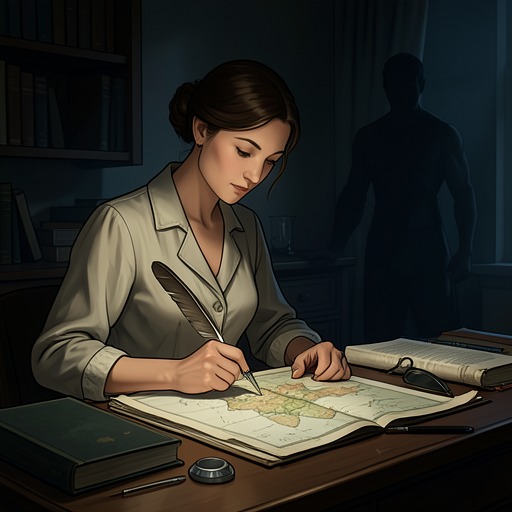
On the back, a faint engraving has nearly worn away. Emma carries a candle closer and reads the letters and date as “A to E—1885.” The notation makes the locket more than a keepsake: it appears to record a connection between two people at a particular time. Emma knows her mother was fifteen in 1885 and supposes that E stands for Elizabeth, but cannot identify A. She considers asking her father, then puts the locket back under the velvet without doing so. Her decision leaves the question open rather than bringing it into the household’s conversation.
The initials and the cave inscription
The locket’s private clue becomes newly charged when Emma and Edwin Fairley explore the cave beneath Ramsden Crags. Searching with a candle, Emma finds names scratched on a smooth patch of wall. Several forms of Elizabeth’s name run down the stone; beside them, the much larger name ADAM appears above a heart pierced by an arrow and marked with the initials A E.
The carved initials recall the engraving Emma has just discovered on the locket. She remembers the hidden object and recognizes the possibility that the initials refer to her mother and Edwin’s father, Adam. The recognition unsettles her: a concealed inscription in a jewellery box and a declaration on a cave wall point toward the same private history. Neither clue alone supplies a full account, but together they make the locket’s A and E far less obscure. Its discovery thus changes Emma’s understanding of her parents’ past before she has an explanation from either family.
The cave scene also gives the locket a counterpart in place. The object preserves its message in miniature, held close to the body and hidden from ordinary view; the cave inscription makes affection visible on a wall, among the traces Emma and Edwin are searching for. Emma’s discovery links these separate records through her memory of the locket. The object is therefore part of the plot’s chain of recognition: it enables her to read the cave’s initials not as decoration, but as evidence bearing on the history of both families.
A family history passed between generations
The locket’s significance belongs to a wider story that is eventually carried forward through another keepsake, Adam’s painted pebble. Years later, Edwin gives the pebble to Adam, explaining that he found it long ago and knows his father painted it. Adam recognizes the painted face as resembling Olivia Wainright. When the story later reaches Emma through Jim Fairley, however, Jim explains that Adam had given him the stone to pass to her: it depicts Elizabeth, not Olivia, as Adam had once believed.
That later disclosure does not identify the lock of hair inside the locket or directly explain why Elizabeth concealed it. It does, however, confirm the importance of the connection suggested by the locket and the cave. Adam painted Elizabeth’s portrait, while the cave preserves his name alongside hers; the gold locket’s dated initials belong within this same history. Together, the objects show how the past survives in partial, easily misread forms until someone passes them on and supplies the missing account.
Jim also conveys Adam’s understanding of the families’ repeated disappointments in love. He tells Emma that the Harte women and Fairley men have long been drawn together yet crossed in love, and that Adam wanted the pattern to end with the younger generation. Jim’s message turns preserved family memory toward a present choice: Emma has already relented about Paula and Jim’s relationship, and Adam’s keepsake arrives as an appeal to let the two families unite. The locket is not itself the cause of that reconciliation, but it is an early material trace of the concealed history that makes the appeal meaningful.
Secrecy, memory, and meaning
The locket’s narrative force comes from the gap between possession and knowledge. Elizabeth kept it hidden beneath velvet; Emma finds it but cannot interpret its initials; and the later cave discovery gives those initials a context without immediately resolving every mystery. Its faded engraving and protected contents make the object a fragile archive, preserving a trace while withholding a complete explanation.
As the story moves across generations, the locket also anticipates the way family history is recovered through material objects and entrusted accounts. Emma first encounters an unanswered question about her mother in the quiet privacy of the trunk; much later, Jim brings her Adam’s painted pebble and the explanation Adam wished her to hear. The locket’s decisive significance is this movement from concealment to recognition: it gives physical form to a past that family silence has not erased, and helps connect Emma’s personal history to the continuing ties between the Hartes and the Fairleys.