Emma and Arthur Ainsley’s failed marriage
A Woman of SubstanceEmma and Arthur Ainsley’s failed marriage is less a single rupture than a relationship Emma keeps in place while it serves stability and leaves her free to build her business. When she becomes pregnant by Paul McGill, the arrangement turns into a conflict over paternity, respectability, and control; Emma ultimately secures a divorce and brings her children into a home shaped by her life with Paul.
The circumstances surrounding marriage
Emma’s earlier experience of pregnancy outside marriage helps explain the care with which she later manages her children’s status. When she was a young servant, Edwin Fairley recoiled from her pregnancy, silenced the marriage proposal he had considered, and let class difference determine his choice. Emma left Fairley without marrying him. The question of her daughter’s birth registration then became practical as well as personal: the law required the father’s name. Blackie O’Neill proposed putting his own name on the certificate rather than leaving the father recorded as unknown, while Emma refused to name the real father. She later told Joe Lowther that Edwina was illegitimate but withheld the father’s identity; Joe accepted her past without demanding further explanation. These episodes establish how marriage, birth records, and a man’s public name could shape the security available to Emma and her children.
Arthur’s marriage to Emma belonged to a later stage of her life, but it did not give her the intimacy she wanted. By the time she was discussing the relationship with Frank Harte, she acknowledged that she had grounds for divorce and nevertheless did not want the upheaval yet. Arthur did not interfere with her or with the business, and she said she was reasonably content with that degree of independence. Frank countered that ledgers could not provide warmth or love. Emma answered with humor, but his challenge exposed the difference between a marriage that accommodated her work and one that fulfilled her emotionally.
Distance, discretion, and competing attachments
Years later, during dinner with Paul, the question of why her marriage had gone wrong unsettled Emma. She gave incompatibility as her answer, describing Arthur as handsome and charming but also weak and vain. Paul asked whether she intended to divorce; she said not at that moment, then asked whether he would. His response revealed that he wanted a divorce from Constance McGill but faced serious difficulties connected to her alcoholism and deteriorating condition. The conversation placed Emma’s stalled marriage beside Paul’s unresolved one: neither relationship could be ended simply by desire, even as the two renewed their bond.
Emma and Paul lived together discreetly, mindful of her children and her responsibilities as a mother. Paul was struck by the contrast between Emma’s fearlessness in business and her concern about how their private arrangement would be judged. Emma expected that divorce would free her from such concern, but for the time being she kept her relationship with Paul circumspect. Her restraint reflects the force of social judgment in her life, even when wealth and authority gave her unusual room to maneuver.
Pregnancy and the struggle over recognition
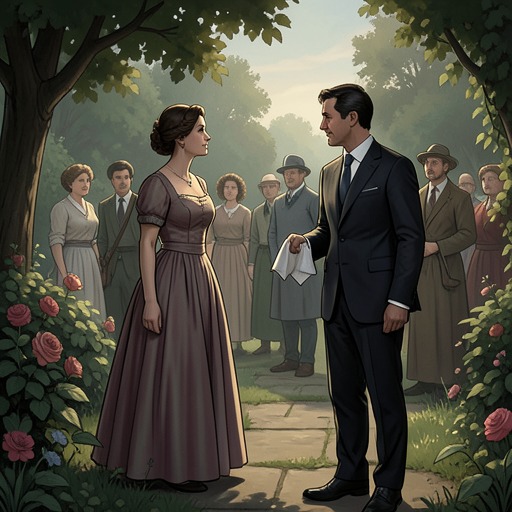
When Emma told Arthur she was almost four months pregnant, she spoke evenly and made clear that she intended to have the child and that Arthur would recognize it as his. She did not identify the father. Arthur’s first response was laughter and a mocking assumption that she had taken a lover; he asked who the man was, but Emma refused to tell him. The exchange turned a private relationship into an explicit contest over what Arthur would acknowledge and what Emma would keep undisclosed.
Emma backed her demand with documents. Arthur seized them, read them, and tore them up, throwing the pieces into the fire. Emma let him finish before revealing that the papers were copies and that she had kept the originals safe. She warned that she would use them and go to his father if Arthur forced her hand. The scene shows her converting documentation into leverage: destroying what he held could not undo the evidence she controlled. The pregnancy and the child’s recognition were not left to Arthur’s goodwill.
Divorce and the household after Arthur
The divorce came after Arthur inherited from his father, Frederick Ainsley. He agreed to let Emma divorce him on the grounds of adultery, but his apparent gallantry was not a simple gift: Emma had secured it by paying him ten thousand pounds. Once the decree nisi was granted, she brought the twins, Robin Harte and Elizabeth Harte, to live with her in Belgrave Square. Arthur did not object, and Emma welcomed the chance to raise them without his influence. Kit Harte, still at boarding school, spent his holidays with her; he approved of Paul and felt no grief at Arthur’s departure from his life.
Emma also reorganized her business around the change. Winston Harte took charge of the Yorkshire shops and mills, while Emma supervised the northern operations from the Knightsbridge store and travelled to Leeds monthly to work with him. Paul, meanwhile, became the respected and much-loved head of the blended household, including children by different fathers. Emma and Paul remained discreet in front of the children, but over time she grew less troubled by the unconventional arrangement. Arthur’s marriage thus ended not only in legal separation but in a reordering of family life and business: Emma exchanged a marriage that left her independent but emotionally unfulfilled for a household in which Paul became a father figure, while she retained command of her enterprises.
Significance
The marriage’s failure demonstrates that Emma’s practical tolerance of Arthur was conditional, not a surrender of authority. She could delay divorce when she judged upheaval inconvenient, insist on recognition when pregnant, preserve evidence when Arthur tried to destroy it, and negotiate the terms of separation once circumstances shifted. Those choices do not erase the social and legal constraints surrounding marriage, adultery, and children’s legitimacy; they show Emma learning to use the limited instruments available to her. In contrast to her earlier abandonment by Edwin, her later confrontation with Arthur ends with Emma controlling the evidence, the settlement, and the shape of the household that follows.