Fairley Hall
A Woman of SubstanceFairley Hall is the Fairley family’s great country house, but its importance in the novel lies in more than its scale or wealth. It stands at the center of Emma Harte’s childhood as a servant, where the boundaries between privilege and labor shape her daily life; later, it becomes the property through which she confronts the family that once held power over her. Its eventual demolition transforms the site from a source of painful memories into a public park, making the house’s history part of Emma’s larger reversal of the social order that defined her youth.
Setting and architecture
Fairley Hall stands in a sheltered valley near Fairley village, within the foothills of the Pennines. From a distance, the house is partly hidden by a copse of tall oaks. Its chimneys and spires rise above the trees, while the surrounding valley appears quiet and orderly. This first view presents the estate as secluded from the village, a separation that reflects the economic divide between the Fairleys and the people whose labor supports their way of life.
The Hall is large and richly furnished, but its design does not convey simple elegance. The oldest part is described as a square, dominating central block, probably dating from the late 1790s, with a cupola and spires at its corners. Later wings extend from either side in competing interpretations of Regency and Victorian styles. To Blackie O’Neill, the additions have produced a building without proportion or symmetry: a mansion whose wealth is unmistakable but whose architectural parts fail to form a coherent whole. His comparison with the more balanced Georgian houses he knows from Ireland makes his response a judgment about taste as well as size.
As Blackie and Emma Harte approach the house, its scale takes on a more threatening character. The dark stone walls and irregular additions seem at odds with the carefully planned gardens around them. Blackie senses a hostility in the building and imagines those who enter it as unable to leave its influence behind. His impression anticipates the house’s role in Emma Harte’s story: the Hall is not merely a backdrop to her service but a place whose social and emotional pressures continue to shape her long after she departs.
The estate and the surrounding economy
The setting connects the Hall to a wider landscape shaped by agriculture and textile production. Fairley village lies in the Pennine region, where the conditions of the West Riding support the manufacture of cloth. The area's millstone grit soil is poor for crops, but the land sustains sheep, while streams provide soft water that is suitable for working fibres. Wool and soft water are identified as two essential resources for textile making. This regional geography helps explain how an industrial economy could develop alongside the Fairleys’ country estate.
That prosperity is sharply uneven. Through her work at Fairley Hall, Emma Harte observes the contrast between the family’s comfort and the workers’ unremitting toil. The Fairleys’ privileged way of life is sustained by labor whose hardship remains largely removed from their view. The Hall’s separation from village life is therefore both physical and economic: the estate seems self-contained, but its wealth depends on a working population living under very different conditions.
The contrast is also present in the domestic spaces themselves. At home, Emma Harte keeps a poor, damp room meticulously clean. The cotton curtains are washed and starched; the few rustic furnishings are polished with beeswax; homemade rag rugs cover part of the worn floor. The bed is the one neglected feature, because she can change its linen only once a week, when her work at the Hall permits her to return home. This careful upkeep contrasts with the abundance of possessions in the house where she serves, and makes visible how much effort ordinary cleanliness demands when time and resources are scarce.
A workplace and a divided household
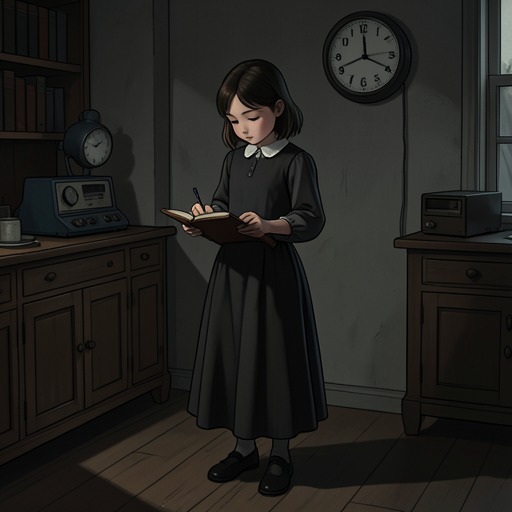
Fairley Hall is one of the settings of Emma Harte’s domestic labor. The work extends beyond cleaning and serving: she dusts the crowded rooms and, at home in the evening, mends clothing belonging to the household. A room full of decorative objects can take considerable time to dust, while the servants’ labor keeps the rich interiors presentable. Emma Harte is not simply surrounded by the Fairleys’ wealth; she is among those made responsible for maintaining its appearance.
The house also gives her limited opportunities to act independently. When Olivia Wainright arrives and takes an active interest in the household and its servants, conditions downstairs improve. Olivia’s attention gives Emma Harte some protection from Murgatroyd’s mistreatment, and he no longer strikes her after Olivia’s arrival. When Emma Harte takes on duties attending Adele Fairley, her closer contact with her mistress gives her a small measure of autonomy in how she manages that work. The change does not erase the hierarchy of the house, but it alters Emma Harte’s daily experience within it.
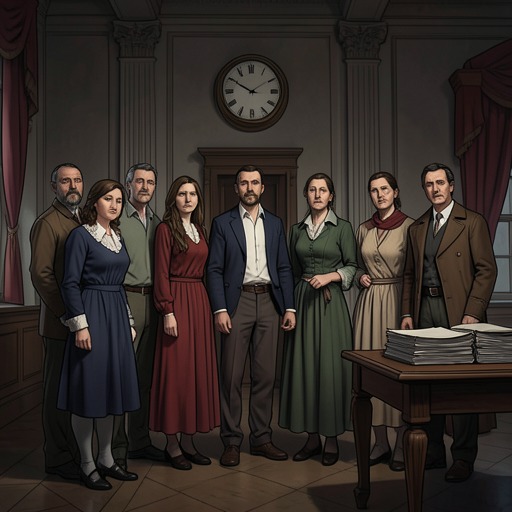
The rooms encode other divisions among the family. Adam Fairley has not entered Adele Fairley’s room for ten years, and his continued refusal to cross its threshold conveys the estrangement between them. In another scene, Adele descends the grand staircase with Emma Harte supporting her arm; the polished banister, carved newel post, and converging flights make the movement through the house ceremonial, even though it is also physically demanding. These spaces are used by the family and the servants alike, but not on equal terms: the house organizes who is served, who is watched, and who can claim authority within its rooms.
For Emma Harte, the Hall is consequently both grand and oppressive. Its high ceilings, large rooms, corridors, and heavy furnishings contribute to her sense of fear and confinement. The impression of seclusion is reinforced by the Hall’s position beside the village: Emma Harte experiences the estate and village as a boundary that shuts her off from the wider world. The building’s scale does not offer her freedom; it intensifies her awareness of how little control she has over her circumstances.
Memory, departure, and return
The Hall’s emotional meaning changes with Emma Harte’s distance from it, but it remains associated with decisive moments in her life. Before leaving, she packs the few possessions she keeps there, including clothing, jewelry, a small vase of dried heather, and a prized green-glass brooch. The disappearance of these belongings from her attic room makes her departure tangible: the servant who had worked within the house is preparing to take the small remnants of her life elsewhere.
The estate is also the scene of a fire in the Fairley mill warehouse. Edwin Fairley escapes with Jack Harte, who collapses outside after they leave the burning building. Edwin tries to help him, while others work to control the fire. The incident binds the family’s industrial property to the personal history unfolding around Fairley Hall: the Fairley name encompasses not only the country house but also mills, warehouses, and the laboring world that sustains the family’s standing.
Years later, the Hall becomes the setting of Emma Harte’s return as its owner. A new butler admits her party, and Gerald Fairley encounters her in the house. Rather than leave, Emma Harte asserts her right to be there and discloses that she controls Deerfield Estates, Procter and Procter, and the General Retail Trading Company. Through those holdings, she owns the Fairley mills as well as the Hall. The reversal is material as well as personal: the former servant now commands the estate, and Gerald, once protected by his family’s position, must face the consequences of the power he had assumed was his.
Emma Harte explains that her campaign against the Fairleys began after Gerald attacked her thirteen years earlier. She also distinguishes her role from his responsibility for the family’s decline, telling him that his own conduct helped bring about his downfall. The confrontation gives the Hall a different function from its earlier one. It is no longer only the place where Emma Harte was subject to the Fairleys’ authority; it is the place where she makes that authority visibly answer to her.
Demolition and significance
After taking control, Emma Harte orders the Hall torn down. On a later visit in May, she sees the bare ground where the house and stables once stood. The rose garden has also disappeared, and not a brick remains. The cleared site brings relief: the building can no longer confront her as a surviving structure tied to childhood humiliation and heartache. Her response marks a change in her relation to the past, from living under its continuing weight to being able to decide what occupies its former ground.
Emma Harte plans to make the site a park for the villagers and name it after her mother, Elizabeth Harte. The decision redirects the estate’s land toward public use, replacing the private house that represented the Fairleys’ separation from village life with a space intended for the community. It does not undo the poverty or labor that had sustained the old order, but it gives the transformed site a different purpose and meaning.
Fairley Hall’s trajectory—from wealthy residence, to workplace and emblem of exclusion, to an estate Emma Harte controls and finally removes—gives the building a central role in the novel’s account of class, memory, and power. Its architecture is marked by accumulation without harmony; its household is divided by rank; and its wealth rests on work largely kept out of sight. In the end, Emma Harte’s most decisive act toward the Hall is not to preserve it as a monument to her victory, but to clear it away and dedicate its land to the people who had lived in its shadow.