Fairley village
A Woman of SubstanceFairley village is the settlement at the heart of the social and emotional geography of Emma Harte’s early life: a place of poor cottages and mill labor beneath the moors, within sight of Fairley Hall’s wealth but far from its comforts. The contrast between village hardship and the Fairleys’ privilege helps form Emma’s conviction that money means safety and power. Later, the surrounding moors return in memories of love, friendship, and endurance, making the village more than a point on the route between home and work: it is the landscape against which Emma measures both her beginnings and the life she builds.
Setting and surroundings
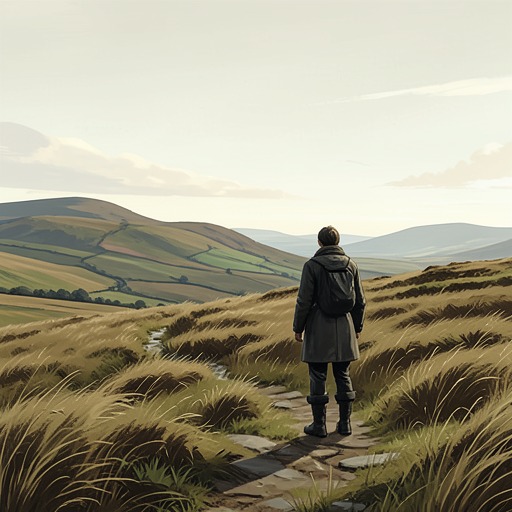
Fairley village lies high in an isolated fold beneath sweeping moors. In winter, the landscape around it is severe: frost hardens the paths, mist obscures the ground, and wind from the North Sea crosses the exposed hills. The moorland stretches towards Leeds, broken by crags, scattered trees, and ruined cottages. The village’s lights offer a small sign of human habitation in terrain otherwise described as empty and inhospitable.
The village is connected to Fairley Hall by a narrow, winding road across the hills. For Emma, who works at the Hall, this is the quickest route, and she makes the journey in every season and at all hours. On an icy February morning in 1904, she sets out before dawn and climbs from the settlement towards Ramsden Ghyll and the higher moors. The route makes the distance between village and Hall tangible: she leaves her family and her ill mother behind, crossing an exposed landscape to reach a workplace where the comforts of the wealthy are set against the conditions of her own life.
Cottages, family life, and mill work
Emma and Frank live in a small cottage on Top Fold, a high, secluded cul-de-sac in Fairley village. Its meagre garden has frozen bushes and hard, bleak soil. Before dawn, Emma leads Frank out into the cold, sends him to visit their aunt Lily, and reminds him that he must not miss the mill’s opening: workers locked out until eight would lose wages. Even in this brief instruction, the village’s daily pressures are clear. Family care must be fitted around strict work hours, and a child’s early-morning errand is measured against the threat of lost pay.
Below the village, the Fairley mill prepares to open as the settlement wakes. Its whistle will summon men and women to another day of combing raw wool and spinning woollens and worsted cloth for shipment around the world. The scale of that trade contrasts with the smallness of the workers’ lives: the cloth travels widely, while the people who make it return to exhausting labor and homes with few protections from the weather. The mill is both a source of employment and a daily reminder of the unequal system on which Fairley’s prosperity rests.
Class divisions and Emma’s ambitions
Working at Fairley Hall gives Emma a close view of the gulf between the village and the estate. She observes that the Fairleys enjoy luxury and isolation, while workers’ toil supports their comfort. The difference is not merely in the buildings or possessions; it is in who has choices and who remains vulnerable to the decisions of others. Emma connects her family’s need for money—including her hope that her mother might regain her health—to a broader understanding of how poverty exposes people to the whims of the rich.
From these observations, Emma forms a practical, increasingly ambitious idea of power. Money can buy necessities, but it can also make a person safer and less dependent; in her view, even justice and liberty seem attainable to those who can pay. She rejects her father’s suggestion that wealth depends on birth or luck. Instead, she imagines that a brilliant plan and harder work might allow someone to make a fortune. Fairley village is thus the starting point of her economic ambition: the place where the inequity she witnesses becomes a problem she intends to overcome.
The village in memory and later life
The moors above Fairley village remain a place of profound personal meaning for Emma. During a later illness, as she falls asleep, she dreams herself back there at sixteen, running towards the Top of the World and meeting Edwin Fairley near Ramsden Crags. In the dream, the youthful landscape and their shared refuge on a ledge interrupt the present’s threat of death. The episode makes the moors a setting of remembered intimacy as well as a physical route; the village below is part of the remembered world from which that younger Emma once climbed.
The same heights also anchor Emma’s long friendship with Blackie O’Neill. Many years later, the two recall that they first met on the moors above Fairley village. Their shared history gives the landscape a meaning that reaches beyond Emma’s relationship with Edwin: it is also the place associated with a friendship that lasts through the changes of her life. In both recollections, the moors preserve an earlier point of connection even as time carries the characters far from their beginnings.
Community and significance
Fairley village remains part of Emma’s later sense of responsibility to the area. At Pennistone Royal, Hilda, a local woman who began working for Emma after the house was restored, speaks proudly of Emma’s charitable work. She recounts that Emma supported her son Peter’s university education and established scholarships for talented children from Pennistone and Fairley; she also praises the large sums given through Emma’s Foundation. These claims come through Hilda’s admiring account, but they show how Emma’s later wealth is connected in local memory to practical support for education and need.
The village therefore holds together the conditions Emma escapes and the community she continues to recognize. Its cold cottages and mill labor reveal the class inequalities that sharpen her desire for wealth, while its people and surrounding landscape remain part of the personal history to which she returns. Fairley village is the ground of her early vulnerability, the vantage point from which she sees privilege, and a lasting reference point for memory, friendship, and local obligation.