Harte’s department store
A Woman of SubstanceHarte’s department store was Emma Harte’s flagship retail venture in Leeds and a practical expression of her belief that merchandising, atmosphere and service could shape what customers bought. She acquired the former Lister’s in late 1912, renovated and modernized it with Blackie O’Neill’s assistance, and opened it with fanfare in January 1913. Its success transformed a once-conservative store into a conspicuous new presence in the city’s retail life.
From Lister’s to Harte’s
The store’s transformation was visible before a customer entered. On Commercial Street, the name E. HARTE appeared in silvery metal letters above the entrance, set against royal-blue woodwork. When Edwin Fairley first encountered it, the name stopped him: he initially thought it a coincidence, then returned to find out who owned the establishment. The doorman’s account confirmed that the proprietor was Emma, making the building a meeting point between her public success and the past she had left behind.
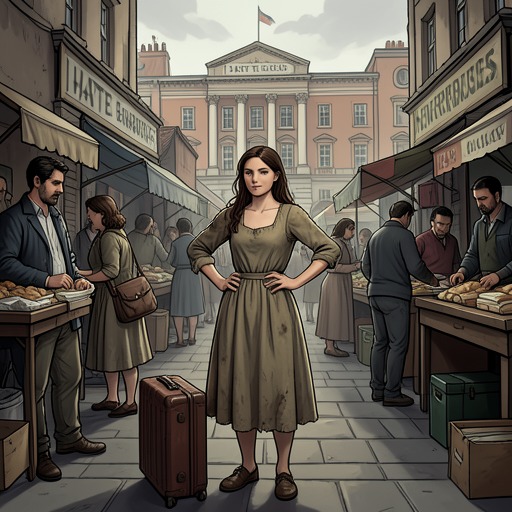
The store’s atmosphere deliberately broke with the conservative character associated with Lister’s. Glittering mirrors, plush carpeting, harmonious lighting and perfumed air gave the interior a sense of glamour and exclusivity. Emma’s advertising brought people through the doors, including visitors who came to inspect and criticize the ambitious young woman’s lavish new venture. The surroundings encouraged them to stay, browse and spend: the environment itself became part of the selling strategy.
Retail design and customer service
Emma treated the presentation of goods as a central part of the store’s appeal. Carefully arranged displays drew attention to merchandise that combined quality and style with reasonable prices. Salesgirls received rigorous training in what Emma called the art of the understated sell: persuasion through courtesy and restraint rather than an overt sales pitch. The approach helped make fashionable goods accessible to customers from Leeds and nearby towns while preserving the store’s polished character.
A second-floor café, the Elizabethan Gazebo, extended the visit beyond shopping. Emma furnished it in the style of an English country garden, with pastoral wallpaper, white-painted trellises, artificial topiary and birdcages holding finely made birds. Waitresses wore pale-green uniforms with frilled white organdy aprons and caps. Its calm setting, attentive service and simple, appealing food made it a fashionable place for coffee, luncheon and afternoon tea. Customers might arrive to meet one another and leave with purchases, as Emma had anticipated. The café was an unusual department-store innovation in Leeds; competitors copied it, but their more ornate imitations did not dislodge the original’s established clientele.
Small services reinforced the same attention to experience. Harte’s offered free gift wrapping in silver paper tied with silver ribbon and decorated with a spray of silk violets, a distinctive detail inspired by Emma’s memory of a birthday gift from Blackie. A uniformed doorman in deep royal blue and gold braid helped with parcels and opened carriage and motorcar doors. These gestures turned courtesy into part of the store’s identity, not an incidental extra.
Delivery carried that service beyond the shop itself. Emma initially arranged for goods to be delivered to customers’ homes three times a week, encouraging them to rely on Harte’s for a wider range of purchases and in greater quantities. Demand grew so sharply that she revised the schedule: the royal-blue vans went out five, and sometimes six, days a week. The expansion shows how the store’s success depended not only on its elegant rooms but on a distribution system responsive to customer habits.
Business pressures and wartime operation
The store formed part of a broader commercial network that required close attention to credit and cash flow. Emma’s ledgers showed that she was owed almost £180,000 by stores in London, Manchester and Scotland that regularly bought from her wholesale warehouse. Although she expected payments to begin arriving, overdue accounts approaching ninety days prompted her to prepare to press delinquent customers. Her ordinary terms were thirty to sixty days, with longer credit sometimes extended to valued customers; business pressure now threatened to end that flexibility.
In 1914, financial instability sharpened her calculations. A newspaper report described the London Stock Exchange closing and the bank rate rising from 4 to 8 per cent on July 31. Emma regarded the measures as signs of an approaching crisis and war, and the higher borrowing cost led her to reject a bank loan she had originally considered for a new venture. The store thus stood within a business exposed to wider financial events, even as Emma continued to make decisions across her enterprises.
During the First World War, Harte’s remained steady, though trade had fallen somewhat. Emma rationed the stock at Gregson Warehouse and found new sources of supply, while her other operations, including Layton’s mill and the clothing factory, took on major government work. The factory’s production shifted entirely to uniforms, and Emma and David Kallinski suspended the Lady Hamilton Clothes line at the war’s outset. The store’s continued stability belonged to this larger pattern of adaptation: retail, wholesale and manufacturing operations were managed together as wartime demand and shortages changed the conditions of business.
Place in Emma’s enterprise
Harte’s department store made Emma’s commercial methods visible to the public: modern presentation, measured selling, distinctive services and attention to delivery all worked together to attract and retain customers. Its success also carried a personal charge. For Edwin, the letters above the Commercial Street entrance disclosed that the proprietor was the woman he had once known as Emma; for Emma, the store’s name and reputation marked an identity established on her own terms. More than a shop, it was the public face of a business built through design, discipline and the ability to turn small customer-facing details into lasting advantages.