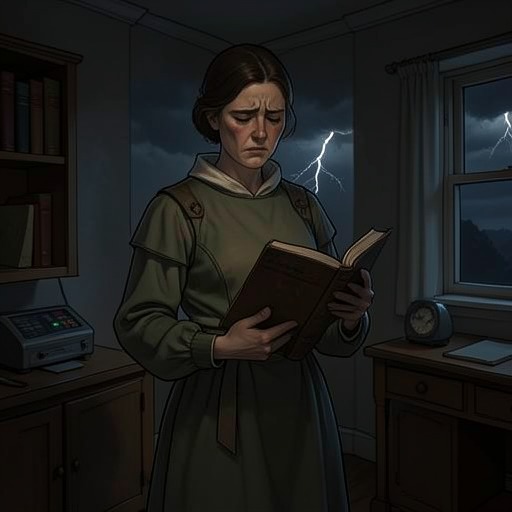
Jack Harte’s bereavement
A Woman of SubstanceJack Harte’s bereavement after Elizabeth Harte dies is presented not as a moment that passes with the funeral, but as a grief that remakes his daily life and burdens the family around him. In the bedroom where Elizabeth dies, Jack cradles her, carries her back to bed, and comforts Emma Harte; months later, he is still physically diminished and emotionally exposed. His loss becomes both private suffering and a pressure on Emma, who postpones her plans to leave for Leeds because she believes she must keep the family together.
The death of Elizabeth Harte
As Elizabeth lies gravely ill, Jack lifts her from the bed and carries her to the open window. She looks towards the moors and names them “The Top of the World”; then she falls back in his arms and becomes still. Jack cries out, cradles her body, and rocks her. The physical closeness that had sustained him through her illness becomes an immediate encounter with her death: he carries her back to the bed, covers her, arranges her hands, smooths her hair, and kisses her cold lips.
Emma runs to her mother, and Jack tells her, “She’s gone, lass.” Father and daughter then cling to one another in shared anguish. Jack tries to console Emma by saying that Elizabeth is free at last from suffering, but his own sobs break through. The scene gives his bereavement a double burden: he is mourning his wife while also attempting to comfort their daughter. His words about Elizabeth’s release express a way of bearing the loss, not an escape from it; the narration leaves him and Emma locked together in grief.
Grief in the months after the loss
Five months later, Jack strives to conceal how much he is suffering, but Emma watches the effort fail. He hardly eats and has lost weight; his once powerful body seems to have shrunk. At times, when he does not know she is observing him, tears fill his eyes and his drawn face reveals his sorrow. The contrast between his attempt at concealment and these involuntary signs makes grief an ongoing physical condition, not simply a feeling he can put away.
Emma’s own grief rises in response, yet she believes she has to control it because “Someone had to hold the family together.” Her attention is fixed on her father’s withdrawal, which seems more pronounced than the apathy that had affected him before Elizabeth’s death. Winston Harte’s stealthy departure the previous week adds a fresh cause for despondency. The passage thus shows bereavement accumulating with family strain: Jack’s loss is not isolated from the household’s other troubles, and Emma increasingly fears for him as the days pass.
Remembrance and altered family roles
One evening, after returning from the pub more intoxicated than usual, Jack is unsteady and his eyes are glazed. When he looks at Emma, he remarks that she sometimes resembles her mother. He notices the shape of her face and mouth, and says she is becoming increasingly like Elizabeth as she grows older. The comparison makes resemblance a form of remembrance: Elizabeth is absent, but Jack recognizes her in their daughter’s changing features.
Jack also recalls Elizabeth as the most beautiful young woman in Fairley and tells Emma that she is beautiful like her mother, though made of sterner stuff. He contrasts Emma’s strength with Elizabeth’s delicacy, then kisses Emma on the forehead and says goodnight. His affection briefly connects the surviving family across the loss, but it does not relieve his grief. Emma sees him move away looking so diminished that she wonders whether he will ever again be called Big Jack. She recognizes him as a lost soul without Elizabeth and believes he will mourn her until his own death.
Consequences for Emma and the household
Jack’s bereavement helps explain why Emma postpones her plan to go to Leeds and make her fortune. She has saved more than five pounds, enough to begin the plan, but says that now is not the time to leave. She has also promised her mother that she would look after the family and feels honour-bound to keep that promise. Her decision is therefore made under the pressure of both ambition and care: the prospect of independence remains, but Jack’s grief and Winston’s departure make leaving feel premature.
The domestic consequences are practical as well as emotional. Emma works late repairing and altering clothes from Fairley Hall because the extra payment matters to her, continuing even as her eyes tire and her fingers ache. Her labor does not cure her father’s sorrow, which she knows she cannot ease, but it shows the role she takes on while he grieves: she keeps working, watches over him, and postpones her own departure. Jack’s loss remains unresolved, while the family’s need for Emma’s steadiness shapes the choices she can make.