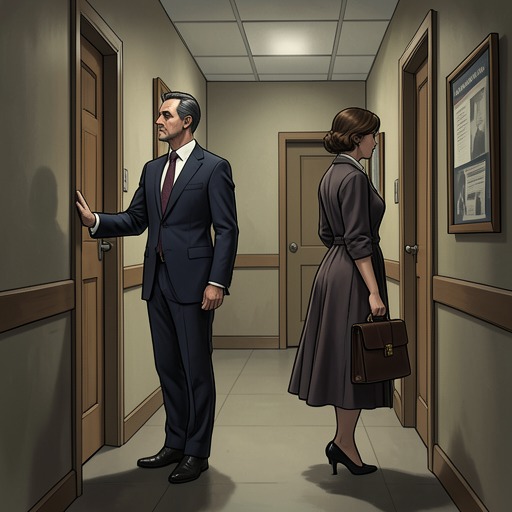
Marion Reese
A Woman of SubstanceMarion Reese is the secretary whose concealed interference helps explain the years of separation between Paul McGill and Emma Harte. Introduced through Paul’s later account to Emma, she appears first as a trusted colleague and confidante, then as the person who secretly blocked their correspondence in the hope of keeping Paul in Australia.
Position in Paul’s life
Marion had worked in Paul’s family’s Sydney office. His father had befriended her as a young girl and trained her to become his private secretary during Paul’s absence. When Paul returned to Australia in 1919 after demobilization, his father was seriously ill and the business demanded his immediate attention. Marion guided him through its affairs and filled him in on what had happened; Paul later described relying heavily on her amid long hours and heavy responsibilities.
She had been close to Paul’s family before the war. Paul regarded her as a friend and valued employee, almost an older sister, and she was about four years his senior. He says that he had never encouraged her romantically and that nothing had ever passed between them. That trust made her both a crucial support during his difficult return and a confidante to whom he disclosed his plans for the future.
The intercepted correspondence
After a late work session, Paul took Marion to supper and, having had too much to drink, told her about Emma and his intention to marry her once he had resolved his marital problems. Marion appeared understanding and promised to help him put the business in order so that he could travel to London. Paul says he did not know then that she had loved him for many years or that his plans meant losing him to another woman.
As Paul reorganized the business and wrote to Emma, Marion confiscated the letters rather than posting them. When Emma stopped replying after her first letter, Paul became puzzled and anxious. He also sent two cablegrams asking her to let him know she was well; Marion destroyed them instead of transmitting them. His account makes the silence between the lovers not a choice by either of them, but the result of a trusted secretary’s deliberate obstruction.
About a year after his return to Australia, in the spring of 1920, Paul set off for England believing that Emma would receive a cable announcing his arrival and meet his boat. Marion had withheld that message too. Paul telephoned Frank Harte and learned that Emma was on her honeymoon: she had married Arthur Ainsley one week earlier. The withheld communications had kept Paul from reaching her before that marriage, deepening the separation he had hoped to end.
Confession and consequences
Paul says Marion initially denied taking the correspondence when he confronted her after returning to Sydney, but eventually confessed. She explained that she had hoped to sabotage his romance so that he would not leave. Emma recognized the consequence with bitter clarity: Marion’s plan had succeeded, and years had been lost.
Paul kept a letter from Marion’s solicitors acknowledging her guilt, on the understanding that he would not prosecute her after threatening to do so. He showed the letter to Emma as proof of his account and returned to her the letters Marion had kept in both directions. Emma read the document and said she would have believed him without it, but its existence gave tangible confirmation to a story she might otherwise have found incredible. Paul had fired Marion immediately after her confession and did not know where she was by the time he told Emma what had happened.
Narrative role
Marion is known to the reader through Paul’s retrospective explanation rather than through a scene in which she speaks for herself. Her characterization is therefore bounded by the account he gives Emma: she was long trusted, secretly in love with him, and willing to manipulate their communications to prevent his departure. The returned letters and the solicitors’ acknowledgment support the central facts of that account, while her whereabouts and subsequent life remain unknown.
Her actions turn ordinary instruments of contact—letters and cablegrams—into instruments of separation. By revealing that Paul had written and that Emma’s replies had been withheld, the disclosure revises the meaning of their silence: each had reason to believe the other had failed to answer. Marion’s private hope that Paul would stay thus becomes a decisive cause of the lovers’ lost time, without making her motives or later fate any less limited by the evidence.