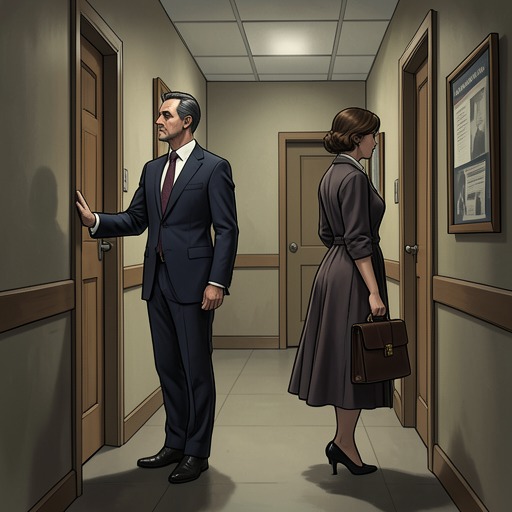
Paul McGill and Constance McGill marriage
A Woman of SubstancePaul McGill and Constance McGill’s marriage is an estranged union that has ceased to function as a partnership but continues to govern Paul’s choices. The relationship is defined by his account of years of failed efforts to help Constance, her severe decline and institutionalization, and a religious obstacle to divorce; its unresolved legal status stands between Paul and the future he wants with Emma Harte and Daisy.
Breakdown and Estrangement
Paul describes the marriage as having broken down over Constance’s drinking. She had been a heavy drinker before the war, and by the time he returned to Sydney he regarded her as beyond help. He says he had been a good husband in the early years, but that her drinking and what he calls her promiscuity destroyed his love for her. This is his retrospective understanding of the marriage, offered while explaining why he has wanted a divorce for many years.
His efforts to care for Constance did not end when affection did. After returning to Sydney, Paul placed her in a nursing home. Following the death of his father, she escaped; it took Paul five weeks to find her, physically debilitated and mentally unwell. The search delayed his intended journey to England, because he felt he had to ensure that she was settled first. His account combines duty with resentment: he says he tried to help her over the years, but believed she would not help herself, and that his patience and pity had long since run out.
Institutional Care and the Divorce Barrier
At the time Paul discusses the marriage with Emma, Constance is still in the nursing home. The staff have stopped her drinking, but she is described as too weak to care for herself or function normally. Paul expects that she will need permanent institutional care, although he presents this as his judgment rather than a confirmed arrangement. The institution has contained the immediate crisis without restoring her independence or resolving the marriage.
Constance’s Roman Catholic faith is another obstacle to divorce. Paul tells Emma that he nonetheless hopes one day to gain his freedom. The religious constraint makes the marriage more than a private history of estrangement: despite its long collapse, Paul remains unable to end it through the route he wants. His difficulty is especially consequential because he hopes to build a life with Emma and Daisy. The continuing bond is therefore legal and practical as well as emotional, keeping his desired future uncertain.
A Relationship Renewed as Conflict
Paul’s later visit to Constance’s nursing home shows how little reconciliation remains between them. As he leaves, he is consumed by anger and admits to himself that he had nearly struck her; he controls himself and departs with some civility. The impulse appalls him because he has never struck a woman and has not felt such overwhelming anger for years. The scene presents the marriage not as a single quarrel but as a prolonged accumulation of frustration that has reached a frightening point.
Driving away, Paul thinks that he loathes Constance and that he will no longer remain tied to her. He recalls a marriage that, in his view, has not been a real marriage for twenty-seven years, and wonders whether she is holding on to him to punish him. He attributes their separation to her drinking and promiscuity and insists to himself that he had once been a good husband. These are Paul’s accusations and self-assessments, not a reciprocal account from Constance; the narrative gives no comparable explanation from her perspective. His anger is thus also part of the relationship’s defining imbalance: Paul’s account is vivid, while Constance’s own view remains unavailable.
Consequences and Narrative Significance
Paul’s resolve to seek a legal way out is directed toward a future with Emma and Daisy. He intends to consult his solicitor and find a loophole, convinced that he must be free for their sake. Yet the determination is immediately followed by the crash: driving fast in heavy rain, he takes a bend too quickly, sees an approaching lorry too late, and loses control of the car. He is pulled from the wreckage just before it catches fire and remains unconscious for several days. The accident interrupts his attempt to change the circumstances of the marriage; the evidence here does not establish that he secures a divorce.
The relationship therefore functions as an enduring constraint rather than a restored partnership. Constance’s condition calls forth Paul’s continuing sense of responsibility, while his account of years of disappointment has hardened into hostility. His hope of freedom is tied to Emma and Daisy, but neither the nursing-home care nor his renewed resolve immediately releases him from the marriage. Its unresolved status gives the story’s later promise of a shared future a legal and personal uncertainty that Paul cannot settle before the accident.