Ramsden Ghyll
A Woman of SubstanceRamsden Ghyll is a ravine between the hills on the moorland route to Fairley Hall, a place whose meaning shifts with Emma Harte’s life. Its treacherous winter path first magnifies her childhood fears; later, it becomes a familiar passage where she remembers her mother and sings, and, during a flood, a deadly-looking barrier that alters her and Edwin Fairley’s journey home. The Ghyll gathers the book’s contrasts between fear and endurance, loss and continuity, ordinary travel and sudden danger into one sharply changing landscape.
Landscape and Route
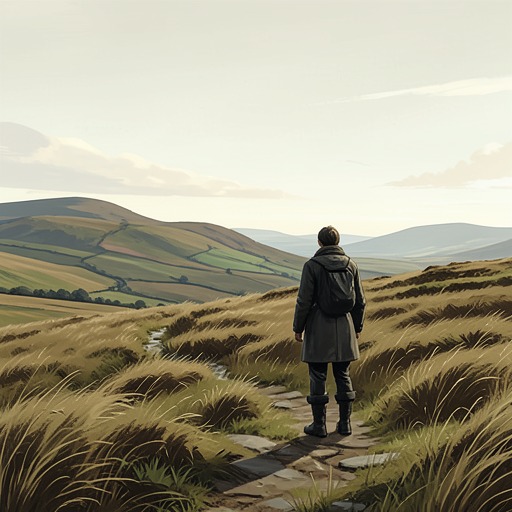
The Ghyll lies below the higher moors, between twin peaks, on a route Emma travels between Fairley village and Fairley Hall. From the lower slope, the path descends into the dell, then climbs steeply out to a flat plateau of moors extending toward the Hall. The passage is narrow and precarious: rocks and gnarled roots break up the frozen ground, and in winter the ascent requires a strenuous, single-file climb. Its physical difficulty is not incidental scenery; the Ghyll makes each crossing a test of attention, pace, and determination.
The ravine’s enclosed form gives it an atmosphere unlike the open plateau. Mist gathers between the peaks and thickens into darkness, while rock formations and blasted tree stumps make the dell seem hostile. On one early crossing, skeletal trees loom at its edge; once inside, Emma imagines goblins, spectres, and lost souls from local superstition. She is frightened enough to hide among the rocks and hold her breath when she hears a heavy sound approaching through the fog. The figure that emerges is a man, not a supernatural monster, but the encounter begins with the landscape shaping her perception: in the Ghyll, a sound and a silhouette can become threats before they resolve into ordinary human presence.
Fear, Song, and Memory
Emma’s responses to the Ghyll change without the place losing its strangeness. On that fearful morning, she tries to master her thoughts by silently singing Onward, Christian Soldiers. She does not sing aloud at that hour, afraid of waking the dead, and finds the school songs she knows too childish for the purpose. The hymn’s marching rhythm instead gives her a way to continue through the ravine while fear presses in around her. The scene makes song a practical act of self-command, not simply an expression of ease.
Years later, crossing the middle of the dell is part of Emma’s routine. She sings aloud there, her soprano carrying through the stillness, and chooses Danny Boy, a song Blackie O’Neill taught her and loved. The memory turns an isolated passage into a point of connection: she thinks warmly of Blackie, notices that he has not visited the Hall for more than a month, and admits to herself that she misses him. The change from a song kept silent to one openly sung registers a changed relationship with the place, while the song itself makes the Ghyll a keeper of human attachments.
The route also links the ravine with grief and with Emma’s enduring connection to her mother. At the Top of the World beneath Ramsden Crags, Emma feels her mother’s presence in a sheltered spot they both loved. After resting there, she takes a basket of clothes and descends into the Ghyll on her way to the Hall. The quiet familiarity of that crossing follows an intimate act of remembrance: the ravine is not itself the place where she encounters her mother’s image, but it lies along the path that carries her back from that private communion to daily obligations.
A Passage Under Pressure
Ramsden Ghyll also measures how urgently Emma can move when someone she loves may be in danger. Rushing home because her mother needs her, she runs into the ravine without waiting for Frank, stumbles once, recovers, and pushes on through the darkness. Overhanging rocks cast shadows and exclude the light, but she is too intent on reaching home to attend to the eeriness that had once made the place terrifying. She emerges into sunlight still breathing hard and impaired, yet keeps going toward Ramsden Crags. The familiar route has not become physically easier; the crisis has made the need to cross it more powerful than fear or fatigue.
The Ghyll’s approach to Ramsden Crags becomes the point where that solitary effort gives way to help. Blackie arrives on one of the Squire’s horses, carrying Frank in front of him. Recognizing the chestnut Russet Dawn, Emma takes Blackie’s offered hand, mounts behind him, and is carried on toward Top Fold. The sequence gives the landscape a practical role in the action: the ravine is part of Emma’s urgent route, while its edge marks the transition from her unaided running to a faster, assisted journey.
Floodwaters and Narrative Significance
After a violent storm, Emma and Edwin again approach the Ghyll, but the familiar crossing has become impossible. Landslides have disrupted the path, scattering rocks and splintered branches. At the ravine’s edge, moonlight reveals water filling the deep gully, its surface crowded with dead birds, rabbits, and a sheep among the debris. The animals make the storm’s force visible in a concrete way; the Ghyll is no longer merely an intimidating landscape but a flooded channel carrying the aftermath of destruction.
Edwin holds Emma as she presses her face against his shoulder, then turns from the flooded ravine and proposes a different route: back over the ridge, across the beck, and along the lower road to the Hall. Emma immediately asks whether the beck will be flooded too. Edwin agrees that it probably will be, but judges it narrower than the ravine and suggests they might swim across. Their exchange establishes a new obstacle rather than showing its resolution: Ramsden Ghyll’s swollen waters force them to reconsider the way home, but the evidence ends with a proposed alternative, not a completed crossing.
Across these scenes, Ramsden Ghyll changes from a feared threshold into a familiar passage and then into a renewed danger. Its repeated crossings give the landscape a structural role in Emma’s story: events that might otherwise remain inward—fear, longing, grief, resolve—become legible through how she moves through it. The same dark ravine that once demanded a song to keep imagined monsters at bay is later crossed in haste without notice, and finally confronts Emma and Edwin as a real, storm-made barrier. Its meaning rests in that contrast: the terrain remains difficult, while Emma’s relation to danger, memory, and endurance changes.