Shane Patrick Desmond O’Neill
A Woman of SubstanceShane Patrick Desmond O’Neill, better known as Blackie O’Neill, enters Emma Harte’s life as a stranger on a misty road and quickly becomes more than the intimidating figure his size first suggests. A navvy bound for Fairley Hall to repair its chimneys and flues, he offers Emma reassurance, laughter, and a vivid account of the future he intends to build for himself. His introduction links physical strength with gentleness, and working-class labor with an expansive faith in education, enterprise, and self-fashioning.
Identity and Introduction
Blackie O’Neill is an Irish working man who has settled in Leeds, where he and his uncle Pat have established a small building and repair business. His name is Shane O’Neill, but he explains that the world calls him Blackie. When Emma Harte asks whether he is a blackamoor, he corrects her with good humor: he is a black Irishman. The exchange makes his Irish identity explicit while showing how readily he answers an awkward question without turning it into a confrontation.
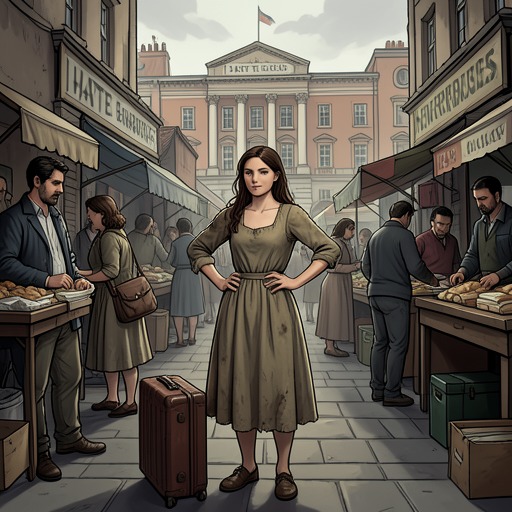
Their meeting begins with fear. Blackie’s immense frame and sack make him seem alarming to Emma in the mist, but he tells her that he will not harm her and asks her not to be afraid. The gentleness in his voice eases her tense, trembling response. Although she remains wary of a stranger, she finds herself asking why he is going to the Hall. That question opens a conversation in which his manner proves as striking as his appearance: a man who could have remained a looming threat instead becomes a patient, amused companion.
The narrator describes him as about six feet three inches tall, broad-backed and powerfully shouldered, with a muscular rather than fleshy build. His long legs and broad chest give him a formidable scale. Thick, glossy black hair, deep brown eyes that appear almost black, a straight nose, and a cleft chin make his appearance distinctive. His eyes can flash with anger or turn mournful when melancholy overtakes him, but they are usually merry; when he laughs, his dimples and animated expression transform his face. The description complicates the first impression of brute force with emotional range and conspicuous warmth.
Work, Migration, and Ambition
Blackie explains that he left Ireland because there was no work there. His uncle Pat, already established in Leeds, invited him over to work as a navvy. Blackie recalls arriving in a growing city of manufactories, mills, foundries, carriages, and elegant houses. To him, the visible signs of industry and wealth suggested possibility: he believed a strong young man willing to work could make a fortune there. Five years later, he and his uncle have their own business, doing repair and building work for mill owners and members of the gentry. It remains small, but Blackie expects it to grow.
His ambition goes beyond earning a living. He intends to become rich, imagines himself as an elegant gentleman, and dreams of a diamond stickpin. The gap between his present work clothes and the social standing he seeks is part of his self-image, not a reason for resignation. He speaks with youthful confidence, laughs at the scale of his aspirations, and treats upward mobility as a project to be pursued through work and learning. His optimism is not presented as a completed success: at this point, it is a promise he makes to himself and to Emma Harte.
Education and the House He Plans to Build
Blackie’s ambitions take practical form in his plan to design and build his own house. He imagines furnishing it with styles associated with Sheraton, Hepplewhite, and Chippendale, as well as paintings and other beautiful things. The house is therefore both a material goal and a declaration that he will shape the life he wants rather than merely occupy the place assigned to him. He promises that Emma Harte will visit when she has become a grand lady, placing her imagined future beside his own.
He has begun preparing for that goal by attending night school in Leeds to study draftsmanship, which he regards as the next best thing to architecture. His confidence rests not only on physical strength or business instinct but on acquiring a skill. When Emma Harte asks whether anyone can attend night school, she is thinking of her brother Frank Harte. Blackie answers that people can go and learn what they want there. His account makes education seem accessible, and his own example gives weight to the possibility: he is already working while studying toward a larger ambition.
Relationship with Emma Harte and Narrative Role
The encounter is reciprocal rather than simply instructive. Emma Harte watches Blackie with fascination, while he notices her scrutiny and recognizes a small local girl making her way to Fairley Hall. He adjusts his pace when her effort to keep up leaves her breathless. That small accommodation sits alongside his physical power and helps establish the kindness she has already heard in his voice. Their conversation also draws Emma Harte’s attention away from the weariness and worry that had marked her morning; his descriptions of Leeds and his plans stir her imagination and prompt her to ask more.
Blackie’s importance in this introduction lies in the future he makes imaginable. He speaks to Emma Harte not as though ambition belongs only to the gentry but as something a working man can pursue through enterprise and evening study. When she turns immediately to the question of whether Frank Harte could learn at night school, his story has already widened beyond his own prospects. The scene presents Blackie as a reassuring stranger and an energetic model of self-education: broad-shouldered and comic, yet careful with a frightened child, and determined to turn a small business and a set of aspirations into a larger life.