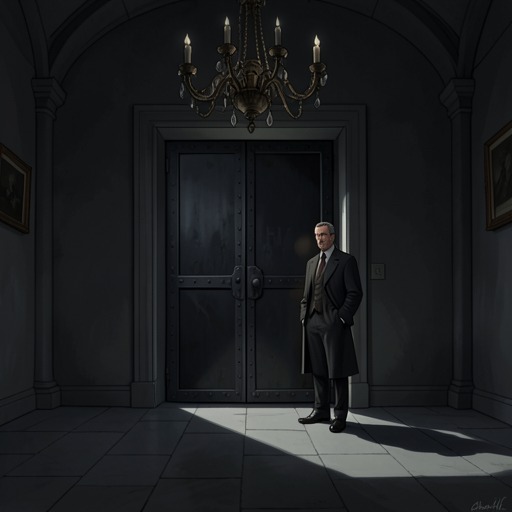
The McGill dynasty and its succession across generations
A Woman of SubstanceThe McGill dynasty and its succession across generations describes how Paul McGill imagines his family’s future as both a business inheritance and a line of descendants. Its defining transition is from Paul’s own achievements to the succession he entrusts to Emma Harte and, ultimately, to their daughter Daisy McGill Amory and her children. The inheritance plan gives that family vision material force: after Paul’s death, Emma receives his estate, with Daisy and her descendants named as its future beneficiaries.
Origins and the idea of a dynasty
The family’s Australian roots reach back to Paul’s grandfather, a Scottish sea captain who settled in Coonamble in 1852. Paul sees himself as carrying forward a dynasty founded by that earlier generation. His sense of continuity is not merely ancestral pride: he connects the family line to the future of the extensive business enterprises he runs, making inheritance a question of who will preserve both family and enterprise.
Paul’s attachment to succession becomes explicit when Emma Harte asks whether he regrets that Daisy was not a boy. She raises the possibility that he might want a son to continue the business, especially since Howard McGill cannot readily follow in his footsteps. Paul rejects the assumption that business inheritance must pass through a son. He says he has not ruled out Daisy succeeding him, imagines her becoming a capable businesswoman, and pictures her marrying and having children. His answer makes the dynasty’s future depend on Daisy’s agency and descendants, rather than on a male heir alone.
Paul, Emma, and Daisy
Since returning to England in 1923, Paul has made his love for Emma unmistakable. He admires her achievements as well as loving her, and the birth of Daisy intensifies his commitment. Daisy does not bear his name, but Paul regards her as his own child and as the continuation of the McGill line. The difference between her name and the inheritance he intends for her makes clear that, for him, descent and belonging are not reducible to a surname.
Paul’s personal commitment also takes material form. He places a platinum wedding band on Emma’s finger and adds the McGill emerald, a family heirloom that belonged to his mother and grandmother. He considers Emma his wife despite their lack of a formal marriage ceremony. The ring and emerald join their private bond to a history that predates them, making inherited property a sign both of family memory and of the future he wants to share with Emma and Daisy.
In the late summer of 1925, Paul buys a mansion in Belgrave Square and gives its deeds to Emma. He has the house remodelled into two self-contained flats: Emma and Daisy occupy the upper floors, while he keeps bachelor quarters on the ground floor. Each flat has its own entrance, but a private interior elevator connects them. The arrangement lets them live together discreetly while maintaining separate households. It reflects Emma’s reluctance to flaunt their relationship, and Paul’s determination to remain close to her and their child despite the complications of their lives.
Inheritance and succession
Paul’s will turns his intentions into a specific chain of inheritance. At the reading, Emma learns that he has named her executrix. His bequests include servants and loyal employees, while a two-million-pound trust is set aside to provide for his wife and son during their lifetimes, with the remainder ultimately going to charity. Separately, Paul leaves his estate to Emma in perpetuity, then directs that it pass to Daisy after Emma’s death and from Daisy to her descendants.
The scale of the estate makes this succession consequential: Paul’s holdings are worth well over two hundred million pounds. Emma is astonished not only by the fortune but by the respect the will grants her. Though she was his common-law wife, Paul treats her in death with the consideration usually associated with a legal widow, publicly acknowledging his devotion and placing the McGill dynasty in her hands for safekeeping. The arrangement gives Emma authority in the present while preserving a defined route toward Daisy’s generation and beyond.
The next generation
Paul’s imagined succession continues beyond Daisy to the children he expects her to have. His hope that Daisy will marry and become a mother is linked to his confidence that the family line can endure through her, not simply through a direct transfer of business control. The distinction matters: his vision combines inheritance of wealth with the continuation of kinship across generations.
After Paul’s death, Emma holds that future in mind when Daisy gives birth to a daughter. Emma thinks of the baby as Paul’s first grandchild and as the first of a new generation in the McGill dynasty. The child, named Paula McGill Amory, makes Paul’s hoped-for continuity tangible even though he is not alive to see her. The sequence from the Australian founder, to Paul, to Daisy and Paula gives the dynasty a form that survives its central figure.
Significance
The McGill succession contrasts with a model in which family continuity is guaranteed by a son. Paul considers Daisy a possible business successor, and his will makes her line the eventual destination of his estate. At the same time, his provisions acknowledge people beyond the direct line, including employees and members of his existing household. His legacy is therefore both dynastic and deliberately arranged: it protects dependants, gives Emma control, and directs wealth toward descendants not yet born.
The narrative presents succession as an act of trust as much as a transfer of property. Paul’s love for Emma and Daisy gives the inheritance its purpose; the will then extends that private commitment into the future. Emma’s role as executrix and steward bridges Paul’s lifetime and Daisy’s eventual inheritance, while Paula’s birth demonstrates that the family’s continuity does not end with the fortune’s first transfer. The dynasty endures through a combination of ancestry, care, and a succession plan that recognizes a daughter and her descendants as its heirs.