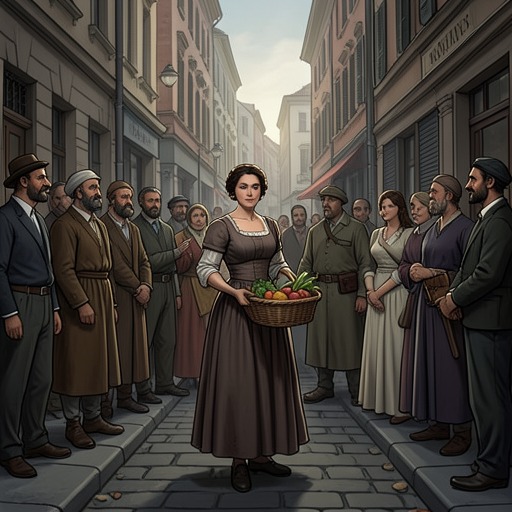
Women’s economic independence
A Woman of SubstanceWomen’s economic independence in the novel is not an abstract ideal but a hard-won source of safety, leverage, and choice. Emma Harte learns to connect money with power while witnessing the gulf between the Fairleys’ protected luxury and the workers whose labor sustains it. She turns that lesson into a working method: plan labor, build a business, conceal ownership when necessary, and negotiate from strength. Her ascent demonstrates the force of a woman’s economic agency, while the demands of care, social class, and gendered business conventions show how far that agency must struggle to reach.
Money, Class, and the Need for Security
At Fairley Hall, Emma sees that wealth buys more than necessities. The Fairleys’ comfort depends on the “pitiless and endless toil” of village workers, while their isolation shields them from the conditions that make their privilege possible. For Emma, the contrast makes poverty a condition of exposure: without money, a person is vulnerable to the whims of the rich and has little power to defend herself or her family. The medicines and nourishing food her mother needs give this insight an immediate, material urgency.
Emma rejects the idea that wealth belongs only to those favored by birth or luck. She imagines that a brilliant plan and exceptional effort can make a fortune, and she commits herself to that possibility. Her ambition begins as a response to insecurity, but it develops into a practical understanding of money as power: wealth can offer safety and help secure forms of justice and liberty otherwise denied to the poor. Economic independence, in this account, means acquiring the means not to remain at another person’s mercy.
Organizing Labor and Building a Business
Emma’s first experiment in economic agency takes place inside domestic service. When Polly falls ill in early February, Emma inherits her duties as well as her own. She works from six in the morning until seven at night, carrying out household chores and attending to Adele Fairley, while fear of dismissal keeps her from complaining. The wages matter to her family, so the need to earn money forces her to endure exhausting work even as it threatens to overwhelm her.
Rather than accepting the disordered routine as inevitable, Emma measures how long tasks take, records them on scrap paper, and designs a timetable. She spreads heavy work across the week and assigns time to individual chores, trimming less important tasks to make the whole system manageable. The plan is a small but consequential act of control: she uses observation and organization to make labor more efficient, even though Cook warns her that proposing changes may provoke Murgatroyd’s anger. Her initiative shows that independence begins not only with earning but with understanding how work is allocated and where its waste can be challenged.
Later, Emma extends that discipline beyond the household. At seventeen, she works at the mill by day and makes clothes for customers at night. On Sundays she bakes for local households and the gentry, preserves produce, and labels supplies for a future shop. She lives on her mill wages and reinvests the earnings from dressmaking and catering in materials and foodstuffs. Her first profit confirms that the enterprise can grow. She aims for elegant shops serving carriage-trade customers, where she believes larger sums can be made, and regards the first shop as a beginning rather than a limit.
Her business drive has a cost in time and family presence. For a whole year she takes no time off except one monthly visit to Edwina in Ripon, consoling herself that the work is for her daughter’s future. She also helps determine a future for Frank: she and Winston agree that he will stay in Fairley, continue at the mill offices until he is fifteen, and then choose whether to pursue writing. Emma insists that his talent should be nurtured through books and writing materials. Her economic ambition is therefore bound up with family provision, but the work of providing falls heavily on her.
Gender, Law, and Personal Choices
Emma’s agency develops within constraints that money alone cannot immediately remove. When she tells Edwin Fairley that she is pregnant, he considers marriage but recoils from the prospect of his father’s disapproval and the loss of his future as a barrister. He sees Emma as a village servant and judges the class difference between them too great to bridge. His silence leaves her facing the consequences of the pregnancy without his recognition or support. The scene makes plain that a woman’s personal security can depend on a man’s willingness to assume responsibility, even when she has little power to compel him to do so.
The birth registration creates another practical problem. The law requires the father’s name, and Emma refuses to identify Edwin. Blackie O’Neill proposes that his own name go on the certificate rather than leaving the father unknown; he offers to accompany her to the registrar and take responsibility for the choice. The arrangement does not erase Edwina’s illegitimate status, but it gives Emma a way to manage the public record while protecting the identity she has chosen to conceal. Here, economic and personal independence operate alongside legal vulnerability: Emma must navigate a rule that makes her child’s status depend on information she does not wish to disclose.
When Emma later accepts Joe Lowther’s proposal, she tells him that Edwina is illegitimate but withholds the father’s identity. She wants to begin the marriage without deceiving him about her child, yet she does not reveal every part of her past. The decision is an exercise of candor and control at once. Her marriage gives her a household, but her larger objective remains to continue her business after childbirth; because of the house’s size and her insistence on maintaining the enterprise, Joe agrees to employ staff. Mrs Fenton becomes housekeeper-cook, Mrs Hewitt cleans daily, and Clara cares for the children. This support makes Emma’s continued business activity possible, while showing that her independence does not abolish domestic labor: it changes who performs some of it and how the household is organized.
Corporate Power and Concealed Ownership
Emma’s most striking assertion of economic independence is Emeremm, an acquisition and holding company she finances herself. She is its sole shareholder but keeps her name off the board and holds no corporate office; appointed directors formally run it on her behalf. The concealment is deliberate. Emma recognizes that men may refuse to do business with a woman, particularly in high finance, and secrecy allows her to exercise ownership while avoiding a gendered barrier to commercial authority. The company’s name, formed from “emerald” and Emma, encodes her presence even while the public structure hides it.
When she later tells Winston Harte about the company, she explains that she formed it in 1917 and owns all its shares, while Ted Jones and the other directors act for her. She offers Winston work in bookkeeping, with the prospect of becoming her assistant, because she needs someone she can trust across her businesses. She also sets out a business discipline: disclose mistakes rather than conceal them, keep a cool head, and negotiate from strength rather than fear. These are not merely personal maxims; they describe the operating conditions she believes necessary to preserve authority in a commercial world where her ownership is not publicly acknowledged.
That hidden structure eventually produces visible consequences. Emma reveals that Procter and Procter is a subsidiary of Emeremm, and that the General Retail Trading Company and Deerfield Estates are likewise under her control. Through those companies, she has acquired the Fairley mills and Fairley Hall. Gerald Fairley realizes that the businesses and family home he regarded as his have passed into Emma’s hands. The reversal transforms her earlier understanding of money into action: the worker who once observed the distance between village poverty and Fairley privilege now controls the mechanisms that sustain the Fairley estate.
What Independence Changes—and What It Cannot
Emma’s rise makes economic independence a means of self-protection and a form of power over institutions, not simply an escape into personal comfort. It lets her build enterprises, protect her family, and eventually overturn the inherited economic hierarchy represented by the Fairleys. Yet the route is neither unburdened nor entirely public. She accumulates wealth through relentless work, makes arrangements around the demands of motherhood, and conceals ownership because male prejudice could obstruct her authority. Her success changes who holds power; it does not make the constraints that shaped her disappear.
The novel therefore presents women’s economic independence as both practical and contested. Emma’s timetable converts exhausting domestic work into something she can analyze and organize; her mill wages and home enterprises create capital; Emeremm turns private ownership into corporate reach. Across these stages, financial agency gives her choices and protection that poverty withheld. Its significance lies equally in the costs and ingenuity of its achievement: Emma must do the work, manage the care, and devise the structures through which a woman can command wealth in a world inclined not to recognize her command.