
From Order To Collapse
A cataclysmic lack of HarmonyThis flow traces the book's recurring movement from controlled form toward emotional and linguistic breakdown.
increasing Bearing strength in each event
 decreasing
Bearing strength in each eventdecreasingGeometric Self

Geometric Self
The authorial self is described as extravagant, eccentric, chaotic, and made from interrelated facets. Identity begins as a complex design rather than a single stable center.
Ordered Complexity
Intricate geometries and brambles coexist. The self contains structure, but that structure is organic, tangled, and resistant to simplification.
Creative Premise
The book's later instability grows from this premise: disorder can be shaped without being eliminated.
Painted Days
Painted Days
The authorial voice paints days, draws stairs toward bliss, and projects inner incandescence into the heart. Creative acts convert unstable experience into visible form.
Forming Emotion
Painting and drawing give sequence to otherwise shifting feelings. Art becomes a technology for climbing through transitory states.
Temporary Bliss
The promised bliss is explicitly transitory, so form never guarantees permanence. Creation provides intervals of coherence rather than final control.
Gnarled Syllables

Gnarled Syllables
The speaker later rejects the idea of writing as clear verbal communication, calling the result meaningless syllables forced together. Order has become visibly strained.
Language Under Pressure
Words still occupy a sequence, but their relationship feels artificial. The form survives while semantic confidence collapses.
Cage Of Form
The parallel cage shows that structure can preserve and imprison at once. The speaker's art is both container and evidence of constraint.
Broken Perspective
Broken Perspective
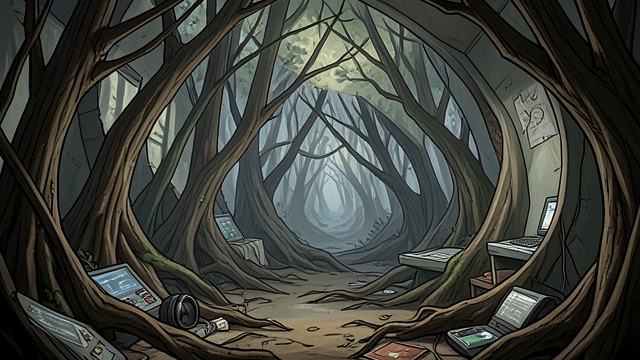
Blurred visions, fragmented bodies, and distorted landscapes replace stable observation. The collection's imagery increasingly reflects a consciousness unable to maintain one angle of view.
World As Interior
External scenes reproduce emotional fracture. Forests, rooms, oceans, and cities become extensions of the speaker's mind.
Loss Of Certainty
The reader is not given a single authoritative reality. Uncertainty becomes a formal feature of the work.
SOS Form
SOS Form
The collection closes with a compressed emergency signal repeated through a failing structure. The final form is simpler than the opening biography, but its simplicity carries greater urgency.
Reduction To Need
Complex metaphors give way to questions about being heard and alive. The speaker's language has reached the point where survival matters more than ornament.
Form As Crisis
The book does not resolve disorder into harmony. It ends by making the failure of communication itself the final shape of experience.
author biography opening
author biography continuation
middle of the collection
after the relationship poems
final poem
