
Hands That Cannot Touch
A cataclysmic lack of HarmonyThis flow follows a desired connection that moves from mental closeness to physical restraint and uncertain release.
increasing Bearing strength in each event
 decreasing
Bearing strength in each eventdecreasingEntangled Hands

Entangled Hands
The speaker recalls arms entangled with another person's arms. Contact is intimate, but the surrounding context makes it an occasion for escape rather than rest.
Closeness As Threat
The embrace does not guarantee safety. Physical intimacy can intensify the speaker's fear of losing the mind.
Flight From Contact
The speaker runs away before mental stability disappears. Survival begins as withdrawal from a bond that has become too powerful.
First Pretence

First Pretence
The speaker remembers having to pretend. The performance conceals a response that cannot be safely expressed within the relationship.
Hidden Condition
Pretence becomes a protective layer between inner panic and external expectation. The speaker survives by withholding truth.
Cost Of Concealment
What protects the speaker also prevents genuine understanding. The bond is strained by a feeling that remains inaccessible to the other person.
Mind At Risk
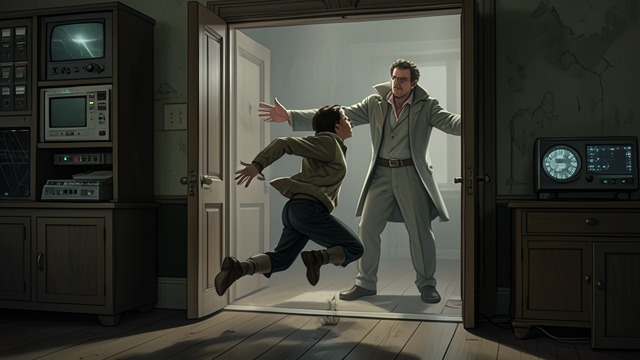
Mind At Risk
The speaker runs before losing control of the mind. The physical movement gives form to an urgent attempt to preserve psychological boundaries.
Urgent Distance
Distance is treated as necessary medicine. The speaker cannot negotiate safely while remaining inside the other's immediate influence.
Ambivalent Separation
Escape protects the self but also damages attachment. The speaker leaves because the relationship matters too much to endure unchanged.
Silence As Killer

Silence As Killer
The speaker asks the other person to say something, calling Silence a killer and the self its favorite prey. Separation has made communication newly urgent.
Need For Response
The earlier flight has not eliminated dependence on the other's voice. The speaker needs evidence that the bond has not become entirely empty.
Reversal Of Escape
Distance was sought as protection, yet Silence now makes it dangerous. The speaker discovers that safety and connection cannot be cleanly separated.
Unheld Survival

Unheld Survival
The speaker remains caught between the need to escape and the need to be answered. Survival has no stable refuge because both closeness and absence carry danger.
Relational Precarity
The bond cannot return to its previous form, but neither can it disappear without consequence. The speaker's continued life is shaped by this unresolved tension.
Open Recognition
The poem does not choose reunion or permanent severance. It records the difficult fact that survival may require living with an unfinished attachment.
opening of Survival
immediately before the escape
during the escape
after the separation
closing moment
