Darkness
A cataclysmic lack of HarmonyDarkness is one of the collection’s central states and governing images. It first appears as the immediate environment of sleeplessness, then widens into a condition of memory, uncertainty, fear, and emotional extremity. Across the poems, Darkness conceals what the speaker cannot face, surrounds the self when language fails, and provides the backdrop against which fragile forms of light and awakening become perceptible.
Definition and First Appearance
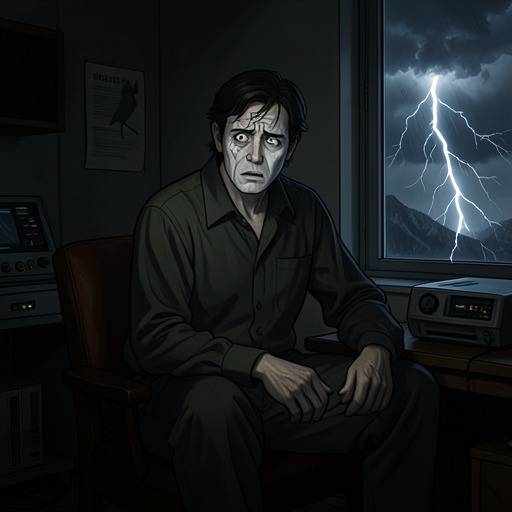
Here, Darkness is both physical obscurity and an inward condition. The speaker lies awake in bed while “Around me the darkness” remains absolute: “No light can be seen.” This setting makes sleeplessness spatial rather than merely psychological. The bed becomes a place from which the speaker cannot escape, while the surrounding absence of light turns wakefulness into exposure to an unseen threat.
The image immediately acquires a maritime and perilous dimension. The sleepless speaker is compared to “a sailor / Fighting storms and seas,” someone “Constantly in danger.” Darkness therefore does not simply mean the absence of illumination; it is the medium in which danger becomes continuous and difficult to locate. The sailor’s struggle gives the state a bodily and environmental scale, making inner distress resemble survival at sea.
Darkness, Memory, and Failed Language
Darkness also marks the point at which communication deteriorates. The poem describes “silent monosyllables” fading into the “cold” Darkness of “our empty memories.” The state is thus linked to both silence and recollection: words remain, but only in diminished fragments, and those fragments disappear into a memory-space that has been emptied of shared substance.
This movement from speech toward disappearance gives Darkness a temporal force. It does not merely hide a present object; it absorbs what once might have been remembered or said. The coldness attached to it intensifies the sense of emotional distance, while the fading letters make the breakdown of language visible. Darkness becomes the final destination of expression when intimacy has been reduced to isolated sounds.
The same state is associated with uncertainty about the world itself. The speaker describes living in an uncertain world, “the Earth,” and treats feeling flummoxed as an entirely possible condition. Darkness here names an epistemic situation as much as a mood: the speaker cannot rely on a stable environment or a complete understanding of experience. The poem preserves that uncertainty rather than resolving it, allowing confusion and astonishment to coexist with moments of apparent calm.
Desire, Fear, and Emotional Extremity
Darkness surrounds an intimate relation that the speaker calls esoteric and not meant for everyone. The encounter is imagined as a private exchange, “Tête-à-tête, immersed in your mind,” but it is also destructive: the other person drives the speaker toward the precipice of Insanity and corrodes a compassionate heart. Darkness therefore shelters secrecy while intensifying danger. What is hidden is not necessarily safe; concealment can protect exceptional feeling and simultaneously enable emotional ruin.
The speaker’s attachment is expressed as an absolute commitment to the beloved’s love, described as the only categorical imperative, even though the speaker recognizes the relation as a risky game. Darkness is consequently connected to voluntary exposure. The speaker knows that the desired bond may be hazardous, yet continues toward it, making obscurity the condition in which devotion and threat become inseparable.
The image also appears in the poem’s account of fear and avoidance. The speaker refuses to turn away but is afraid to know the truth, and therefore pretends to be blind. Darkness is reproduced psychologically through chosen nonrecognition: the speaker does not merely lack sight but performs blindness as a defense against knowledge. This creates a tension between the refusal to look away and the refusal to see clearly, placing Darkness at the boundary between fear, denial, and self-protection.
A Space of Burial and Recurrence
In another vision, the speaker asks to be buried “Down where the sun doesn't shine,” in a place “Where day and night are the same.” Darkness here becomes a burial-space stripped of ordinary temporal distinctions. If day and night are indistinguishable, the state suspends measurement, change, and return; it offers not rest within time but an existence outside its usual alternation.
Yet this imagined burial is not simply annihilation. The speaker wants to carve something into the mind forever, so the sunless place becomes paradoxically a site of preservation. Darkness hides the body while promising permanence to memory or inscription. Its recurring logic is therefore double: it erases visible forms, but it can also protect what the speaker wants to retain beyond ordinary light and time.
The collection later returns to the state as an explicit refrain: “Darkness / Darkness.” The repetition gives the word the force of an incantation or a verdict. It interrupts surrounding description and makes the state itself the subject of attention. In this recurrence, Darkness is no longer only a setting for an individual scene; it has become a durable condition through which the collection’s emotional weather is organized.
Night, Light, and Awakening
The repeated Darkness is followed by a cold, eerie night in which the Moon is shining, though only partially visible. This scene complicates the image’s apparent totality. Darkness does not eliminate every source of light; instead, it interrupts and obscures illumination. The partially hidden Moon offers a model for incomplete knowledge, in which visibility exists but never becomes whole.
That tension is reversed in the speaker’s dream of the Moon landing. The speaker says, “I came alive, when I was dreaming,” while imagining a journey through factories of stars. Dreaming becomes an awakening within Darkness rather than a simple escape from it. The state that previously signified sleepless isolation can also frame a moment of imaginative vitality, suggesting that light may emerge as a mental event even when the surrounding world remains obscure.
This contrast prevents Darkness from becoming a single, fixed symbol. It can be cold, eerie, and threatening; it can absorb memory and language; but it can also make radiance legible by contrast. The dream of the Moon landing places technological and cosmic aspiration against the earlier bed, storm, and burial images, expanding the state from private night into a vast field where the speaker’s imagination briefly becomes alive.
Emotional Storm and Open Ending
Near the end of the sequence, Darkness is joined to an inward storm. The speaker describes a raging thunder inside, accompanied by a tornado of emotions consuming every part of a tormented soul. Weather imagery converts psychological suffering into violent movement, while the earlier sailor and storm comparison is intensified from external danger into internal catastrophe. Darkness is the atmosphere in which this consumption occurs: the speaker is not merely sad but overwhelmed by forces that cannot be easily separated or controlled.
The concluding mood remains gloomy and miserable. The speaker walks the path with a head underwater and asks, “Is this the end?” The question leaves the state unresolved. Darkness does not culminate in a clear revelation, recovery, or definitive ending; it persists as uncertainty, pressure, and impaired perception. Its significance lies precisely in that suspension, where the speaker continues moving without possessing a reliable view of the destination.
As a recurring poetic state, Darkness links the collection’s most distinct experiences: sleeplessness in bed, danger at sea, empty memories, concealed desire, fear of truth, imagined burial, partially obscured moonlight, cosmic dreaming, and the inward thunder of emotional crisis. It is the book’s principal environment of not-knowing, but not a blank one. Within it, language fades, desire becomes risky, and vision is obstructed; at the same time, the Moon, stars, and dream of awakening show that obscurity can make fragile illumination newly visible.