Death
A cataclysmic lack of HarmonyDeath is the poem's ultimate horizon and one of its most pervasive states: it is named as the inevitable destination toward which time carries a fragmented, solitary subject, while also appearing through bodily deterioration, fantasies of burial, artistic depletion, and unanswered cries for confirmation. Rather than remaining a single terminal event, Death becomes a pressure that reorganizes the speaker's experience of time, embodiment, communication, and presence.
Inevitable Destination
The clearest formulation places Death at the end of a passage through space and time. The clock sentences the fragmented figure to a greater escape, and navigation itself becomes a movement toward an “inevitable ultimate destination.” The image combines mechanical time with legal punishment: the clock does not merely measure life but sentences the subject, making mortality feel imposed, inescapable, and progressively nearer. Death is therefore both an endpoint and the force that gives the preceding journey its direction.
This movement occurs alongside solitude. The figure stares at a fragmented life while spending each day alone, so Death is not introduced only as a future biological conclusion. It is already shadowed by social and existential separation. The progression from fragmentation to solitude to the clock's sentence makes mortality resemble an intensified form of abandonment: the subject remains present long enough to recognize the destination, but not securely held within a sustaining community.
Death in the Body and the Imagination
The poem translates mortality into physical change through the image of a shrinking body that is slowly deteriorating. The body is not stable evidence of selfhood; it contracts and breaks down, suggesting that Death advances through the ordinary material conditions of existence rather than arriving without warning. This emphasis on diminishment makes the abstract destination legible as a gradual loss of substance.
Death also enters the poem as a theatrical and musical power. A figure trapped inside a crystal ball is described as dancing among the goddesses of winter while playing a song performed by the orchestra of Death. The crystal ball encloses the subject in a fragile, suspended world, but the dance does not escape mortality; it is choreographed by it. The orchestra gives Death collective, almost ceremonial force, turning the condition of dying into an atmosphere and an accompaniment that surrounds human action.
Burial imagery gives that atmosphere a more concrete finality. The speaker expresses a wish to be buried underneath, down where the sun does not shine and where day and night are the same. The desired underground space abolishes the ordinary alternation that structures waking life. In this image, Death is associated with concealment, darkness, and the erasure of temporal distinction; the grave is not only a place beneath the surface but a condition outside the rhythms by which the living orient themselves.
Death, Desire, and Destruction
Death is entangled with hostile intimacy in the statement that another person had to wish the speaker dead before the speaker could kill that person's aura. The line does not describe a straightforward physical killing. Instead, it links a death wish to the destruction of an aura, implying that mortality language can govern emotional or symbolic relations as well as bodies. The sequence reverses ordinary assumptions about vulnerability: the wish for the speaker's death becomes the condition for an act that extinguishes another person's radiance or influence.
This relation makes Death a language of power and severance. The later burial wish similarly imagines removal from the visible world, while the attack on another person's aura imagines the removal of an intangible presence. Across both images, Death marks the point at which connection is broken beyond ordinary repair, whether through physical disappearance or the annihilation of a person's felt power.
Exhaustion and Failed Survival
The poem connects mortality to the depletion of creative and physical resources. Even without determination, strength, or skill, the speaker's fingers keep typing until only a single inch of “out of battery-creativity” remains. The act of typing persists after the qualities that would normally sustain it have been exhausted. This is a reduced but stubborn form of survival: the body and imagination are failing, yet the fingers continue to produce language.
The battery metaphor gives artistic exhaustion a technological limit. Creativity is treated as a charge that can run down, and the remaining fragment is measured almost physically. Death thus appears not only as the end of the body but as the threatened termination of expression. Continued typing delays that termination, although the poem offers no assurance that communication or creation will be restored.
The SOS at the Edge of Life
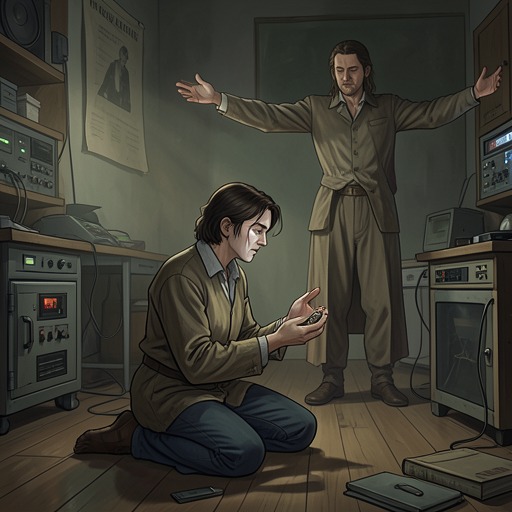
The most explicit crisis appears under the heading “Failure - 404.” The failed digital address is followed by a voice asking whether it can be heard and by the repeated signal “SOS.” Inaudible sounds leave the speaker's mouth, so the emergency message exists but cannot successfully cross the boundary between sender and listener. The poem turns the conventional distress signal into evidence of communicative breakdown.
The repeated SOS intensifies the uncertainty rather than resolving it. The speaker asks whether life remains, and an emptiness takes over the house before the final question asks whether this is the end before the end. Death here is neither fully confirmed nor safely distant. It is a condition of suspended recognition in which the speaker may still be calling, but the surrounding world offers no reliable answer.
The recurrence of failure, inaudibility, emptiness, and the question of being alive makes Death inseparable from social disappearance. A person can be threatened by mortality while still typing and sending signals, yet the absence of reception makes continued existence difficult to verify. The poem's decisive tension lies there: expression persists at the very moment when the medium, the house, and perhaps the self are becoming empty. Death is consequently rendered as destination, bodily process, symbolic violence, creative exhaustion, and the terrifying possibility that a living voice can become indistinguishable from silence.