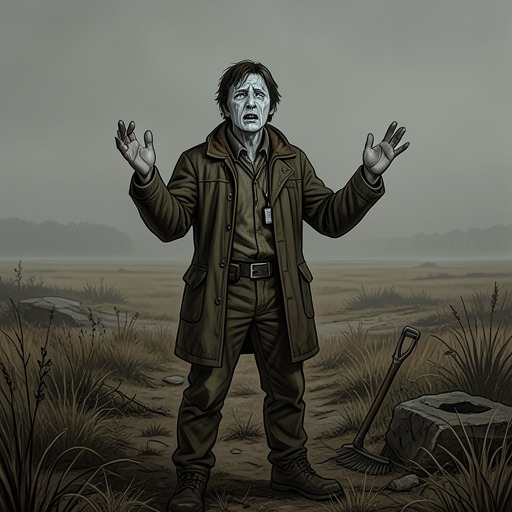
Failure - 404
A cataclysmic lack of HarmonyFailure - 404 is the book’s most concentrated expression of communication breaking down. Repeated beside SOS, it transforms a digital error code into a human emergency: a speaker tries to transmit a voice, cannot verify that anyone receives it, and finally confronts the possibility that even existence has become unconfirmed. The expression joins technological failure to emotional isolation, making absence not merely a condition but the medium through which the speaker’s distress is experienced.
Definition and Form
Failure - 404 appears twice in immediate succession, giving the phrase the force of a repeated system message rather than a single description. Its number suggests a missing destination, but the poem does not explain what has disappeared. That refusal of explanation is central to the expression’s effect. The phrase names a failure while leaving the failed object unresolved: the absent recipient, the speaker’s own sense of self, or the possibility of meaningful contact may all be implicated.
The repetition also makes the expression performative. It does not simply report that communication has failed; its return enacts a transmission that cannot reach completion. Each recurrence seems to promise recognition and simultaneously confirm that recognition has not arrived. In this way, Failure - 404 operates as both diagnosis and symptom: the language announces a breakdown, while the poem’s repeated call demonstrates the breakdown in real time.
Relation to SOS and Inaudible Speech
The expression is embedded in a sequence of distress calls. After the repeated Failure - 404, the speaker asks whether the voice can be heard and sends SOS. The mouth produces inaudible sounds, yet SOS returns several times. The contrast between the standardized emergency signal and the absence of audible speech sharpens the crisis. The speaker possesses the form of a request for help, but not the assurance that the request has crossed the distance separating speaker from listener.
This sequence makes sound itself uncertain. The speaker asks whether the voice is heard, then describes sounds leaving the mouth without audibility, and continues to repeat SOS. The repetition is not evidence of successful contact; it is evidence of persistence under conditions where contact cannot be confirmed. Failure - 404 therefore marks a communication loop in which urgency intensifies precisely because no response interrupts it.
Exhaustion and Creative Depletion
The expression also recalls an earlier condition of depleted production. The speaker’s fingers keep typing until almost nothing remains, down to a single inch of out-of-battery creativity. Typing is consequently both labor and attempted transmission. The hands continue after determination, strength, and skill have been exhausted, but the act approaches the same failure later named by Failure - 404: something is being sent, yet the means of sending are running out.
The image of exhausted battery gives the expression a material dimension. Creativity is treated as a charge that can be spent, while typing becomes a bodily extension of a failing device. The digital language is not decorative; it describes how the speaker’s capacity to make language is itself threatened. Failure - 404 thus links the inability to reach another person with the inability to continue producing the words needed to reach that person.
Uncertainty, Concealment, and the Missing Answer
The expression belongs to a wider field of unresolved knowledge. The speaker describes living in an uncertain world, Earth, where bewilderment remains probable, and identifies the feeling for another person as something esoteric and not meant for everyone. Elsewhere, the speaker refuses to turn toward the truth and pretends to be blind. These statements complicate the apparent simplicity of an error message: the missing answer may result not only from external absence but also from hesitation, concealment, or fear of what recognition would reveal.
The poem repeatedly keeps interpretation open rather than repairing the broken channel. A question about whether the speaker is alive follows the inaudible SOS, and another asks whether this is the end before the end. Neither question receives an answer. Failure - 404 therefore names an epistemic failure as well as a technical one: the speaker cannot establish where the message has gone, whether a listener exists, or whether the self sending the message can still be securely affirmed.
Final Consequences and Significance
The final sequence gives the expression its bleakest context. An emptiness takes over the house; the speaker is left alone and forced to face a world described as too silent and grey. The house, ordinarily a place from which communication might begin, becomes the interior location of failed contact. Emptiness is not merely outside the speaker or beyond the device. It occupies the domestic space itself, turning the setting into an extension of the error.
Failure - 404 consequently carries the book from fatigue into existential abandonment. Its repeated return beside SOS preserves the speaker’s agency—the call continues—but also records the limits of that agency. The poem can still type, ask, and signal, yet none of these acts guarantees reception. The expression’s decisive significance lies in that unresolved tension: it converts the numerical language of a missing connection into a formal pattern of repetition, an account of creative depletion, and a final test of whether a voice can prove that it remains present.