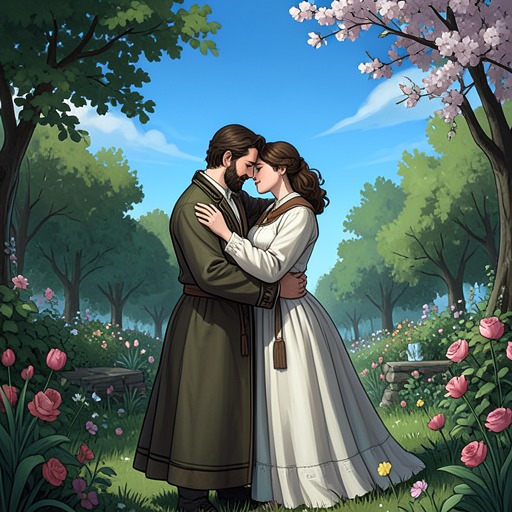
Snowdon
A cataclysmic lack of HarmonySnowdon is presented as a landmark of imagined intimacy rather than as a fully described geographical setting. It appears in a scene where two figures occupy a huge field of daffodils, one running with a crown of flowers, while the mountain is declared “not far away.” Its decisive significance lies in the contrast between apparent nearness and actual obstruction: Snowdon is close enough to orient the scene, but the figures remain stuck in the sand, making the landscape a measure of frustrated movement and desired union.
Setting and Appearance
Snowdon belongs to a pastoral and dreamlike tableau assembled from open space, flowers, sand, and distant elevation. The field of daffodils supplies the scene’s expansive background, while the crown of flowers gives the beloved a ceremonial, almost childlike radiance. Against this brightness, Snowdon provides a fixed vertical point beyond the immediate play of bodies. The mountain is not described through physical features; its importance comes from its position in relation to the figures and from the statement that it is nearby.
The scene’s geography is therefore deliberately unstable. A mountain, a field, and sand coexist within an intimate image whose scale shifts between landscape and touch. Snowdon seems accessible, yet the figures’ toes are trapped where they stand. This discrepancy makes the location less a destination than a spatial expression of uncertainty: the desired elsewhere is visible and near, but proximity does not guarantee arrival.
Relation to the Two Figures
Snowdon frames a moment of togetherness. The figures’ hands are entangled, and the shared image is defined by the phrase “just us in the world,” which temporarily excludes everything beyond their private encounter. The mountain’s nearness reinforces that sense of a world reduced to two people and a small number of charged natural forms: flowers above, sand below, and Snowdon in the distance.
Yet the joined hands do not erase constraint. The figures are held by the sand even as they imagine movement through the field. Snowdon thus stands beside an image of connection that is physically incomplete. The relationship has achieved contact, but not freedom of movement; it has created closeness without dissolving the conditions that keep the figures in place.
Crossing and Resistance
Snowdon is connected to the effort to overcome separation. Elsewhere in the same imaginative sequence, the pair confronts an imaginary wall between them and climbs it together against the current. That action gives the mountain scene a broader spatial logic: natural obstacles and invented boundaries both become forms through which intimacy must struggle to express itself.
The contrast is central. Snowdon is “not far away,” but the feet remain stuck; the hands are joined, but the wall between the figures still has to be climbed. The location therefore holds two values at once, hope and resistance. It offers a horizon toward which movement might be directed while preserving the evidence that movement is difficult, partial, and perhaps only imaginable.
Thematic Significance
Snowdon’s role is consistent with the book’s recurring use of landscape to externalize unstable inner states. The surrounding poems move through uncertainty, silence, darkness, dreams of the Moon landing, and questions about whether an ending has arrived. Within that larger pattern, Snowdon becomes a concrete landmark for an emotional condition in which the future remains visible but unresolved.
Its elevation also contrasts with the book’s downward and submerged images: crashing waves, a colourless “sky” broken visually across the page, and a speaker walking with a head underwater. Snowdon offers height and orientation without providing release. It is near enough to promise a shared direction, but the scene ends not with arrival at the mountain, only with the figures still joined and still impeded. Snowdon consequently functions as an emblem of possible closeness under conditions that remain uncertain.