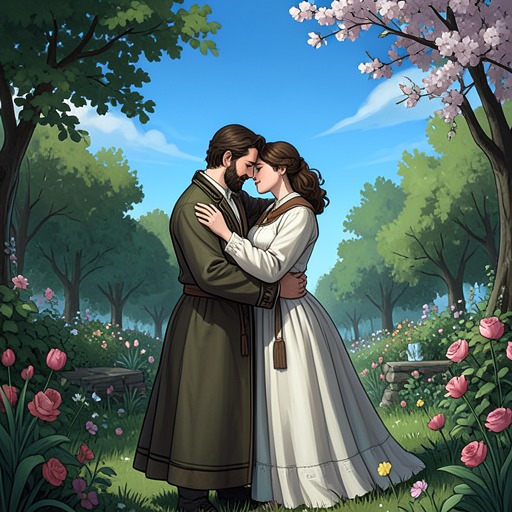
Spring
A cataclysmic lack of HarmonySpring is the poem’s clearest temporal image of renewal and orientation. It appears not as a dated setting or a separate episode, but as a comparison that gives emotional form to the speaker’s devotion: amid storms, solitude, and the pressures of heteronormativity, love produces a movement toward life, light, and the beloved.
Definition and Imagery
Spring enters through the image of a sunflower. The speaker describes blooming and turning toward the beloved as a sunflower turns toward the sun, linking seasonal growth with an active, sustained act of attention. The comparison makes the beloved the source of vitality and places the speaker’s emotional flourishing within a natural cycle of emergence rather than stasis.
The image also gives Spring a relational meaning. The flower does not merely bloom; it turns. Renewal therefore involves direction, dependence, and recognition. The season’s promise is embodied in a motion away from inward enclosure and toward the person whose presence organizes the speaker’s emotional world.
Contrast with Darkness and Solitude
Spring’s regenerative force becomes sharper because the surrounding imagery is marked by danger and deprivation. A sailor fights storms and seas while remaining constantly in danger, while elsewhere no light can be seen. Against this unstable and lightless environment, the sunflower’s springtime orientation supplies an opposing pattern: instead of struggling without bearings, the speaker blooms by turning toward a sustaining source.
The contrast extends to the speaker’s psychological condition. The beloved is associated with love described as the speaker’s only categorical imperative, while another passage presents a relationship that drives the speaker toward Insanity and corrodes a compassionate heart. Hope is imagined as something fragile that must be held, and Solitude and acedia scratch at the heart. Spring consequently does not erase suffering; it names the fragile possibility of life continuing through it.
Love, Desire, and Social Constraint
Spring is embedded in a larger metaphorical system in which love behaves as a force of growth and desire behaves as a wave. The wave of shared desires crashes against the chains of Heteronormativity, making intimacy both a source of movement and a point of conflict with imposed social expectations. The seasonal image answers those chains indirectly: blooming and turning toward the beloved become signs of an attachment that resists being reduced to conventional norms.
This resistance is not presented as abstract doctrine alone. The poem places desire beside treasure, vows, and the willingness to accept risk. The speaker calls the beloved a dream-gem and treasure, vows to cherish the person forever, and acknowledges that such devotion is a risky game willingly embraced. Within this structure, Spring marks the emotional condition in which commitment can become life-giving even when the surrounding world makes love precarious.
Narrative and Thematic Significance
As a temporal symbol, Spring does not guarantee resolution. Later imagery returns to an inner thunderstorm, a tornado of emotions, and a gloomy path walked with the head underwater. Society is also said to have brainwashed humans into fearing others’ opinions, showing that the pressures opposing intimacy remain active. Spring therefore functions less as a permanent arrival than as a recurring counter-image to suffocation and misery.
Its decisive significance lies in the way it converts emotional dependence into vitality. The speaker’s blooming is inseparable from turning toward the beloved, so renewal is represented as relational rather than solitary. In a work crowded with storms, darkness, Insanity, fragile Hope, and social fear, Spring provides the brief but powerful grammar of emergence: life answers confinement by growing, and growth acquires meaning through the direction of love.