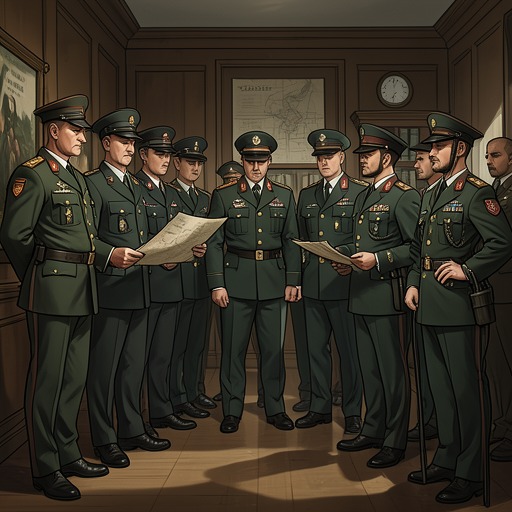
“All a man need ever do is obey”
Across the River and into the Trees“All a man need ever do is obey” is Richard Cantwell’s starkest formulation of military duty—and, in the story of his ruined regiment, an indictment of what that duty can require. He describes obedience as an institutional rule, not a guarantee that orders are wise: a commander may recognize the danger, yet still be required to carry it out. The expression’s certainty sounds less like a solution than the hard conclusion of someone who has lived with its consequences.
The rule and its qualification
When Renata asks why Cantwell must obey people whose judgment he knows to be wrong, he explains that in his army a man obeys “like a dog” and can only hope for a good master. The comparison makes the command relationship one of dependence: responsibility descends through a hierarchy, while a subordinate’s ability to judge an order does not necessarily give him the authority to refuse it.
Cantwell qualifies the rule with experience. After reaching a certain level of command, he says, he has had many decent people above him but only two good masters. His answer distinguishes personal character from institutional power: good superiors are rare, but obedience remains the expectation regardless. Renata wishes he were a general, and he admits that he would like that too, though not with the same intensity. The exchange leaves ambition beside its cost: rank may bring command, but it does not free a soldier from the system of command.
The regiment as the cost of obedience
The expression gathers its force from Cantwell’s account of losing a regiment he had inherited and come to value. The regiment had been his great joy, but orders sent it into an attack that he describes as dangerously arranged: the men were to advance in a line of three, with nothing in reserve, into woods he expected to resemble “Passchendaele with tree bursts.” The American twenty-eighth division had already been bogged down nearby, giving warning of the conditions ahead. Even so, the attack proceeded.
Cantwell recalls that the regiment was destroyed under other people’s orders. Every second man was dead, he says, and nearly all the others were wounded, many with injuries that would last for life. He does not claim to have built the regiment; he had inherited it. That distinction sharpens rather than diminishes his grief: command had made its fate his responsibility, while obedience left him carrying out decisions he believed were wrong. He calls the regiment beautiful and himself the one who destroyed it, yet places that destruction within the chain of orders. The rule does not absolve him; it shows how responsibility and authority can come apart.
The order of battle and its human aftermath
In recounting another attack, Cantwell describes how higher-level decisions shaped the operation. The troops had been moved back two thousand yards from their intended starting point. Aircraft then marked the German positions with coloured smoke before bombing them; Cantwell reports that prisoners from the Sixth Parachute Division shook after the attack. He presents the bombing as effective against the positions holding up his advance, but the episode also sits within a larger pattern: the military machine issues plans, identifies targets, and sends men forward into their consequences.
His memories of the First World War place this command ethic beside the desperation of ordinary soldiers. As a young lieutenant on the Piave, he fought through a winter of attacks and learned to count his surviving shooters after bombardments. He also remembers men seeking ways to avoid another frontal assault, and he and the Gran Maestro founded their order in hatred of those who profited from war. Those experiences complicate any simple celebration of obedience. Cantwell understands both the demands of fighting and the human reasons men may resist being sent to die.
The expression as a bitter conclusion
The phrase appears after Renata suggests that sleep might help Cantwell escape his memories. The narrator then gives the maxim an almost impersonal finality: “All a man need ever do is obey.” Set against the intimate attempt to comfort him, the sentence closes the remembered account without resolving its moral problem. Obedience is stated as if it were simple precisely when the story has shown its consequences to be anything but.
The expression therefore works in two directions. It names the discipline that holds a military force together, but it also exposes the gap between following an order and believing it right. Cantwell’s submission to command did not prevent him from judging the decisions that cost his regiment; it made him an instrument of them. The terse maxim endures as a bitter summary of that contradiction: duty can demand action even when knowledge, care for the men, and the foreseeable outcome all point the other way.