“Let us cross over the river and rest under the shade of the trees”
Across the River and into the Trees“Let us cross over the river and rest under the shade of the trees” is the reported final saying of Stonewall Jackson, recalled by Richard Cantwell in the novel’s closing scene. Cantwell’s recollection gives the expression a double place in the story: it is a historical deathbed utterance, and, as Cantwell speaks it while suffering a fatal attack, a frame for his own approaching death. The river in the saying also resonates with the landscape and military past through which the novel has carried him, without resolving the phrase into a single literal or symbolic meaning.
Source and Form
Cantwell introduces the saying to Ronald Jackson as something General Thomas J. Jackson spoke on the occasion of his death. He qualifies his memory, saying he had once memorized the words but cannot answer for their accuracy, and presents them as the reported version. The expression arrives, then, already marked by transmission: a remembered account of another man’s last words, recited by a soldier who is aware that his own life may be ending.
In Cantwell’s account, the saying follows an earlier military order, “Order A. P. Hill to prepare for action,” and some further delirious speech. This juxtaposition places command beside a final appeal for rest. The first statement belongs to the language of action and military responsibility; the second turns toward a river crossing and shade. Cantwell does not explain the contrast, but its sequence makes the reported words more than a detached historical anecdote: they give his listener a compact image of a soldier’s passage from command into death.
The Saying in Cantwell’s Final Scene
Cantwell asks Ronald Jackson whether he knows the quotation and identifies its speaker. Ronald Jackson recognizes the reference as Stonewall Jackson. Cantwell starts to speak again, but another attack interrupts him; he grips the seat and understands that he cannot live. The remembered saying therefore falls at a precise hinge in the scene. It is offered not as a formal farewell, but as a brief exchange that immediately precedes Cantwell’s final practical decisions.
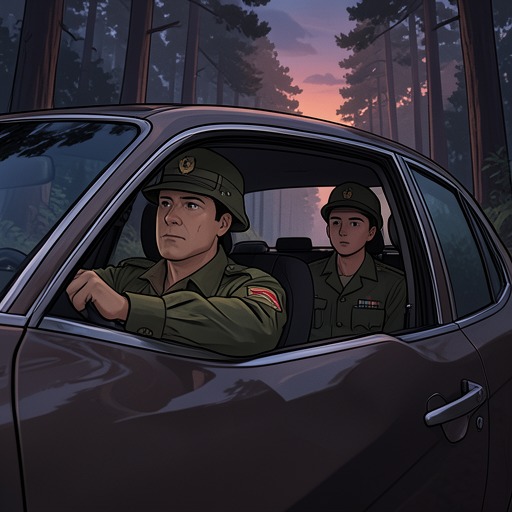
He tells Ronald Jackson to pull over, switch to parking lights, and confirm that he knows the road to Trieste. Cantwell then says he is going to move to the large back seat of the car. It is the last thing he says. He reaches the seat and carefully shuts the door, while Ronald Jackson later turns the car around and prepares to continue toward the highway. The expression’s language of crossing and rest stands beside these concrete actions: directions, a change of seat, a closed door, and the driver’s onward journey. The text does not state that Cantwell is consciously reenacting Stonewall Jackson’s deathbed scene; its force comes from the proximity between the recitation and Cantwell’s own death.
Rivers, War Memory, and Landscape
The expression’s river image belongs to a book in which waterways are both physical features and repositories of war memory. Earlier, as Cantwell crosses the Piave River into Italy, the road and canals recall his youth in wartime. The former positions have become difficult to distinguish from the surrounding ground, yet he remembers that the dead from the last offensive were put into the canals and later buried near the road. He also recalls that they were dug up again and buried in a large ossuary near Nervesa. The landscape has been altered and made ordinary again, but the road beside the canals continues to carry the history Cantwell sees in it.
The Piave is not presented as an untouched natural boundary. Cantwell explains that its water has been siphoned off for hydroelectric projects, leaving the river with little water; he imagines that the Honourable Pacciardi might fight there, but doubts that the fighting would last long. The remembered river crossing in Stonewall Jackson’s saying thus meets a landscape shaped by both military use and later infrastructure. These connections do not make the quotation a direct reference to the Piave, but they deepen the novel’s recurring association between rivers, movement, and the persistence of past events in present-day terrain.
The approach to Venice offers a contrasting view of that terrain. Across the marshes, Cantwell sees the church tower of Torcello, the campanile of Burano, and twelve sailing barges moving with the wind toward the city. His attachment to Venice is inseparable from having fought for it as a boy, even though he did not enter it then. The river and marshland therefore mark not only danger and memory but also the distance to a place he calls his own. Near the end, the saying’s crossing can be heard alongside this history of reaching, defending, and belonging, though the text leaves the relationship suggestive rather than explicit.
Recurrence and Significance
The novel’s closing setting keeps the expression’s imagery in motion. In the cold, the broken ice has refrozen, and the calling duck no longer looks up; Cantwell observes that it has abandoned treachery for security. The scene places an animal’s changed behavior against his own return to the memory of Renata and their farewell. He warns himself not to think of her, recognizes that they have already said goodbye, and reflects that loving and leaving can hurt. The river-crossing quotation soon follows, so rest, separation, and death gather in the same final stretch of narration without becoming interchangeable.
The expression’s significance lies partly in its recurrence as a remembered utterance at the threshold of another death. Cantwell’s uncertainty about the exact historical wording keeps the moment grounded in recollection rather than presenting it as an authoritative account. Its familiar movement—from an order to prepare for action toward a request to cross and rest—also echoes the novel’s larger contrasts between military duty and human limits. But the ending does not turn the phrase into a promise of comfort or explain what lies beyond the crossing. It gives Cantwell a historical precedent for speaking at the edge of death, then leaves the reader with his last words, his carefully shut door, and Ronald Jackson continuing along the road.