28th Division
Across the River and into the TreesThe 28th Division appears briefly but pointedly as a formation caught in the difficult conditions of a woodland operation: it had been bogged down on the Colonel’s right, and its experience made the ground ahead easier to assess. Later, after Paris has been taken, the prospect of the division being paraded through the city turns triumph into another anticipated military burden.
Identity and Introduction
The novel supplies no organizational history, command structure, or detailed account of the 28th Division. It identifies the formation through its place beside the Colonel’s force in the woods and through a later exchange about what might happen after the capture of Paris. Those limited references make its condition and expected use more important here than any institutional description.
The Woodland Operation
The Colonel recalls that the 28th Division had been bogged down on his right for some time. Because its experience provided reasonably accurate information about conditions in the woods, he knew the ground facing his own force would be unfavorable. The division’s predicament thus functions as practical intelligence: the difficulties it had encountered were a warning about what another unit could expect, not an abstract assessment of terrain.
In the same recollection, the Colonel describes his own regiment being ordered into an attack in the woods, with its patches removed and no reserve behind the three units in line. The account does not identify that regiment as the 28th Division. Rather, the juxtaposition places the division’s prolonged difficulty beside a separate assault and sharpens the sense that the operation’s terrain and deployment left little room for safety. The division is evidence of the conditions; the Colonel’s regiment is the force he describes committing to the attack.
After Paris
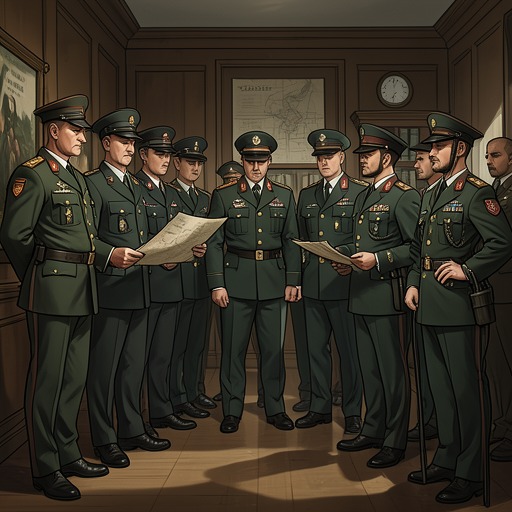
When Renata says she has taken Paris, the Colonel responds by anticipating that the 28th Division will next be paraded through the city. Her answer dismisses the concern, but he says that he cares. The exchange does not confirm that such a parade takes place or establish the division’s actual movements. It does show that, in the Colonel’s view, the capture of a city may be followed by another demand on troops rather than a simple end to military obligations.
Narrative Significance
The division links two different scales of consequence. In the woods, its stalled progress conveys what the terrain has already cost and helps explain why the next operation looks so dangerous; after Paris, its possible public appearance evokes the burden that can persist beyond a celebrated victory. The novel offers no fuller account of the formation, leaving its significance in these brief appearances: a neighboring unit whose hardship warns of danger, and a force whose anticipated parade tempers the language of triumph.