Ardennes
Across the River and into the TreesThe Ardennes appears in the novel through the Colonel’s recollection of a brief wartime pursuit with his best friend, George S. Patton. Its significance lies not in a broad description of the region but in the way a particular stretch of upland becomes legible to two commanders: wet sand records the enemy’s movement, terrain helps them anticipate its next decision, and a choice to pursue replaces the security of a written plan. The memory preserves the Ardennes as both a working battlefield and a private moment the Colonel later considers sharing with Renata.
Setting and Terrain
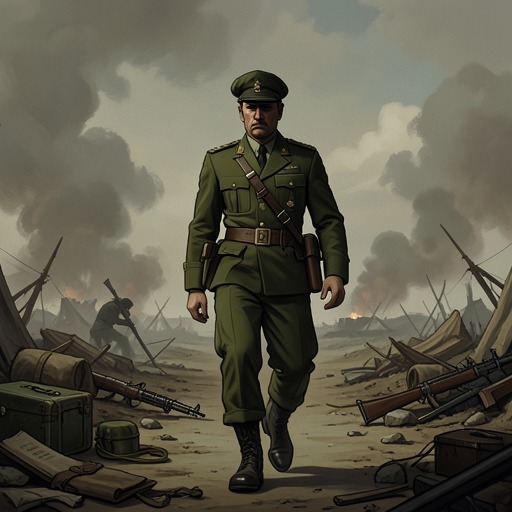
The remembered action takes place in early fall on high, rolling ground crossed by sandy roads and trails. Scrub oak and pines grow across the upland. Rain the previous day has left the sand moist, making the prints of enemy tanks and half-tracks clear. As the weather clears and visibility improves, the two men can survey the surrounding country and study the tracks rather than relying on a report detached from the ground.
The landscape functions as practical evidence. The Colonel recognizes the individual tracks of the vehicles they are following and uses them, together with what he knows of the enemy’s remaining mines and ammunition, to judge how far the pursuit can continue. The Ardennes is thus rendered through the details that matter to the men moving across it: routes, visibility, vehicle traces, and the defensive positions the enemy might choose. The recollection offers no general account of the region; its terrain is defined by what it lets the pursuers see and infer.
A Pursuit Across the Upland
The Colonel remembers being with George S. Patton by a stroke of chance during active operations, when their forces were pursuing the enemy. They are unusually far forward for men of their rank, close enough to examine the tracks themselves. Their exchange makes the unusual position explicit: they have moved ahead of the point, yet the Colonel treats their forward presence as an opportunity rather than a reason to turn back.
His assessment is specific. He believes the enemy has exhausted its mines, estimates approximately how many rounds remain, and has worked out where it would have to fight before reaching the Siegfried. He expects it not to defend at either of two likely locations, but to race onward toward its destination. When George S. Patton asks whether the enemy could have left a force at the logical defensive position, the possibility remains part of their discussion; it does not erase the Colonel’s confidence in the larger pattern he has read.
The scene’s momentum comes from a decision made against the comfort of procedure. The Colonel proposes discarding the book and pursuing decisively. George S. Patton answers with agreement, while noting that he himself wrote the book. Their exchange joins professional knowledge to improvisation: the men do not reject experience, but choose to act on their reading of the immediate ground rather than allow a written framework to settle the question for them.
Judgment, Risk, and Command
The Colonel’s confidence rests on accumulated observation, not on a claim that war can be predicted without error. He says that he has been right more than ninety-five percent of the time, but recognizes that the remaining failures can carry serious consequences. That qualification matters to the Ardennes memory: his rapid judgment is presented as a command strength, yet the recollection also retains the cost attached to being wrong. A high batting average does not make the dangerous fraction disappear.
The pursuit also places senior officers physically close to the action. The Colonel is then a general and assistant divisional commander; George S. Patton is his best friend, and both are far forward as they assess enemy movement. Their rank does not remove them from the terrain or the uncertainty of the decision. Instead, the scene shows command as a combination of detailed knowledge, calculated inference, and willingness to accept the risks of acting before every possibility can be ruled out.
The Ardennes as Remembered Ground
The episode reaches the reader as recollection rather than as a continuous account of the pursuit. In the present, the Colonel considers whether Renata would like to hear the story and recognizes that George S. Patton is the one person who could tell it with the authority of a shared witness, but cannot be the one to tell it to her. The memory is therefore intimate as well as military: its meaning depends partly on the friendship that made the moment shared and on the absence that now prevents that shared story from being retold by both men.
The recollection ends not with a report of the pursuit’s outcome but with the Colonel’s attention returning to the country itself: the wind among the trees, the heather underfoot, and the tracks in the wet sand. That ending keeps the Ardennes scene bounded. It records what the men observed and the resolve with which they chose to continue, while leaving the larger result unstated. The land remains vivid in memory as the place where tactical calculation, risk, and friendship briefly converged.