Duck-shooting etiquette
Across the River and into the TreesDuck-shooting etiquette is presented not as a written rulebook but as a shared expectation about fair chances and proper conduct in the field. Its sharpest test comes when a boatman shoots at ducks flying toward Richard Cantwell’s blind. Cantwell regards this as a grave breach of the sport’s code; his own decision to fire back, then apologize for acting in anger, reveals that etiquette governs both the treatment of a fellow shooter and the shooter’s response to a provocation.
The sporting boundary
The episode begins with ducks flying low toward Cantwell’s position. One falls, and another shot follows. Cantwell realizes that the boatman is firing at birds that would otherwise have come to his blind. The wrong is specific: the boatman is not merely shooting nearby, but taking birds from the flight approaching another shooter. Cantwell understands the act as a violation of the reciprocal fairness on which an organized shoot depends.
The distinction matters because shooting is not depicted as simply taking as many birds as possible. The blind gives Cantwell a place from which the ducks are expected to approach; the boatman’s interference deprives him of that opportunity. The narrative presents the resulting anger as a response to an understood sporting boundary, not as a dispute over whether the boatman may possess a shotgun or shoot ducks at all. It does not supply a formal rulebook or a penalty. Instead, the norm becomes legible through the participants’ actions and their later exchange.
Cripples and the boatman’s role
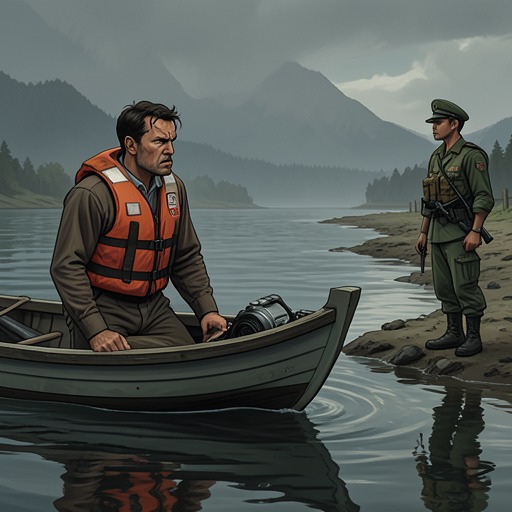
The boatman has a legitimate function in the shoot: he carries a shotgun to kill wounded ducks that might escape beyond the dog’s reach. That practical duty makes the incident more pointed. His shooting at Cantwell’s approaching birds is not the same act as finishing a cripple that the dog cannot retrieve. The narrative thus distinguishes between shooting required to prevent a wounded bird from escaping and shooting that intrudes on another participant’s fair chance.
The distinction also keeps the episode from reducing the boatman to a simple opponent. The same man whose action Cantwell condemns has a stated responsibility in the handling of wounded birds. The text gives no explanation for why he shoots toward Cantwell’s flight, and Cantwell does not learn one at the time. The rule is therefore shown through the observable breach and its consequences, not through a settled account of the boatman’s motives.
Anger, distance, and restraint
Cantwell first recognizes that the boatman is too far away to hear a shout. He fires twice in the man’s direction, knowing that the pellets cannot reach him; the shots serve to show that Cantwell has noticed what he is doing. This is a retaliatory gesture rather than an attempt to injure the boatman, but it still marks a departure from composed sporting conduct. Cantwell is pleased with the shoot’s organization and has been enjoying it, which makes the intrusion feel especially disruptive.
He also knows that anger is bad for him. With no water available, he takes two pills and washes them down with gin from his flask. The detail connects the breach of etiquette to the effort of controlling his temper: the incident has become more than a matter of missed birds, but the narrative does not present his anger as harmless or self-justifying. His later acknowledgment that he shot in anger confirms that he recognizes his own response as a failure of restraint.
Apology and the wider moral pattern
When the boatman later asks whether Cantwell had good shooting, Cantwell answers that he killed four ducks and that the dog found three crippled birds shot by other people. Asked why he fired, Cantwell apologizes and says he did so in anger. He does not press the boatman to explain his own anger. The exchange does not establish a formal reconciliation or settle the earlier breach, but it records Cantwell accepting responsibility for his part in the encounter rather than treating the other man’s conduct as permission to do anything in return. The boatman, in turn, says he is sorry the ducks did not fly better.
That modest exchange resonates with Cantwell’s account of wartime conduct, though the two settings are not equivalent. During fighting on the Piave, he killed enemy soldiers but says he never hated them; later, he tells his daughter that after killing so many, he and his men could afford to be kind. The hunting episode offers a smaller, more immediate test of a related distinction: recognizing a wrong does not remove the obligation to govern one’s own conduct. Elsewhere, Cantwell describes a devastating attack ordered despite the dangerous conditions and says that a regiment was destroyed. Against such matters of command and consequence, the sporting dispute is limited in scale, but it is precisely its ordinary scale that makes his apology visible. Etiquette here is not only a claim to one’s fair share of the shoot; it is also a discipline of restraint after that claim has been violated.