Erwin Rommel
Across the River and into the TreesErwin Rommel is a remembered adversary who becomes a friend in Richard Cantwell’s account: the two fought as young officers, later spoke and skied together, and remained figures Cantwell imagined consulting about war. Though Rommel is absent from the present action, these recollections give him unusual weight. He stands at the meeting point of military rivalry, private affection, and Cantwell’s insistence that war cannot be understood through reputations or simplified victories alone.
Early Encounters and Later Friendship
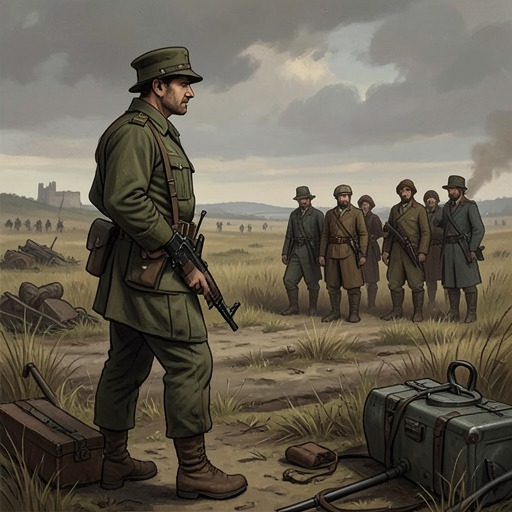
Cantwell recalls fighting Rommel when both were young, on the route between Cortina and Grappa. Rommel was a captain; Cantwell, although serving as an acting captain, was in reality a sub-lieutenant. Their first relationship was therefore defined by opposing sides in battle, not by personal acquaintance. Cantwell emphasizes that he did not know Rommel then.
Their relationship changed after the war, when they were able to talk. Cantwell remembers Rommel as very nice and says he liked him; they also went skiing together. This later companionship does not erase their earlier conflict. Instead, it makes the enemy designation inadequate to describe the man Cantwell came to know. Rommel’s presence in the novel is built from that contrast: the young officer across the battlefield and the agreeable companion after it belong to the same remembered life.
Cantwell also places Rommel among the Germans he could like, naming Ernst Udet as the one he liked best. This tolerance is not presented as a claim that wartime suffering did not matter. Renata has reason to regard Germans differently: German soldiers killed her father and burned the family villa on the Brenta. Cantwell asks her to understand his own attitude, explaining that having killed so many makes kindness possible. He estimates that he has killed 122 men with certainty, not counting possible kills. Against that ledger, his friendship with Rommel appears neither as forgetfulness nor as innocence, but as a distinction he makes between a person and the enemy category under which he once fought him.
Reputation, Victory, and the Cost of War
Rommel’s reputation enters Cantwell’s conversations when Renata points out that he was beaten by a British general. Cantwell resists the idea that the outcome can be credited to one commander alone: he asks whether anyone else had already weakened Rommel and notes the numerical advantage of fifteen to one. He sets that ratio against the earlier fighting he and the Gran Maestro endured, when they won repeatedly despite being outnumbered three or four to one.
That earlier success came at a terrible cost. Cantwell recalls a year in which the forces he and the Gran Maestro faced three main battles and suffered more than 140,000 dead. He connects this scale of loss to their ability to speak gaily and make jokes without solemnity: humor is not proof that the dead have been forgotten, but part of the manner in which survivors speak about what they endured. In this comparison, Rommel is not merely the famous opponent defeated by a famous general. His defeat becomes a way to question clean accounts of victory, which can conceal the accumulated actions and casualties behind a celebrated name.
A Professional interlocutor for Later Campaigns
During his account of the later war, Cantwell says Rommel might understand the campaigns in detail when few others could. He explains that Rommel was kept under wraps in France and that the two tactical air forces, the American force and the Royal Air Force, had destroyed his communications. Cantwell wishes he could discuss certain matters with Rommel, as well as with Udet. The wish is revealing: he imagines conversation not with an abstract defeated enemy, but with someone whose military experience might meet his own on equal terms.
That imagined professional exchange also clarifies Cantwell’s qualified view of air power. He distinguishes the tactical use of heavy bombers, which he accepts when properly employed, from ground support, for which he prefers a capable commander such as Pete Quesada. The distinction belongs to Cantwell’s broader effort to judge military methods by what they do in particular circumstances, rather than by their scale or spectacle. Rommel matters here as a potential interlocutor: Cantwell believes he might understand the campaigns and the decisions that outsiders reduce to headlines.
Memory, Fellowship, and the Measure of Victory
Cantwell’s account of a major bombing describes the Valhalla Express marking the target with coloured smoke before the following sections bombed the German positions. The prisoners taken afterward were men of the Sixth Parachute Division; Cantwell calls them brave and recounts that they shook uncontrollably. The episode records the destructive force of the attack while refusing to make its opponents contemptible. That combination of tactical judgment and recognition of the enemy’s humanity helps explain why Cantwell can remember Rommel as a friend without denying that they once fought on opposite sides.
The same tension shapes Cantwell’s story of command. He says he received a regiment after a commander he had known since the man was eighteen was relieved. Later, while his force was trying to gain the high ground, Cantwell believed the professional German defenders might have surrendered if approached with a flag and allowed to consider the demand. Instead, a phone call brought orders from higher headquarters to take the town by assault, reportedly because its name had appeared in a newspaper. Cantwell obeyed; the regiment was destroyed. He does not make Rommel responsible for that decision, but the imagined possibility of speaking with him sharpens the contrast between professional judgment and distant orders.
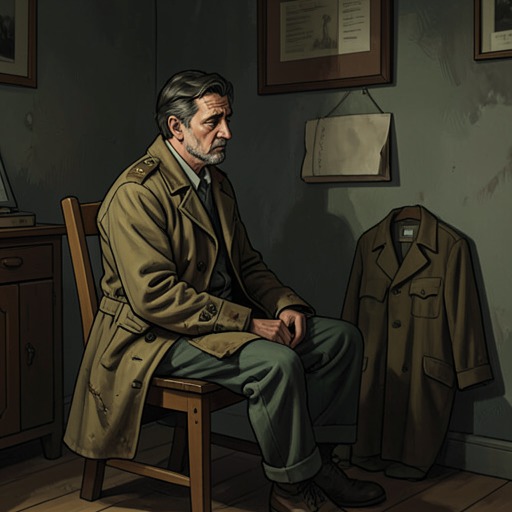
After the regiment’s destruction, the American replacement system rebuilt it, leaving a core of survivors who understood what had happened and distrusted the prospect of fighting in the woods ahead. Cantwell imagines that, instead of meeting in hell, he and his dead companions might find a corner table with Rommel and Udet in Valhalla. The image joins the opposing armies in an imagined afterlife without pretending that the losses were small. Near the end of his recollections, Cantwell attributes to his old friend Dr. Rommel the principle that a fight must be won and that everything else is secondary. Rommel’s remembered voice thus carries both warmth and severity: he is a companion Cantwell liked, a soldier whose judgment he respected, and a figure through whom the novel tests what victory can mean after the costs of command have been counted.