Hürtgen Forest
Across the River and into the TreesHürtgen Forest is the setting of one of the Colonel’s most searching accounts of command and combat: a place where advance plans met prepared defenses, and where the cost of repeated attacks accumulated in men, vehicles, and units. Recalling the operation to Renata, he rejects the idea of an easy campaign. The forest becomes not merely a battlefield but a landscape in which confident briefings, compromised plans, and attrition steadily lose their meaning.
Location and the operation’s name
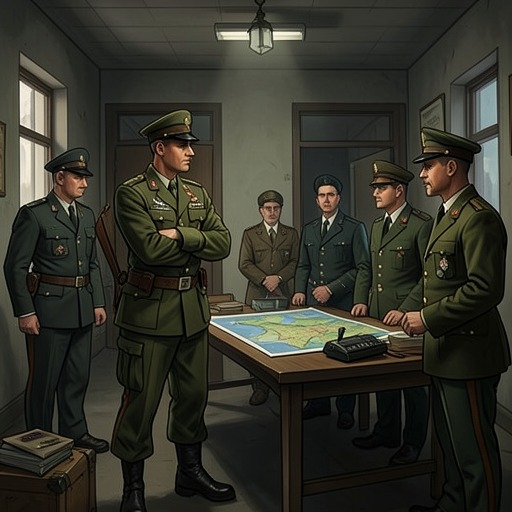
The Colonel recalls being briefed in Paris, during two days’ leave between the Schnee-Eifel fight and the fighting he later associates with Hürtgen Forest. General Walter Bedell Smith described the coming operation as easy. The Colonel complicates the familiar name: in his account, Hürtgen Forest was only a small sector of the area, which he identifies as the Stadtswald. He says the German High Command had anticipated fighting there after Aachen had been taken and the road into Germany breached. The name thus points, in his telling, to a larger forested battlefield than its conventional label suggests.
That mismatch between expectation and conditions governs the story he tells. The briefing had made the operation sound manageable; the Colonel’s later account emphasizes that the terrain and German preparation made the attack anything but straightforward. He does not present the general who gave the briefing as a villain. Instead, he distinguishes a mistaken assessment from deliberate wrongdoing, while insisting that being wrong had grave consequences for the soldiers sent into the woods.
Plans, concealment, and deployment
Before the attack, divisional patches were removed even as far back as the rear echelon, so the Germans would not know which American force was approaching. Yet the Colonel describes an attack arranged with three elements in line and nothing in reserve. He considers that deployment fundamentally unsound. The effort to conceal the force’s identity was also undermined when a regiment was committed before the main attack: the enemy would be able to take at least one prisoner and learn who they were.
The American Twenty-eighth Division, already bogged down on the right, offered a warning about what conditions in the woods would be like. The Colonel calls those conditions unfavourable, and his account shows why prior knowledge did not spare the advancing troops. Despite the warning, the attack went ahead. The regiment committed before it began was destroyed; it was later rebuilt through the American replacement system. The Colonel describes that system as keeping men in service until they were badly hit, killed, or removed from duty after breaking down. Rebuilding the unit did not erase the danger: a core of surviving soldiers remained who understood what the forest was likely to demand.
Terrain and the cost of fighting
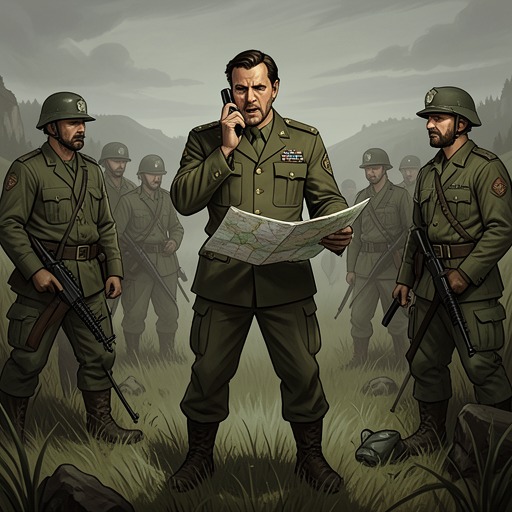
The Colonel recalls the forest as a place where staying alive was difficult even without taking part in an attack. His forces were attacking repeatedly, day after day, while rain, snow, or fog persisted. In some stretches, the roads had been mined as many as fourteen mines deep. Vehicles churned through mud, sometimes breaking through to a lower layer, and their loss also cost the lives of people traveling in them.
German defenses made movement dangerous and predictable. Mortars and heavy artillery covered the area; machine-gun and automatic-weapon fire was organized along prepared lanes. The ground was channelled so that, in the Colonel’s assessment, attempts to outthink the defenders could still lead directly into their fire. He also recalls at least one railway gun. Forest, roads, and defensive positions worked together to constrain an attacker’s choices: even forward movement through the woods became an exposure to planned fire.
The first day brought the loss of all three battalion commanders: one was killed within twenty minutes, and the other two were hit later. The Colonel notes that company commanders were also lost repeatedly. Replacements arrived, but he reflects that transporting and recovering them consumed men and fuel that could otherwise have been used in the fighting. His recollection makes casualty figures inseparable from the practical work of moving through the forest: each loss required further effort from a force already under pressure.
Memory and significance
The Colonel remembers particular moments rather than offering only a campaign outline. One was a bare stretch of hill that had to be crossed on the way into Grosshau, under observation and fire from 88s. A small patch of dead ground seemed to offer some cover, but, after it was cleared, the troops found that German mortars also had good observation there. The apparent refuge proved exposed too.
He also recalls that, before the troops finally entered a town, they had used a great deal of white phosphorus against it. Afterward, he saw a German dog and a cat feeding on the remains of a German soldier. He relates the scene as a disturbing detail that resists easy abstraction into battlefield statistics; it does not, in his telling, offer a lesson that can prevent another war. The account closes instead on the forest’s persistent human cost: soldiers were killed in the woods and in the towns that had looked innocent but were, in fact, fortresses. Hürtgen Forest endures in the Colonel’s memory as a place where inaccurate expectations met a defense prepared for the ground, and where the consequences were borne repeatedly by the men ordered forward.