Mallard
Across the River and into the TreesMallards are central to the novel’s duck-hunting scenes, but they are more than targets: they are also live callers, valued food and feathers, and individual birds whose beauty Richard Cantwell notices even while hunting them. Their presence links the practical routines of the frozen lagoon to the landscape’s history of war and engineering, and the final decision to spare a wing-tipped drake brings the hunt’s competing attitudes toward animals into focus.
Appearance and Place in the Hunt
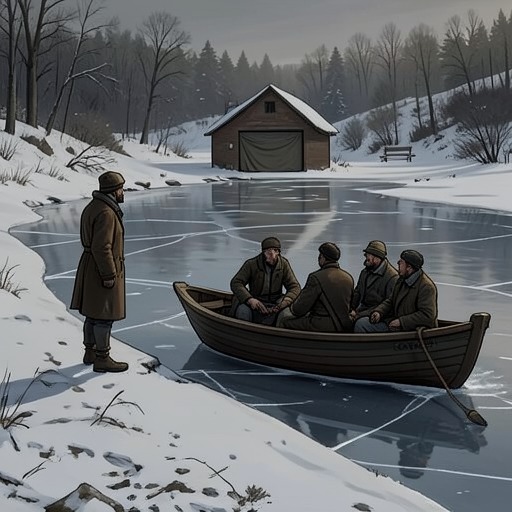
The opening hunt begins two hours before daylight, with boats moving through darkness along the canals. Each carries a shooter, guns, wooden decoys, and a sack holding one or two live Mallards, including hens or a hen and drake. A dog rides in each boat. The birds are part of a working arrangement: decoys establish the spread, while a live hen is put out on a string and anchor as a caller. The novel presents this practice through its exact materials and motions rather than as an abstract account of hunting.
Once the boatman has arranged the decoys in two groups, one toward the anticipated sunrise and another to the shooter’s right, he lowers the live hen into the water. She dips her head and splashes water over her back. The scene gives the bird a place within the hunters’ technique, but it also registers her as an active animal: she moves and calls, while the people around her interpret what she does according to their purposes. Richard Cantwell, concerned that too little open water will attract birds, asks the boatman to break more ice. The boatman complies, though he knows the work is unnecessary. The exchange reveals that the hunter’s knowledge is not complete and that the caller’s use is embedded in a human-managed landscape of decoys, ice, and deliberate disturbance.
Mallards are also valued after the shot. Richard tells a waiter that, if the next hunt is lucky, there will be plenty of large, green-headed ducks, good to eat and carrying beautiful feathers. The waiter’s wife has saved feathers and sent thanks through him. The birds therefore circulate between lagoon and household: they are food, a source of plumage, and gifts whose remains are kept. That practical value coexists with Richard’s attention to their appearance, rather than replacing it.
Waterways, War, and Seasonal Change
The canals beside the road into Venice carry two histories at once. Remembering fighting along the Piave River, Richard sees the old positions beside canals where dead soldiers were thrown after a major killing. The gates downstream remained in enemy hands and were closed, so little water moved through the canals. The bodies remained there until labour troops removed and buried them near the road; later, the dead were dug up again and reburied in an ossuary near Nervesa. In the same canals, Richard now sees many ducks and geese, as well as men fishing. Mallards belong to this changed scene not as symbols with a single meaning, but as living wildlife present in waterways marked by military violence and subsequent human use.
The lagoon where the hunt takes place is itself altered by immediate conditions. A sudden, windless cold has frozen the shallow water overnight. The new ice bends under the boatman’s oar, then breaks sharply, slowing the boat. Later, after the decoys have been set out, the broken ice begins to freeze again. The caller remains in the water as the weather grows colder; by a later morning she no longer looks up and has shifted from calling to a posture Richard reads as seeking security. The changing ice and the bird’s altered behavior give the hunting scenes a seasonal progression. They also make clear that the lagoon is not a static backdrop: cold, channels, and human activity shape the conditions in which the birds and hunters meet.
From the canal road, the landscape opens toward Torcello and Burano, whose church tower and campanile stand beyond the marshes. Richard remembers having fought to defend Venice without seeing it, then recalls a clear, cold day when he saw the city across the water but still did not enter it. The present-day route and the old military front thus meet in a landscape where canals support travel, fishing, and bird life while retaining memories of conflict. The Mallards’ presence belongs to this continuity of use and change, not to an untouched natural setting.
Hunting Encounters and Individual Birds
The birds arrive in distinct episodes, each exposing a different relation between preparation and chance. One group of Mallards approaches low across the frozen lagoon and flares upward when a shot sounds from behind, where Richard knows there is no other blind. He sees one bird fall and hears another shot; the sullen boatman has fired at ducks that would otherwise have come toward Richard. The incident makes the hunt competitive even within the shared arrangement of boats and blinds: a bird’s flight can be interrupted by another shooter, and Richard’s opportunity depends on where the others are positioned.
In a later passage, Richard sees a single drake clearly against the mountains and brings it down. It lands on the ice just outside the blind, breaking through the lightly refrozen patch opened earlier for the decoys. The live caller looks toward the fallen bird and shifts her feet. Richard speaks to her, wondering whether she saw the drake coming, but the question remains his interpretation rather than knowledge of what the hen perceives. He notices the drake’s winter plumage on breast and wings and imagines making Renata a vest from Mallard skins, with a Mallard drake’s feathers for the back and other duck feathers arranged in stripes across the front. He also recognizes the obstacles: the ducks are destined for market, and no one nearby knows how to skin and cure the hides. The fantasy combines affection, aesthetic appreciation, and the practical use of birds, without making those impulses fully compatible.
The final encounter changes the result for one bird. Bobby emerges from the sedge carrying a drake in his jaws. Richard takes it from the dog, finds it intact, and handles it gently, attending to its beating heart and captured, hopeless eyes. On examining it, he determines that the bird is only wing-tipped. Rather than have it treated as an ordinary kill, he directs the boatman to put it in the sack with the hen, to be kept as a caller or released in spring. The boatman takes it carefully. The hen can be heard inside the bag, though Richard cannot tell whether she is speaking to the drake or protesting. The scene ends not with certainty about the birds’ understanding, but with a practical decision that preserves the injured bird’s life and assigns it a future beyond the hunt.
Use, Attention, and the Limits of Understanding
Across these scenes, Mallards occupy several roles that do not settle into one another. The live hen is deployed as a caller; the decoys and open patches of water are arranged to draw wild birds; the shot birds may be eaten, sold, or valued for their feathers. Yet Richard repeatedly attends to individual details: the drake’s winter plumage, the way it falls onto ice, and the vulnerable movement of the bird retrieved by Bobby. His proposed feather vest for Renata makes the tension especially clear. The bird’s beauty inspires the idea, but realizing it would require killing and preserving skins, and the actual ducks are already bound for market.
The narration also preserves a boundary around animal experience. Richard guesses at what the hen sees and hears her through the burlap sack, but admits he cannot understand duck-talk. That limit matters: the birds are integral to human plans, yet their intentions remain uncertain. The caller’s possible protest, the drake’s captured eyes, and the wing-tipped bird’s survival are presented through observation and inference rather than an invented account of animal thought. By ending with the injured drake kept for future use or release, the novel leaves the hunt’s instrumental logic in place while allowing a specific bird to escape its usual conclusion.