Richard Cantwell and Ronald Jackson’s Superior-Subordinate Relationship
Across the River and into the TreesRichard Cantwell and Ronald Jackson’s Superior-Subordinate Relationship is defined by the gap between formal military authority and the Colonel’s conflicted attention to the young driver under his command. Cantwell can be cutting, distrustful of Jackson’s instincts, and convinced that he does not truly belong to the soldiering profession; at the same time, he recognizes that Jackson is unhappy and makes a deliberate effort to release him from duty for an evening. Their exchanges reveal a relationship in which care rarely arrives as gentleness, but is present beneath impatience and command.
Identity and Unequal Positions
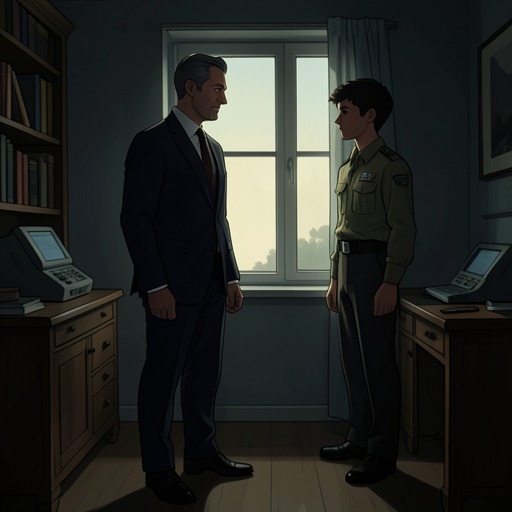
Cantwell is a fifty-year-old infantry colonel in the United States Army, and Jackson serves as his driver. The imbalance is explicit: Jackson addresses him as sir, receives his instructions, and is expected to follow them. Yet Cantwell’s authority is not presented as effortless distance. He has recently taken mannitol hexanitrate before a physical examination required for his trip to Venice, and the surgeon’s warning about the risks makes clear that his command role is carried by a body under strain. Jackson accompanies him in the car, placing the younger subordinate beside a commander whose private vulnerabilities remain largely outside the chain of command.
The two men also differ in what military life means to them. Cantwell regards combat as an experience that other people rarely want to hear about and distrusts the institutional habits of officers who seek advancement or privilege. He judges Jackson more personally: despite the combat infantryman badge, Purple Heart, and other decorations he wears, Cantwell thinks of him as a man placed in uniform against his will, who has stayed in the Army for his own reasons rather than from a soldier’s vocation. This is Cantwell’s assessment, not a neutral account of Jackson’s inner life, and its severity establishes how readily the Colonel distinguishes military credentials from the character he believes true soldiering requires.
The Journey and Cantwell’s Judgment
While driving from Trieste to Venice, Cantwell asks Jackson what he did in civilian life. Jackson explains that he had been in partnership with his brother in a garage in Rawlins, Wyoming. Cantwell asks whether he will return there. Jackson answers that his brother was killed in the Pacific and that the man running the garage was no good; they lost their investment. Cantwell responds that the loss is bad. Jackson agrees emphatically, then adds the formal address, sir. The exchange briefly joins personal misfortune to military hierarchy: Jackson speaks plainly about what he has lost, but the habitual form of respect remains in place.
The conversation also clarifies why Cantwell’s account of Jackson is incomplete. The driver is not simply an indifferent soldier: he has lost a brother and a livelihood, and his circumstances include a civilian future already disrupted by war. Cantwell elicits this history but does not pursue it at length. He believes one man’s war is usually boring to another, and stops talking about his own combat experience. That restraint leaves Jackson’s story in the foreground for a moment, while preserving the distance between a commander shaped by war and a subordinate whose relationship to military service Cantwell thinks he can read.
Reprimand, Deference, and Friction
Cantwell’s command style can turn abruptly harsh. When Jackson takes precautions over Cantwell’s property despite being told that people in Venice do not steal, the Colonel calls him excessively noble, tells him to listen the first time, and sends him to retrieve the bags, park the car, and check its oil, water, and tires. Jackson replies that he heard him. The outward exchange is brief, but the narration also gives Jackson’s private judgment: Cantwell can be mean and, just as readily, very nice. That contrast is central to their relationship. Jackson experiences the Colonel’s conduct as changeable rather than simply cruel, while Cantwell expects immediate attention and compliance.
The friction does not erase the subordinate’s formality or his capacity to answer back within it. At the Gritti Palace Hotel, Cantwell calls for Jackson, assigns him a place on town, authorizes him to sign for food, and sets a time for him to report the next morning. He also checks whether Jackson has money and tells him not to return unless he gets into trouble. Jackson has entered the room and stands at a semblance of attention; even as Cantwell tries to dismiss him, the encounter remains staged by rank and duty.
A Command Used to Grant Freedom
Cantwell explains that he is tired of seeing Jackson worry and wants him to have some fun. He makes Jackson repeat the instructions, converting an informal wish into a properly acknowledged order: Jackson is to report to the hotel lobby at eleven the next morning, keep out of the Colonel’s sight, and make a reasonable attempt to enjoy himself. The formality is deliberately comic, but the instruction itself is serious. Cantwell uses the authority that normally constrains Jackson to create a small interval of freedom from service and from the anxious attention he has been giving his commander.
Jackson’s response is neither easy intimacy nor simple obedience. He performs the requested recitation with his serial number and the prescribed time, then adds the qualification that he will make a reasonable attempt. When Cantwell begins to apologize, Jackson says he disagrees with the Colonel’s implied self-judgment. Cantwell thanks him, hopes Jackson is right, and sends him away with another request to have fun. Their exchange allows Jackson to reassure his superior, but only briefly: the Colonel still ends it by dismissing him in the language of command.
After Jackson leaves, Cantwell calls him one of the sad Americans, and the Gran Maestro asks what sort of man he is. Cantwell agrees that Jackson is sad, while criticizing the broader group as self-righteous, overfed, and undertrained; he adds that if they are undertrained, that is his responsibility. He nevertheless distinguishes the good soldiers among them and believes they could have fought as well as, perhaps better than, the men in the campaigns he remembers. The judgment is harsh, but the acceptance of responsibility complicates it. Cantwell does not treat a subordinate’s shortcomings as wholly separate from the command structure in which he serves.
The Relationship’s Limits and Meaning
Cantwell and Jackson do not become equals or confidants in these scenes. Jackson’s losses are acknowledged but not repaired; Cantwell’s concern takes the form of orders, corrections, and permission rather than sustained personal conversation. Their relationship nevertheless exceeds a purely mechanical exchange of commands. Cantwell notices that Jackson worries, asks about his civilian life, checks that he has money, and gives him time away from the Colonel. Jackson, in turn, can recognize both the meanness and kindness in his commander and can answer an apology without abandoning respect.
The result is a compact portrait of command as both pressure and responsibility. Cantwell demands attention, judges Jackson against an ideal of soldierly character, and retains control over his movements. Yet he also sees a young subordinate’s unhappiness and directs that authority toward an opportunity for pleasure. The tenderness remains limited by rank and by the Colonel’s abrasive manner; it is conveyed not through equality, but through the unusual order to leave him alone and enjoy the evening.