The military trade
Across the River and into the TreesThe military trade is Richard Cantwell’s term for the work of war: learning how to fight, directing others under orders, and living with the consequences. The novel presents it as a craft requiring precision and endurance, but never as a clean or self-justifying one. Cantwell can describe what effective command demands; his recollections also expose how military systems turn people into numbers, how obedience can produce preventable loss, and how little the public record may convey about combat as lived experience.
A Craft of Fighting and Survival
Cantwell defines his profession narrowly as the work of fighting armed men. That boundary matters to him: it distinguishes the military purpose he accepts from violence without a legitimate target. Yet he recognizes that war repeatedly exceeds the distinction. He reflects that soldiers have killed things that were not armed, and his thought of himself as a breaker of spells falters because such a task belongs outside his trade. The uncertainty is not resolved by professional language; naming the work does not make every act within it justifiable.
His account of the winter along the Piave shows the practical knowledge behind the title. While ill, he commanded troops defending against attacks by enemy soldiers carrying stick bombs. He taught his men to shoot effectively and to keep looking at the advancing enemy, turning training into a capacity they could use under pressure. After bombardments, he had to count quickly to determine how many shooters remained. Command here is not an abstraction: it is the repeated calculation of what a unit can still do after an attack, and the effort to make that capacity count.
The distinction between survival and invulnerability also marks Cantwell’s experience. He recalls being hit three times in that winter and taking those wounds as evidence that he might be personally protected, despite the heavy artillery that preceded attacks. A later, more serious wound ended that confidence. He understands the change as the loss of an illusion, not as proof that a soldier can master the risks of his profession. The trade teaches competence, but it cannot guarantee control over what happens next.
Orders, Judgment, and Responsibility
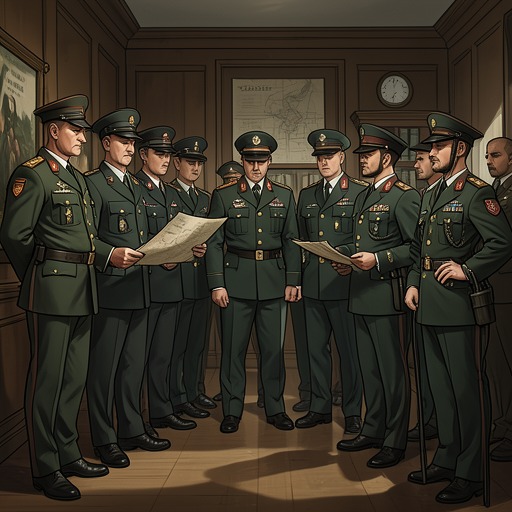
Cantwell explains command as a chain of delegated decisions. Higher headquarters sets the task; a commander determines how to carry it out, issues orders—often by telephone—and presses people he respects to do what he knows may be nearly impossible. The work also requires sleepless attention: thinking late, rising early, and making decisions within constraints imposed from above. His description makes command both technical and moral. Orders explain how an action was authorized; they do not erase the human consequences of choosing its method.
A bombing mission illustrates the gap between military effectiveness and human cost. The Valhalla Express first dropped coloured smoke over the German positions, accurately marking the target; later sections bombed the positions. Cantwell calls the attack successful in military terms, while recounting that the captured soldiers were visibly shaken and unable to control their trembling. The sequence complicates any simple equation between success and virtue: the attack achieved its immediate purpose, but its effects on the people subjected to it remain part of the account.
The loss of a regiment makes the pressure of the command system more severe. Cantwell had received a regiment after its former commander was relieved, and describes it as the command he had wanted until it was taken from him. While his force was working toward high ground, he believed the opposing professionals might have surrendered if approached with a flag and allowed to discuss the situation. Instead, an order from higher headquarters required an assault, reportedly because the town had become important in newspaper coverage. Cantwell’s regiment was committed without reserve, despite the risks of the ground and the possibility that the enemy would recognize the attackers. It was destroyed. He rejects the search for a single villain, but his account preserves the distance between the judgment of commanders near the fighting and the decisions transmitted through distant headquarters, including the Supreme Headquarters Allied Expeditionary Force.
Soldiers, Comradeship, and the Refusal to Glorify War
Cantwell’s understanding of the trade is shaped by concern for soldiers who did not want to die. The Gran Maestro shares his knowledge of men trying to avoid another frontal attack, and the two men’s recognition of this desperation is among the experiences that helped lead them to found the Order. Cantwell contrasts their army with the Americans he criticizes: in the former, he says, soldiers did not even resort to shooting themselves to avoid service. His remarks are not a simple celebration of discipline. They keep in view the circumstances that could make evasion seem like a soldier’s only means of survival.
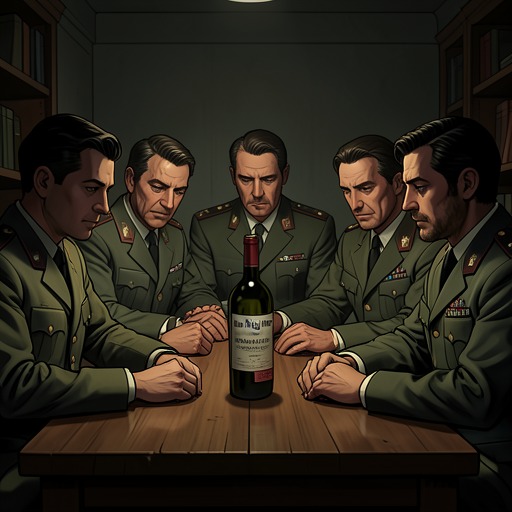
This shared knowledge also explains the bond between Cantwell and the Gran Maestro. Their opposition to those who profit from war grows out of what they witnessed, not from an abstract dislike of military life. Their respect for one another rests alongside their awareness of its costs. Cantwell can assess Ronald Jackson as an inexperienced American officer and criticize the army’s shortcomings while also acknowledging capable soldiers. The trade creates standards of competence and loyalty, but it also binds commanders to the failures of the institutions they serve.
The Landscape as a Record of War
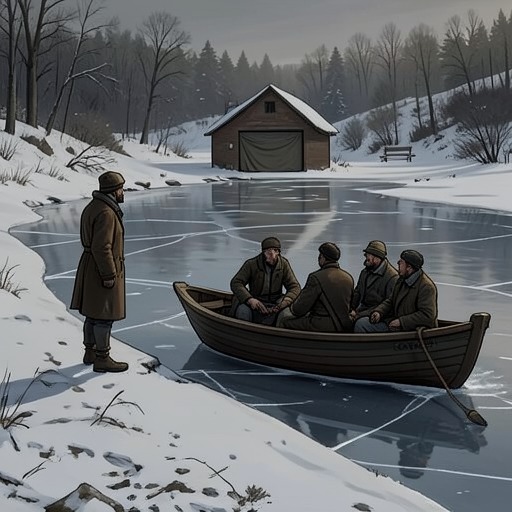
The Piave country carries the trade’s consequences beyond the battlefield. Cantwell remembers a great killing at the end of an offensive and the decision to clear the positions by throwing the dead into canals. The gates downstream remained in Austrian hands and were shut, leaving little movement in the water. The dead remained there for a long time before labour troops hauled them out at night and buried them near the road. Cantwell later recalls that the remains were dug up again and placed in a large ossuary near Nervesa. The apparently ordinary road and its willows therefore hold a history that the present landscape does not readily disclose.
That country has also been altered by practical uses unrelated to battle. Cantwell sees ducks and geese on the canals and people fishing there; elsewhere, he notes that the Piave no longer carries its former flow because water has been diverted for hydroelectric projects. The contrast matters to his idea of a military homeland. He regards Venice as his city because he fought to defend it as a young man, even though at the time he could not see it from the positions where he served. In his memory, military duty attaches belonging to a place, while the river and canals preserve evidence of both human engineering and the war fought around them.
Experience, Love, and the Limits of Telling
Cantwell distrusts accounts that turn war into easily consumed entertainment. He distinguishes those who write from their brief first impressions of battle from people who report events for quick advantage, and from professional writers who describe combat without having experienced it. In his judgment, news travels quickly without necessarily being exact, while accounts by people who have been there may still fail to hold the interest of readers who have not. His refusal to write about war is therefore not silence without explanation: it expresses skepticism about what can be communicated and about the incentives that distort what is told.
The trade’s language also enters Cantwell’s private life. Speaking Spanish with Renata, he calls loving him a poor kind of work; for him, Spanish is a language in which feeling can be stated plainly and made to endure. The analogy gives professional language an intimate counterpoint. Military duty is imposed through orders and measured in tasks, while love is a freely accepted attachment that Cantwell nevertheless describes through the vocabulary of work. The comparison does not make the two forms of commitment equivalent. Instead, it shows how thoroughly the habits of the trade shape his account of even a relationship that offers another way of belonging.
By the novel’s final return to duck-shooting, Cantwell tries not to think of Renata because he has already said goodbye. The recollection joins the ordinary discipline of hunting to the emotional cost of leaving: the language of a trade recurs where he would prefer not to revisit its consequences. Across battle, command, landscape, and parting, the military trade remains both a source of Cantwell’s identity and a limit on what he can protect. It gives him methods for acting under pressure, not a means of escaping loss.