United States Army
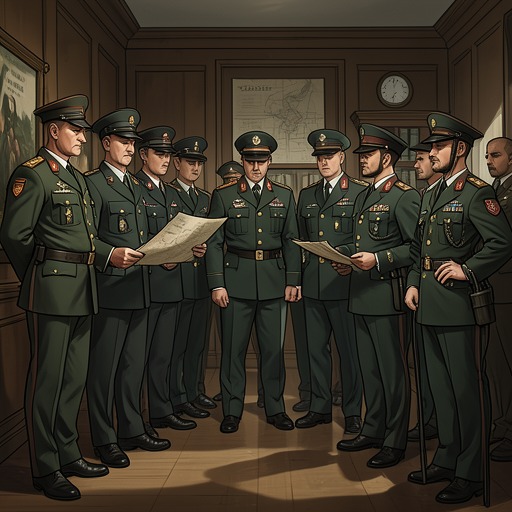
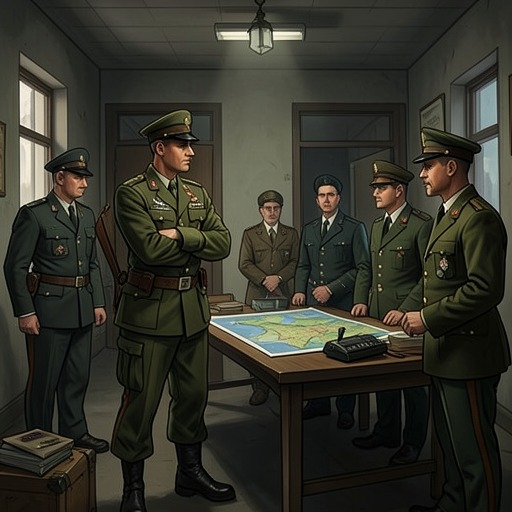
Across the River and into the TreesThe United States Army appears in the novel through Colonel Richard Cantwell’s service, from his position as an infantry officer to his account of commanding a regiment destroyed under orders. Its institutional portrait is deliberately double: the Army provides rank, responsibility, and a framework for action, yet its hierarchy can require commanders to carry out decisions they believe are wrong. Cantwell’s experience makes obedience a professional condition and a moral burden, measured in the lives and wounds of the people under his command.
Identity and Personnel
At fifty, Cantwell is a colonel of infantry in the United States Army, having been reduced from general officer. The story introduces the Army through this tension between formal rank and personal standing: he remains a senior officer, but his current title records a loss of position. Even the physical examination he takes before coming to Venice for a shooting trip is shaped by his military career. He takes mannitol hexanitrate in an effort to pass; the surgeon, after checking the readings twice, warns that the drug is contraindicated in conditions involving increased pressure. Cantwell says he does not understand the medical explanation, while the surgeon’s familiarity with him conveys a long-standing professional relationship. The episode presents fitness not as an abstract standard but as a threshold Cantwell is trying to meet in order to continue acting as a soldier.
His judgment of the Army’s personnel is neither wholly dismissive nor simply defensive. In conversation with the Gran Maestro, Cantwell calls many American soldiers self-righteous, overfed, and undertrained, then accepts responsibility for the lack of training as his own. He immediately qualifies the criticism: the Army also has good soldiers, who, in his view, could have performed as well as or better than the older troops being discussed. The exchange exposes the difference between a commander’s authority and his control over the institution’s results. Cantwell claims responsibility for training failures, but he does not treat the Army as uniformly incapable.
Training and the Soldier’s Work
Cantwell’s sharpest criticism concerns practical preparation. He says that in his Army soldiers do not even shoot for self-inflicted wounds, contrasting their experience with the knowledge he and the Gran Maestro share from an earlier war. That recollection concerns soldiers trying to avoid another attack through improvised means; it is not presented as an account of United States Army practice. Instead, the contrast shows Cantwell measuring military institutions by what their people know about the realities of service, including the lengths to which frightened men may go to escape combat.
The distinction between training and battlefield competence also appears in Cantwell’s account of his own earlier command. During a winter of attacks, he taught his soldiers to shoot and to keep their attention on the enemy during the brief interval when they could fire freely. His unit used rifle fire and the machine guns that remained usable after bombardment to break attacks. Cantwell describes this as a learned capacity, not an automatic consequence of belonging to an army. His recollection of counting quickly after bombardments to determine how many shooters remained makes the work of command depend on immediate, practical knowledge of what the unit can still do.
Rank, Command, and Obedience
Cantwell explains that he began the Second World War as a spare-parts colonel: an officer held available for a division commander to replace a commander who had been killed or relieved. In his account, few such officers were killed, while many were relieved; capable officers could be promoted quickly once the war began to move rapidly. This description gives advancement a distinctly institutional shape. Rank is not only recognition of individual merit but part of a system that must continually fill vacancies and adapt to expanding operations.
His later experience reveals the limits of a commander’s discretion within that system. Cantwell says he inherited a regiment after its previous commander was relieved, and that it was the regiment he had hoped to command until he lost it under orders. He recounts being ordered to take high ground by assault even though, as he explains it, the opposing professionals might have negotiated a withdrawal if approached with a flag. Higher headquarters, he says, could turn a town’s appearance in a newspaper into pressure for an assault. The chain of command could run through Corps, Army, Army Group, or the Supreme Headquarters Allied Expeditionary Force; the decision reached the field as an order, regardless of the commander’s own assessment.
Cantwell’s account of obedience is blunt: in his Army, a soldier obeys as a dog obeys a master, hoping to have a good one. He says that after reaching a certain command level he encountered many agreeable people but only two good masters. The image captures the imbalance built into the institution as he describes it. A subordinate may judge an order, a master, or a plan to be bad, but the Army’s structure still demands action. Cantwell does not claim that this requirement absolves the people who issue orders; he describes it as the condition under which responsibility is exercised and harm may follow.
Combat, Loss, and Institutional Cost
The regiment’s destruction is the clearest consequence of that structure. Cantwell says that his unit was sent forward in a formation with no reserve, in terrain he expected to resemble Passchendaele with tree bursts. The nearby Twenty-eighth Division had already been bogged down, giving the Army information that the woods would be an unfavorable place to fight. Even so, one regiment was ordered into the operation before the main attack began. Removing identifying patches from the troops did not prevent the enemy from taking prisoners, and the precaution became pointless in the face of the larger decision. Cantwell says the regiment was destroyed, while rejecting the idea that its commander was to blame.
He remembers the unit as beautiful and says he destroyed it under other people’s orders. By then, every second man was dead and nearly all the survivors were wounded; he describes the wounds as lasting for life. The regiment had been inherited rather than built by Cantwell, but for a time it had been his great joy. Its loss therefore registers at once as a military defeat, an institutional consequence of command, and a personal bereavement. His account does not erase the commander’s role: he says that he obeyed and that the regiment was destroyed. It does, however, insist on the distance between the person who must carry an order out and the higher authority that determines the operation.
The Army’s institutional language and material routines appear alongside this account of command. Cantwell jokes that food identified as K Rations was not bad, while C Rations were bad and Ten-in-Ones were good; he sets those ordinary distinctions against what he calls the dull but informative mechanics of fighting. In the same spirit, he relates the operation through timestamps and messages between staff sections, making the machinery of coordination part of his explanation rather than a backdrop. Together, the details show an Army of provisions, reporting, promotion, training, and orders—and a human cost that those systems can record without preventing.