Walter Bedell Smith
Across the River and into the TreesWalter Bedell Smith is presented through Richard Cantwell’s retrospective account of a wartime briefing: a General who explained an operation with confidence, but whose assurances would be measured against the costly realities of its execution. The novel gives him no independent scene or private motive; his significance lies in the tension between the authority of the plan and Cantwell’s experience of what followed.
Identity and Narrative Presence
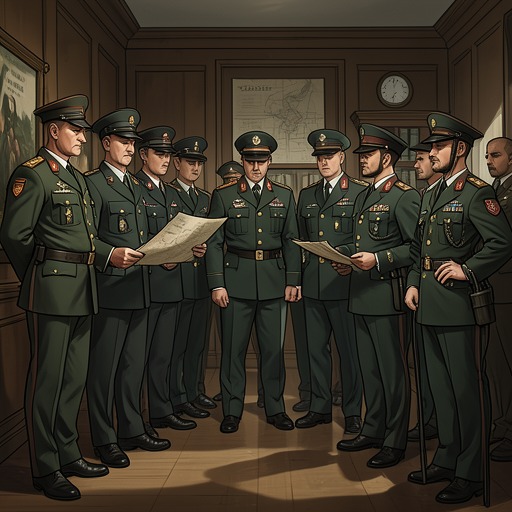
Cantwell recalls meeting Smith in Paris during two days of leave between the Schnee-Eifel fight and the operation later known as the Hürtgen Forest campaign. The gathering was restricted to people considered accredited and trusted. Smith appears there as the General responsible for explaining the coming attack, not as a battlefield participant in the events Cantwell recounts.
The account also qualifies the operation’s name and scale. Cantwell says the fighting was not really confined to the Hürtgen Forest, which he describes as only a small sector; the larger area was the Stadtswald, where German High Command had expected to fight after Aachen fell and the road into Germany was breached. This distinction frames Smith’s briefing against a campaign whose true terrain and stakes, in Cantwell’s telling, were more complicated than the presentation suggested.
The Briefing and Its Assurances
Cantwell remembers Smith as an executive figure who used a pointer to lay out the attack, its rationale, and its expected success with complete conviction. The operation was presented as easy, with no problem foreseen. Smith also assured the audience that the necessary resources would be available. In Cantwell’s account, these assurances made the briefing sound orderly and manageable before the attack had tested them against conditions on the ground.
The distance between planning and combat becomes concrete in Cantwell’s discussion of headquarters. The Supreme Headquarters Allied Expeditionary Force was then based at Versailles, outside Paris, while the planned attack lay about 380 kilometres away; Cantwell notes that headquarters moved forward to Rheims, still 240 kilometres from the fighting, only many months later. He says he understands the logistical and organizational reasons for a large army’s command structure, but regards command from such a distance as historically unprecedented. The point is not simply geography: the measurements give form to his concern that those directing an operation could be remote from the people carrying it out.
Cantwell’s Judgment and the Outcome
Cantwell explicitly refuses to cast Smith as the villain. Smith, he says, made the promises and explained how the operation would proceed; he was wrong, but the account does not assign him sole blame. Cantwell’s judgment instead widens into a criticism of command and democratic responsibility, even as he acknowledges that there may be no single villain in such a system.
The attack, Cantwell recalls, was launched where the Germans had wanted it to be fought. The plan placed the attacking force in line without reserves, and the terrain seemed to him like Passchendaele with tree bursts. A regiment was ordered into action before the attack began and was destroyed. These consequences sharply reverse the confidence of the Paris briefing: what had been represented as facile success became a battle Cantwell remembers through exposed forces, an unfavorable position, and the loss of a regiment. His recollection therefore makes Smith a focal point for the gap between a command presentation and its human and military consequences, while stopping short of presenting him as the sole cause.