Ananias (Sapphira's husband)
Acts of the ApostlesAnanias (Sapphira's husband) appears in Acts as one half of a married couple whose treatment of a property sale exposes the difference between outward participation in a sharing community and actual trust in its common life. He and Sapphira sell land, give only part of the proceeds to the community while retaining the rest, and act as though they have contributed the whole amount. Peter confronts Ananias; he falls dead, and Sapphira later repeats the false account and also dies. The episode’s lasting significance lies in its stark claim that the use of possessions, and the honesty on which common life depends, are matters of life and death.
Identity and Place in the Community
Ananias is identified through his marriage to Sapphira and his participation in the Jerusalem community’s practice of holding property and resources in common. The passage does not provide a further personal history, occupation, or account of how he and Sapphira came to belong to the community. Its focus is instead on the couple’s property, their contribution, and the truthfulness of the impression they create.
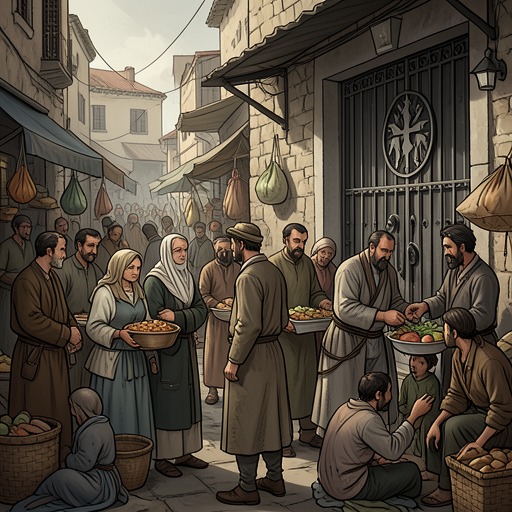
The community’s shared resources are described as a means of ensuring that no one among its members is needy. The episode follows the account of common sharing, and its contrast depends on that ideal: members’ material resources are meant to serve the group rather than remain protected as private wealth while being represented as fully surrendered. Ananias’s action therefore concerns more than an individual gift. It tests the honesty and solidarity on which the community’s provision for one another rests.
The Property Sale and Concealed Gift
Ananias and Sapphira sell a piece of property. They place some of the sale money in the common treasury but keep a portion for private use. The account emphasizes that keeping part of the proceeds is not itself the whole offense: the couple present their contribution as though they had given all of it. Their action joins the retention of resources to a false account of what they have done.
That distinction makes the episode a story about trust as well as money. The couple behave as if they have committed the full proceeds to the community, although they have not. The commentary interprets this as a failure to trust that God can provide for people through the community. In the parallel with the widow who gives her last resource at the temple, the contrast is not simply between a large gift and a small one. It is between trust that resources entrusted to God will sustain the needy and a public appearance of full sharing that conceals private reservation.
Peter’s Confrontation and Sapphira’s Death
Peter confronts Ananias with a direct indictment. Ananias falls dead immediately afterward. The account does not describe an extended exchange or give him a later opportunity to explain himself; its abrupt sequence makes the confrontation and death the episode’s decisive turn.
Peter subsequently gives Sapphira an opportunity to tell the truth. She does not know that her husband has died, and she also lies; she is immediately struck. The parallel outcomes bind the couple’s actions together while preserving a difference in the circumstances of the second encounter: Peter explicitly gives Sapphira the chance to speak truthfully, but the false account continues. Their deaths are the immediate consequence narrated for the deceit, and the story presents the deaths as divine judgment.
The Old Age and the Community’s Common Good
The account’s language places the couple’s conduct within a larger conflict of values. Luke says that Satan had filled their hearts, marking their behavior as belonging to the old age rather than to the values of the Realm. In the book’s account of that old order, idolatry, injustice, exploitation, enmity, violence, and death stand against a coming order marked by love, justice, mutual support, equality, abundance, health, peace, and life. Ananias and Sapphira’s concealed reservation of money is thus treated as a concrete breach in a community meant to embody a different way of life.
The story also resists reducing the episode to a lesson about one couple’s private morality. Dishonesty produces distrustful relationships; withholding resources undermines the community that is supposed to meet people’s needs. The warning extends from individuals to groups and nations: when communities deceive one another and hoard resources, they foster distrust and hostility that can culminate in collapse. The episode’s final force is therefore social as well as personal. What people do with possessions shapes whether common life can endure.
Narrative and Theological Significance
The narrative places the faithful widow in a sharp contrast with Ananias and Sapphira. The widow gives her last financial resource to God through the temple, trusting that provision for the poor will sustain her; the couple keep part of their proceeds while presenting themselves as having surrendered the whole. The contrast complicates any simple celebration of sacrificial giving: the issue is not merely the amount handed over, but whether a community’s material practice is grounded in trust and genuine solidarity.
The episode leaves a difficult theological question open for readers and preachers: whether God straightforwardly puts people to death for lying, misuse of funds, or other violations of the common good. The interpretation also identifies a cautionary purpose that remains relevant beyond the immediate judgment scene. Its severe ending gives narrative weight to the claim that deceit and resource-hoarding damage the bonds on which a community’s survival depends. Ananias is therefore remembered not through an extended personal arc, but as a central figure in a story about the cost of pretending to share while withholding what sustains others.