Aquila
Acts of the ApostlesAquila appears in Acts not as a separately developed protagonist but as part of a working and teaching partnership with Priscilla. A Jewish refugee who came to Corinth after the expulsion of Jews from Rome, he made a living as a tentmaker and shared responsibility for teaching within the community of the Realm. His story connects displacement and labor with a form of leadership in which Priscilla and Aquila jointly instruct Apollos.
Identity and Background
Aquila and Priscilla are introduced in the account of Paul’s arrival in Corinth. They are Jewish refugees: Emperor Claudius had expelled the Jewish population from Rome, probably in 49 CE. Their presence makes Jewish displacement part of the background to Paul’s Corinthian ministry, and it invites concern about the Jewish community’s vulnerability to Roman prejudice. The account also gives Paul’s later journey toward Rome an anxious edge: even after Jews were permitted to return, memories of the expulsion and other expressions of prejudice could remain.
The material does not supply a fuller personal history for Aquila, nor does it present his life separately from Priscilla’s. What it establishes is a shared situation in Corinth, a shared occupation, and a partnership that becomes visible through work and teaching. The narrative’s emphasis falls on what they do together rather than on a private biography.
Work and Ministry in Corinth
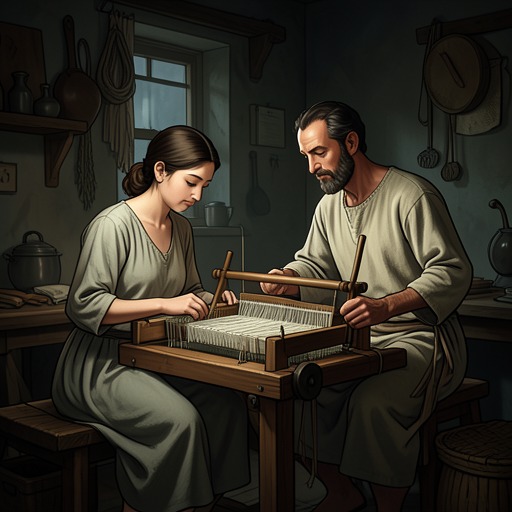
Aquila, Priscilla, and Paul were evidently all tentmakers. Tents were often made from leather or heavy cloth, so tentmaking could involve leatherworking or weaving. Their craft placed them in the marketplace, where workers’ stalls could also become places for discussion. For Paul, the trade helped explain how he financed his missionary work while providing a setting for witness; Aquila and Priscilla are part of that same world of labor and public encounter.
The phrase “tent maker ministry” later names a practice in which ministers support their work through employment outside the church. In the account of Aquila, the occupation is not simply incidental background: it joins livelihood to mission and shows the work of the community taking place in ordinary economic settings. The evidence does not suggest that Aquila’s trade was a formal church office; rather, it locates him in the practical partnership through which work and ministry meet.
Priscilla, Aquila, and Apollos
Aquila’s clearest teaching role emerges in the episode involving Apollos. Priscilla and Aquila jointly teach him, sharing responsibility rather than leaving instruction to one partner. Apollos is described as eloquent and well versed in scripture, and he is himself a teacher. Yet his experience is incomplete because he has received only the baptism of John. The account’s framework for full participation in the community of the Realm includes repentance, baptism in the name of Jesus, and receiving the Holy Spirit.
That the couple teach someone already learned and capable of teaching gives their contribution particular weight. They are not merely hosts or companions in Paul’s work: together they help address a gap in Apollos’s understanding. The evidence stresses the joint nature of their instruction, making Aquila’s teaching part of a partnership rather than an isolated achievement.
Shared Leadership and Narrative Significance
Priscilla and Aquila model an egalitarian approach to leadership. Their shared teaching is presented as an impulse toward restoring relationships between women and men in the Realm. The account links this partnership to a wider movement in Luke-Acts: women’s participation has already been represented through Mary learning as a disciple, and Priscilla’s recognition as a teacher takes that impulse further into the life of the community.
Aquila’s significance therefore lies in the pattern his story helps make visible. A displaced Jewish worker participates in a mission sustained partly through skilled labor; with Priscilla, he shares the responsibility of teaching; and that teaching serves a community understood as moving toward the Realm. The narrative does not provide an ending for Aquila’s personal arc. Instead, it leaves him within an ongoing partnership whose importance is measured by its shared work and its challenge to unequal leadership.