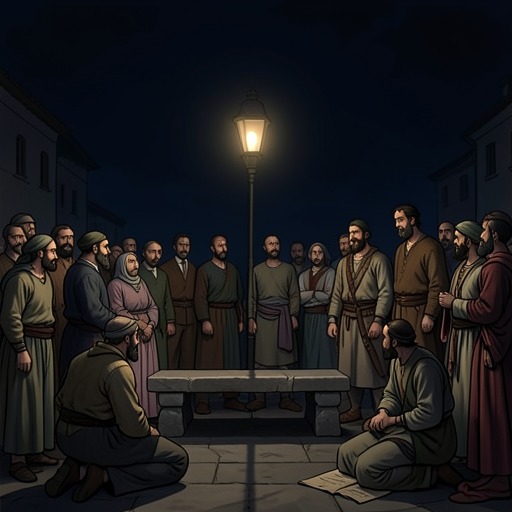
Arrest and hearing of Peter and John
Acts of the ApostlesThe arrest and hearing of Peter and John in Acts 4:1–31 establish a recurring conflict in Acts: testimony to the Realm of God challenges authorities invested in the old age, who respond by attempting to control or suppress that testimony. The hearing begins after the healing at the Beautiful Gate and Peter’s interpretation of it; it ends not with the apostles’ silence, but with their continuing witness and the community’s renewed boldness.
Background: Healing, resurrection, and the Realm
The immediate context is the healing of a person who could not walk at the Beautiful Gate. Peter’s sermon interprets Jesus’ resurrection as the decisive sign of the Realm’s presence and future arrival. The arrest that follows is therefore not an isolated dispute: it brings the healing, the resurrection claim, and the authorities’ response into one sequence. The episode also introduces a pattern that recurs through Acts, in which witnesses to the Realm speak boldly and some Jewish leaders object. The book warns that this pattern can reinforce a negative picture of Judaism, a danger that must be kept in view when describing the conflict.
The episode takes place within Luke’s account of an apocalypse whose completion is delayed. In that framework, the old age is marked by injustice, violence, and death, while the coming Realm is characterized by justice, mutual support, social equality, health, peace, and life. Luke presents Jesus’ ministry, the gift of the Holy Spirit, and the emergence of the church as signs that the last days are already underway; qualities of the coming Realm can be embodied in the present even as its full arrival remains future. Peter and John’s witness thus announces more than an abstract belief about life after death: it contests the order of the old age with a claim about God’s active rule.
Arrest and examination
A group of Sadducees and temple authorities are greatly disturbed by the apostles’ proclamation of resurrection in Jesus. The disturbance has both theological and social stakes. The Sadducees did not believe in resurrection, while priests controlled the temple bank and were often intertwined with the wealthy Sadducees. Luke therefore portrays the resurrection claim as a challenge not only to their theology but also to their social and economic power.
The authorities arrest the apostles and hold them until the next day, when they can be examined in daylight in keeping with Jewish legal protocol. The examiners are subsequently identified as the council. Their prestige sharpens the contrast with Peter and John, whose social standing is lower. The scene puts a powerful body of leaders in the position of questioning witnesses whose claim has already drawn a large public response.
The council asks by what name the apostles healed the person who had been unable to walk. In the ancient setting described by Luke, invoking a name meant invoking the power associated with it; a mighty deed could be attributed to an evil source as well as a divine one. The question therefore gives the council a way to contest the healing’s authority and, in turn, defend its own standing. Peter answers that the apostles acted in the name of Jesus, whom God raised from the dead. The answer joins the healing to resurrection: God’s raising of Jesus confirms the resurrection claim disputed by the Sadducees and identifies the healing as a sign of the Realm.
Evidence, authority, and an ironic trial
The council cannot deny the evidence before it: the person who had been cured is standing there. The healing undermines any attempt to dismiss the apostles’ account, and the authorities’ response shifts from disputing what happened to limiting its effects. They do not actively punish Peter and John, but they try to silence them. Their concern is also practical: a popular response could threaten their power and their own safety.
The trial’s irony runs in both directions. The authorities examine the apostles, but from the reader’s perspective the authorities themselves are on trial. The people have already responded to the healing, and the narrative presents that response as the right verdict. Luke’s first readers, living after the destruction of the Second Temple in 70 CE, could also hear a further judgment in the fact that the temple authorities’ institution had been destroyed. That retrospective framing intensifies the scene, but it should not be turned into a blanket condemnation of Jews or Judaism; the passage depicts a particular conflict over authority and witness.
Peter’s reply culminates in the claim that salvation is found in Jesus. Luke’s wording carries a double sense: the term for being saved can refer to the healing itself as well as inclusion in the Realm. The narrative thus binds bodily restoration to the larger hope of communal and cosmic restoration. It does not, however, address that question in the categories used by later debates over the religious fate of people of other traditions. Reading the passage responsibly requires distinguishing Luke’s argument from questions framed in much later theological terms.
Silencing and continued witness
Because the council cannot refute the visible result of the healing, it tries to restrict what the apostles can say. The apostles answer that they cannot keep from speaking about what they have seen and heard. Their refusal makes testimony itself an action: the order to be silent does not resolve the dispute but exposes how authorities in the old age seek to preserve their power by controlling others’ speech.
The episode’s pattern extends beyond this hearing. In Acts, witnesses repeatedly encounter opposition, and the narrative presents the Holy Spirit as the source of courage to testify amid conflict. The concern is not that conflict is automatically proof of faithfulness, but that a community claiming to embody the Realm must ask whether it speaks boldly enough—and whether it has adopted the very silencing practices it sees in others. Churches, too, can suppress people whose voices might help the community become more just.
For that reason, the hearing offers both encouragement and a searching test. It portrays public witness as vulnerable to institutional pressure, while showing that an observable act of healing and a persistent account of resurrection can unsettle efforts to control the meaning of events. Its final movement is not toward a settled agreement with the authorities, but toward testimony that continues despite their attempt to contain it.