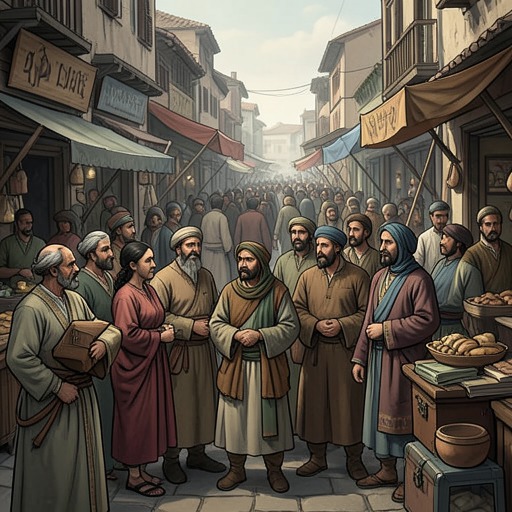
Bar-Jesus
Acts of the ApostlesBar-Jesus, also called Elymas, is a Jewish magician and false prophet whose position beside the Roman proconsul Sergius Paulus is overturned when Paul pronounces judgment on him and he becomes blind. The episode at Paphos makes his bodily blindness a sign of the theological blindness the commentary attributes to him, while the proconsul’s response—belief—marks a Gentile official as more discerning than the Jewish figure attempting to dissuade him. The commentary treats the scene both as part of Luke’s turn toward Gentile mission and as a passage whose anti-Jewish tone must be named rather than repeated uncritically.
Identity and Position
Bar-Jesus, also identified as Elymas, is a Jewish magician who is with Sergius Paulus, the proconsul governing the Roman province. The commentary suggests that he may have served as the proconsul’s religious adviser. His access to a powerful official gives him social standing as well as influence: the relationship is not merely a private association but a position from which he can shape what the proconsul hears and believes.
The commentary describes magic in antiquity as an attempt to manipulate the forces of the universe, and notes that the Jewish community forbade it. It therefore presents Bar-Jesus as doubly compromised: he is identified as a false prophet, and his practice conflicts with the religious prohibition the commentary invokes. Its sharpest characterization calls him a child of the devil, placing him in direct opposition to the message about the Realm.
Opposition at Paphos
Saul, Barnabas, and John travel to Cyprus, moving from the island’s eastern edge through its synagogues to Paphos on the southwestern shore. There they meet Sergius Paulus, who summons them to hear their message. Bar-Jesus opposes the disciples and tries to persuade the proconsul to turn away from faith. His intervention puts his influence and relationship with the official at risk: if Sergius Paulus believes in the coming of the Realm, Bar-Jesus may lose both the proconsul’s attention and the social standing attached to their alliance.
The proconsul thus faces a choice between retaining a familiar relationship with Bar-Jesus and believing that the God of Israel is bringing the Realm through Jesus. The commentary frames that belief as a choice with consequences, since it brings Sergius Paulus into conflict with values and representatives of the old age. Bar-Jesus’s effort to preserve his place beside the proconsul becomes part of the struggle over which message will command the official’s attention.
Judgment and Reversal
Under the influence of the Holy Spirit, Paul names Bar-Jesus’s theological and ethical inadequacy and becomes the channel through whom God pronounces judgment. Bar-Jesus then becomes blind. In the commentary’s interpretation, the punishment does more than defeat his effort to persuade the proconsul: it gives visible form to the spiritual condition the passage attributes to him. The person trying to turn another away from the message is himself rendered unable to see.
Sergius Paulus sees Bar-Jesus become blind and believes. The reversal is pointed: the Jewish magician who advocates magic and cooperates with what the commentary calls the devil is portrayed as theologically compromised, while the Gentile official responsible for enacting Roman rule at Paphos shows greater theological discernment. The episode therefore links Bar-Jesus’s loss of sight to the proconsul’s recognition and belief, making the contrast between them central to the scene’s force.
Relationships and Power
Bar-Jesus’s relationship with Sergius Paulus combines religious counsel, access to authority, and social advantage. The commentary reads his opposition to the disciples as an attempt to preserve the influence he stands to lose if the proconsul accepts their message. It compares his conduct with that of the dishonest manager in the parable in Luke: both are presented as acting unethically in the financial or social sphere to protect their own position. In this parallel, Bar-Jesus’s effort to redirect the proconsul is not an isolated theological disagreement but an instance of self-protective management of relationships and power.
The proconsul’s role complicates the contrast. He is a person of high social standing and an agent of Roman power, which the commentary recognizes can be repressive; nevertheless, he responds to the event with greater ethical and theological insight than Bar-Jesus. The commentary consequently presents the scene not as a simple division between a worthy religious insider and an unworthy outsider, but as a pointed reversal in which the Gentile official believes and the Jewish religious figure is shown as compromised.
Narrative Significance and Critical Reading
The commentary situates the episode within Luke’s ongoing account of why many Jewish people turned away from the Realm and why Luke’s church should direct its energy toward Gentiles. Bar-Jesus’s resistance and the proconsul’s belief give the missionary movement a concrete turning point: opposition by a Jewish figure accompanies the response of a Gentile official. The scene also resonates with the commentary’s comparison to the dishonest manager and the Pharisees, whom it portrays as theologically blind and as making crooked God’s straight paths. Bar-Jesus thus becomes part of a larger pattern in which compromised religious leadership stands against the movement’s message.
That pattern carries a serious interpretive risk. The commentary explicitly says that the parallels have an anti-Jewish tone and that a preacher should bring this tone to congregants’ attention. Bar-Jesus’s characterization should therefore not be converted into a judgment on Jewish people as a whole; the commentary itself identifies the problem in a reading that portrays Jewish figures as blind and Gentiles as discerning. Its practical challenge is broader and self-implicating: congregations should examine how people and institutions become entangled with false values and manipulative practices to preserve power, expose contemporary counterparts to Bar-Jesus, and learn from the proconsul’s willingness to recognize the message.