Beautiful Gate
Acts of the ApostlesThe Beautiful Gate is the temple entrance where Peter and John encounter and heal a person who could not walk, turning a routine journey to prayer into a public demonstration of the Realm of God. The gate’s significance extends beyond the location of the miracle: the encounter moves from a request for alms to restoration, from restoration to Peter’s interpretation before a gathering crowd, and from that witness to conflict with the authorities. In Luke-Acts, the scene presents the church continuing the Spirit-empowered ministry of Jesus.
Setting and Approach
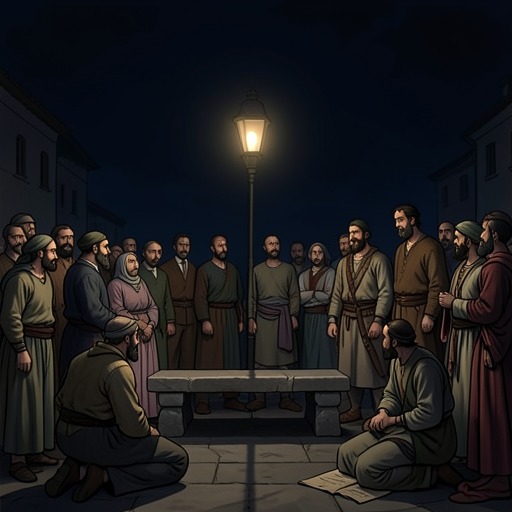
Peter and John pass through the Beautiful Gate on their way to pray at the customary hour of 3:00 p.m. They are described as faithful Jewish people going about a religious practice, not as healers who have set out to find someone to cure. The encounter occurs along their ordinary path. The book identifies the gate as probably the bronze Nicanor Gate, situating the scene within the temple while retaining the qualification that this identification is probable rather than certain.
That everyday approach shapes the gate’s narrative importance. Peter and John meet the person in need as they go to pray; the healing is not a prearranged demonstration. The scene therefore links the church’s witness to attention along ordinary routes: the person asking for help is encountered in the course of an existing practice, and what follows changes the meaning of that encounter.
The Person at the Gate and the Healing
The person at the gate asks for alms. The book cautions against defining him as a “crippled beggar,” since that label makes his inability to walk and his means of income seem to constitute his identity. It instead describes him as a person who was unable to walk and who made his income by asking for alms. That distinction keeps his personhood from being reduced to his bodily condition or to the action through which he survives.
Alms serve as a survival tactic in the old age, the book explains, but they do little beyond enabling survival. Peter’s response goes beyond the aid requested: he heals the person, and the healing demonstrates the presence of the Realm. The movement from alms to healing is thus also a movement from subsistence toward the restoration that the Realm represents. The account does not present the person as having asked for a healing; the initiative emerges from the encounter with Peter and John.
The miracle also functions within Luke-Acts as more than a display of extraordinary power. Healings and other miracles confirm, in the book’s reading, that Jesus and the church represent God and the presence and character of the Realm. What happens in a particular miracle becomes a miniature of the restoration occurring in that Realm. At the Beautiful Gate, the person’s healing makes that larger claim visible in a concrete event.
From the Gate to Solomon’s Portico
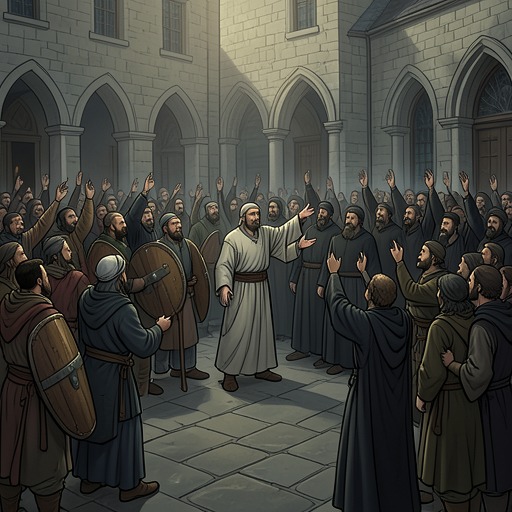
The healing draws an astonished crowd, and the people gather with the healed person at Solomon’s Portico, a large porch on the east side of the temple where religious matters were discussed. The narrative therefore moves from an encounter at the gate into a public setting for interpretation. Peter takes the moment to address the group, turning the event into a witness about its meaning rather than allowing attention to stop at the spectacle of the healing.
Peter’s speech identifies the God of Israel as the power behind Jesus, in whose name Peter performed the healing. The book emphasizes that Luke presents a favorable response to Jesus and the church as consistent with faithful Jewish identity. That framing affirms the Jewish identity of Luke’s community and urges its gentile members to respect Jewish members. The gate’s story thus opens onto a question of communal belonging as well as one of healing: Peter’s interpretation locates the event within Israel’s relationship with God.
The public interpretation continues into confrontation. The book’s proposed reading of the larger sequence follows three movements: a manifestation of the Realm in the healing, an interpretation of that manifestation in Peter’s address, and conflict with the rulers of the old age. In the subsequent hearing, the council asks by what name the apostles healed the person. Peter answers that they acted in the name of Jesus, whom God raised from the dead. The resurrection and the healing together testify to the Realm, while the authorities’ challenge makes the political and religious stakes of the gate encounter explicit.
Peter Before and After the Resurrection
The Beautiful Gate scene also marks a contrast in Peter’s story. In Luke’s account of Jesus’ trial, Peter denies knowing Jesus, despite having claimed that he was ready to go with Jesus to prison and death. After the resurrection, ascension, and outpouring of the Spirit, Peter leads the healing at the gate and acts in Jesus’ name. The book reads this change alongside Jesus’ earlier hope that Peter would become a source of strength for the community.
The contrast makes the gate more than a setting attached to Peter’s public ministry: it is where the difference between his earlier denial and his later witness becomes visible in action. The subsequent arrest and questioning do not amount to the imprisonment Peter once professed himself ready to face, but he is taken into custody and questioned. In the book’s account, he now fulfills the hope that Jesus expressed for him: the one who once denied knowing Jesus openly acts in his name.
Narrative and Theological Significance
The Beautiful Gate joins place, action, and interpretation in a compact sequence. A familiar prayer journey brings Peter and John face to face with someone whose income depends on asking for alms. The healing changes the immediate situation; the crowd carries the event into a public forum; Peter’s speech connects it to the God of Israel and the raised Jesus; and the authorities’ response turns witness into conflict. The location matters because the story passes through these stages there, rather than treating the miracle as an isolated marvel.
The book also treats the miracle as a point of interpretive difficulty for contemporary preaching. Some congregants may ask whether a healing of this kind happened in the past, whether such healings can be expected now, or whether it is appropriate to pray for miraculous healing. It warns that encouraging expectations of healing can lead to disappointment and ultimately distrust in God and the church. Its deeper emphasis is not to promise that every person will be cured, but to point to God working to make the world more like the Realm.
On that reading, the gate remains significant as a place where the larger claim of restoration takes visible form and where the church’s witness begins with an encounter rather than a plan. The episode invites attention to people and communities who, figuratively, cannot walk, beg, or depend on others, and asks what they need in order to walk. The Beautiful Gate thus holds together the person’s concrete encounter, the movement beyond mere survival, and the public testimony that the healing represents the Realm.