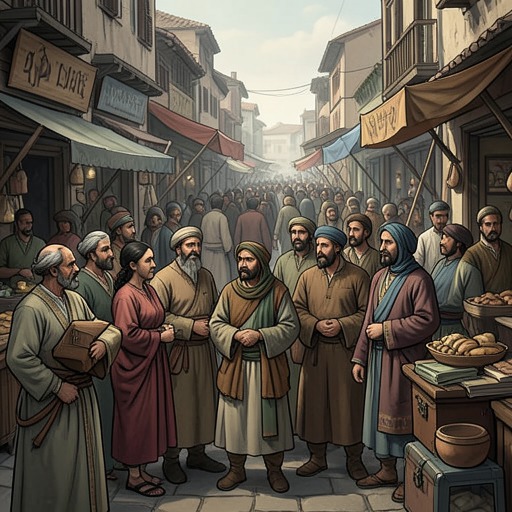
Beroea
Acts of the ApostlesBeroea, about 50 miles southwest of Thessalonica, is a place of welcome that becomes a temporary refuge in Acts 17:1–15. After a hostile response in Thessalonica forces Paul and Silas to leave, many people in Beroea receive their message; when opposition pursues them there, Paul is sent on to Athens. The city’s role in the narrative is defined by this contrast between receptive listeners and resistance that crosses city boundaries.
Setting in the Journey
Beroea appears during a stretch of Paul and Silas’s travels marked by sharply different responses to their witness. In Thessalonica, their synagogue preaching attracts a diverse group, including some Jewish people, many devout Greeks, and leading women. But the wider reaction turns hostile: a crowd attacks Jason’s house while searching for the missionaries, and Jason is taken before the authorities. The witnesses leave Thessalonica at night and travel to Beroea.
The distance between the cities gives the change of setting practical as well as narrative force. Beroea is not an abstract destination: it is the next place where the travelers can continue their work. Yet the movement does not leave the conflict behind. Opponents from Thessalonica travel to Beroea to stir up unrest, carrying the earlier confrontation into the new setting.
Welcome and Opposition
The response in Beroea differs from the dominant reaction in Thessalonica. In the synagogue, many Jewish people join the movement, along with Greeks, women and men, who are described as people of high social rank. The account thus portrays welcome as socially varied and shows that Jewish people appear on both sides of the story’s response to the message: some in Thessalonica oppose it, while many in Beroea receive it.
That contrast matters because the narrative does not present Beroea as a wholly secure haven. The Thessalonian opponents arrive and stir up unrest, and the Bereoans send Paul away to safety in Athens. His movement onward is therefore both a consequence of renewed danger and a continuation of the journey. The account explicitly notes the irony that Paul is safer in Athens, a city full of idols, than in the Thessalonian synagogue.
Narrative and Theological Significance
Beroea serves as a counterpoint to Thessalonica: it demonstrates that responses to the witness can change from city to city, even as opposition can pursue the messengers across those boundaries. The episode also keeps the account from reducing Jewish communities to a single response. Luke’s hostile portrayal of opposition in Thessalonica is set beside the welcome of Jewish people in Beroea, a contrast that calls for care in interpreting the narrative rather than treating its conflict as a judgment on all Jewish people.
More broadly, the city belongs to the geographical movement through which Acts presents the witness spreading beyond Jerusalem and Judea. The route from Jerusalem through Samaria toward the ends of the earth gives places in the story theological significance as stages in an expanding mission. In the Thessalonica–Beroea episode, that movement is neither a smooth advance nor a simple sequence of victories: welcome enables the witness, resistance interrupts it, and onward travel carries it into another setting.